Loading...
This comparison has not been analyzed yet.
One-time AI generation (~1 minute). Scores and timeline are already available below.
Claire Chennault vs Ivan Chernyakhovsky
Claire Chennault leads by 14.9 pts · 2 figures compared
…
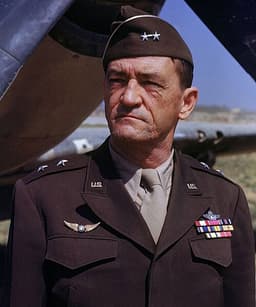
Claire Chennault
General · Modern
69.3Total
Ivan Chernyakhovsky
General · Modern
54.4Total
Basic Information
Born
1893
1906
Died
1958
1945
Era
Modern
Modern
Nationality
United States
USSR
Occupation
General
General
Civilization
Western
Western
Score Comparison
Military (10%)
61.7
78.0
Political (20%)
62.7
35.1
Influence (20%)
75.0
58.0
Legacy (20%)
72.0
50.0
Leadership (15%)
68.0
50.7
Strategy (15%)
68.0
67.2
TOTAL
69.3
54.4
Claire Chennault — Complete Timeline
1937 AD
Development of Air Power TheoryCultural
Chennault developed and advocated for the use of fighter aircraft in offensive operations, contrary to prevailing US doctrine. His theories were later validated in combat and influenced US air tactics in World War II.
Air PowerTheoryTactics
Impact: nationalconstructive
Retirement from US Army Air CorpsPolitical Action
Chennault retired from the US Army Air Corps due to deafness and disagreements over air doctrine. He then accepted a position as an advisor to the Chinese Air Force, where he began developing the Flying Tigers.
US ArmyRetirementChina
Impact: national
1941 AD
Formation of the Flying TigersWar◆ Major
Chennault organized and commanded the American Volunteer Group, known as the Flying Tigers, to fight the Japanese in China. The group of volunteer pilots flew P-40 Warhawks and achieved notable success against Japanese aircraft.
World War IIChinaFlying Tigers
Impact: regionalconstructive
1943 AD
Command of 14th Air ForceWar◆ Major
Chennault was appointed commander of the US 14th Air Force in China. He led the air force in operations against Japanese forces, including attacks on shipping, airfields, and supply lines.
World War IIChinaAir Force
Impact: regional
Ivan Chernyakhovsky — Complete Timeline
1943 AD
Battle of KurskWar◆ Major
Chernyakhovsky commanded the 60th Army during the Battle of Kursk. His forces defended the northern face and later participated in the counteroffensive, liberating Kursk and advancing toward Ukraine.
World War IIKurskCounteroffensive
Impact: regional
1944 AD
Command of the 3rd Belorussian FrontWar◆ Major
Chernyakhovsky was appointed commander of the 3rd Belorussian Front at age 37, becoming the youngest front commander in the Soviet Army. He led the front in Operation Bagration and the liberation of Vilnius.
World War IIBelorussian FrontYoungest
Impact: regional
1945 AD
East Prussian OffensiveWar◆ Major
Chernyakhovsky commanded the 3rd Belorussian Front in the East Prussian Offensive. His forces advanced into East Prussia, capturing towns and encircling German forces in K
World War IIEast PrussiaOffensive
Impact: regional
Death in combat near MelzakWar◆ Major
Chernyakhovsky was killed by artillery shell fragments near Melzak (now Pieni
World War IIKilled in ActionEast Prussia
Impact: nationaltragic
This comparison has not been analyzed yet.
One-time AI generation (~1 minute). Scores and timeline are already available below.
Rankings
🥇
Claire ChennaultLeader
Mil: 61.7Pol: 62.7Inf: 75.0
69.3
🥈
Ivan Chernyakhovsky
Mil: 78.0Pol: 35.1Inf: 58.0
54.4
+14.9 behind
How This Comparison Works
Algorithm
Each figure is scored on 6 dimensions (0—100 scale) based on structured historical data: Military (10%), Political (20%), Influence (20%), Legacy (20%), Leadership (15%), Strategy (15%). The weighted total produces the final ranking.
Data Sources
Scores are computed from structured sub-indicators in the database. Scale factors adjust for era (Ancient ×0.85, Modern ×1.0) and civilization size (Eastern ×1.05, Other ×0.80) to account for differences in population and military scale.
Maximum 3 Figures
Comparisons are limited to 2—3 figures to ensure readability and statistical meaningfulness.
Error Margins
±5 points per dimension — Sub-scores are derived from historical records with inherent uncertainty. Two figures within 5 points on a dimension should be considered roughly equivalent in that area.
Total Score Accuracy
±3 points overall — The weighted combination of 6 dimensions produces a total score with approximately ±3 points of uncertainty. Differences of less than 3 points are not statistically significant— the figures are effectively tied.
Known Limitations
- Historical records are incomplete and uneven across civilizations
- Figures from oral-tradition societies may be underrepresented
- Occupation labels can misclassify multi-role figures
- Scores measure capability and impact, not moral character
- Quantitative scoring is a comparison tool, not absolute truth
Capability Radar
Military (10%) — Battles & Warfare
Battles
65
75
Win Rate
70
80
Expansion
60
70
Political (20%) — Governance & Reform
Reform
50
20
Diplomacy
75
25
Economy
30
15
Influence (20%) — Cultural & Global Reach
Cultural
65
35
Global
65
45
Legacy (20%) — Historical Impact
Historical
70
55
Longevity
60
40
Leadership (15%) — Power & Stability
Tenure
40
30
Stability
35
20
Strategy (15%) — Tactics & Innovation
Strategy
75
78
Tactics
85
82
Reform
80
60
Similar Comparisons
Comments & Discussion
No comments yet. Be the first to share your thoughts!