Loading...
Christian V of Denmark vs Umberto I of Italy
Christian V of Denmark leads by 3.5 pts · 2 figures compared
…

Christian V of Denmark
Emperor · Modern
53.7Total
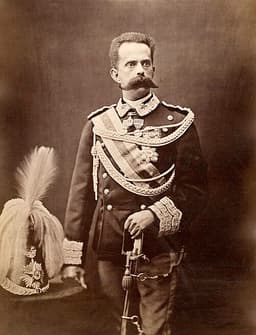
Umberto I of Italy
Emperor · Modern
50.2Total
Basic Information
Born
1646
1844
Died
1699
1900
Era
Modern
Modern
Nationality
Denmark
Italy
Occupation
Emperor
Emperor
Civilization
Western
Western
Score Comparison
Military (10%)
47.5
45.0
Political (20%)
62.7
43.7
Influence (20%)
51.8
49.4
Legacy (20%)
43.3
40.8
Leadership (15%)
72.0
74.0
Strategy (15%)
50.0
54.6
TOTAL
53.7
50.2
Christian V of Denmark — Complete Timeline
1660 AD
Introduction of Absolute MonarchyPolitical Action
Christian V oversaw the transition to absolute monarchy in Denmark, formalized by the King's Law of 1665. This made him the first hereditary absolute monarch, concentrating all power in the crown and ending the nobility's political influence.
Absolute MonarchyKing's LawConstitution
Impact: national
1671 AD
Establishment of the Danish West India CompanyPolitical Action◆ Major
Christian V chartered the Danish West India Company to colonize and trade in the Caribbean. This led to the acquisition of the islands of St. Thomas, St. John, and St. Croix, which became Danish colonies.
ColonizationCaribbeanTrade
Impact: global
1675 AD
Scanian WarWar◆ Major
Christian V led Denmark in the Scanian War against Sweden, attempting to reclaim lost territories. The war ended with the Treaty of Lund in 1679, which restored the status quo but failed to achieve Danish objectives.
WarSwedenScanian War
Impact: regional
1683 AD
Promulgation of the Danish Law (Danske Lov)Reform◆ Major
Christian V issued the Danish Law, a comprehensive legal code that unified and modernized Danish law. It replaced various regional laws and remained in force until 1900, shaping the Danish legal system.
Legal CodeReformDanske Lov
Impact: nationalconstructive
Umberto I of Italy — Complete Timeline
1878 AD
Accession to the ThronePolitical Action◆ Major
Umberto I became King of Italy upon the death of his father Victor Emmanuel II. His reign was marked by colonial expansion, social unrest, and the strengthening of the Triple Alliance with Germany and Austria-Hungary.
MonarchySuccession
Impact: national
1882 AD
Triple Alliance RenewalPolitical Action◆ Major
Umberto I supported Italy's entry into the Triple Alliance with Germany and Austria-Hungary. This defensive alliance shaped Italian foreign policy until World War I, isolating France and aligning Italy with Central Powers.
AllianceForeign Policy
Impact: regional
1895 AD
First Italo-Ethiopian WarWar◆ Major
Umberto I's government pursued colonial expansion in the Horn of Africa, leading to war with Ethiopia. The Italian defeat at the Battle of Adwa in 1896 was a major humiliation, causing his government to fall.
ColonialismWarDefeat
Impact: regionaldestructive
1898 AD
Bava-Beccaris MassacrePolitical Action◆ Major
Umberto I authorized General Bava-Beccaris to use artillery against protesters in Milan, killing dozens. He later decorated the general, earning widespread condemnation and making him a target for anarchists.
RepressionMassacreAnarchism
Impact: nationaldestructive
1900 AD
Assassination by Gaetano BresciPolitical Action
Anarchist Gaetano Bresci shot and killed Umberto I in Monza. The assassination was motivated by the Bava-Beccaris massacre. Umberto I was succeeded by his son Victor Emmanuel III.
AssassinationAnarchismMonarchy
Impact: nationaltragic
Expert Analysis
Origins
Christian V of Denmark was born on April 15, 1646, in Flensburg, the son of King Frederick III and Sophie Amalie of Brunswick-Lüneburg. He received a princely education focused on military and governance, but was not initially expected to become an absolute monarch. His father had introduced absolutism in 1660, and Christian grew up in a court where royal power was being centralized. His early experiences included military campaigns against Sweden, which shaped his bellicose tendencies.
Umberto I of Italy was born on March 14, 1844, in Turin, the son of King Victor Emmanuel II and Maria Adelaide of Austria. He was educated in military and constitutional matters, as Italy was newly unified under his father's rule. Umberto served in the Italian Wars of Independence, including the Battle of Custoza in 1866, where he commanded a division. His upbringing emphasized the challenges of governing a fragmented nation with strong regional identities.
Rise to Power
Christian V ascended the throne on February 9, 1670, upon his father's death. The King's Law of 1665 had already formalized absolute monarchy, making Christian the first hereditary absolute monarch of Denmark. He inherited a centralized state and a powerful nobility that had been subdued by his father. His early reign focused on consolidating power and expanding Danish influence in the Baltic.
Umberto I became King of Italy on January 9, 1878, after the death of his father Victor Emmanuel II. He inherited a constitutional monarchy with a parliamentary system, but faced significant challenges: a weak economy, regional disparities, and social unrest. His rise was smooth legally, but he lacked the unifying charisma of his father. He sought to strengthen the monarchy by engaging in foreign policy and colonial ventures.
Leadership & Governance
Christian V governed as an absolute monarch, issuing laws and decrees without parliamentary consent. His most significant achievement was the promulgation of the Danish Law (Danske Lov) in 1683, a comprehensive code that unified the legal system across Denmark and Norway. This law replaced regional variations and remained in force for over 200 years. He also chartered the Danish West India Company in 1671, leading to the colonization of St. Thomas, St. John, and St. Croix. However, his military leadership was less effective: the Scanian War (1675-1679) against Sweden ended with the Treaty of Lund, which failed to recover lost territories and drained resources. His leadership score of 72.0 reflects his strong administrative control but mediocre military outcomes.
Umberto I ruled as a constitutional monarch, but he often clashed with parliament and pursued an aggressive foreign policy. He supported the Triple Alliance with Germany and Austria-Hungary, which isolated Italy from France and contributed to tensions. His government's colonial ambitions led to the First Italo-Ethiopian War, culminating in the disastrous Battle of Adwa in 1896, where Italian forces were crushed by Ethiopian troops. This was a major blow to Italian prestige. Domestically, he authorized the Bava-Beccaris massacre in 1898, when General Bava-Beccaris used artillery against protesters in Milan, killing dozens. Umberto later decorated the general, earning widespread hatred. His political score of 43.7 indicates poor governance and inability to manage social unrest.
Triumph & Tragedy
Christian V's triumph was the Danish Law, which standardized justice and administration across his realms, earning him a legacy as a legal reformer. His tragedy was the Scanian War, which failed to achieve its objectives and exposed the limits of Danish military power. The war also strained the economy and led to no territorial gains. His military score of 47.5 reflects this failure.
Umberto I's triumph was the consolidation of the Italian monarchy after unification, maintaining stability despite regional tensions. However, his tragedy was the Bava-Beccaris massacre and his subsequent assassination. The massacre alienated the working class and fueled anarchist movements. His assassination on July 29, 1900, by anarchist Gaetano Bresci, was directly linked to the massacre. His legacy score of 40.8 reflects the negative perception of his reign.
Character & Destiny
Christian V was a determined ruler who sought to centralize power and impose uniform laws. He was influenced by French absolutism and modeled his court after Louis XIV. His character was marked by a sense of duty but also a lack of military acumen. His decision to go to war with Sweden was driven by revanchism, but he lacked the strategic insight to win. His strategy score of 50.0 is average.
Umberto I was a conservative monarch who believed in strong executive power and colonial expansion. He was stubborn and often ignored parliamentary advice. His authorization of the Bava-Beccaris massacre showed a callous disregard for civilian life. His character alienated many, and his death at the hands of an anarchist was a direct consequence of his repressive policies. His leadership score of 74.0 is relatively high, but his political score of 43.7 drags down his overall effectiveness.
Legacy
Christian V's Danish Law remained the basis of Danish legal system until 1683, and his establishment of the Danish West India Company led to a colonial presence in the Caribbean that lasted until 1917. He is remembered as a legal reformer and the first absolute monarch of Denmark. His legacy score of 43.3 is modest but reflects the long-lasting impact of his legal code.
Umberto I's legacy is overshadowed by the Bava-Beccaris massacre and the defeat at Adwa. He is often seen as a symbol of the failures of the Italian monarchy. His assassination marked a turning point, leading to increased repression and eventually the rise of fascism. His legacy score of 40.8 is the lowest among the two.
Conclusion
Christian V of Denmark had a greater impact than Umberto I of Italy. Christian V scored a total of 53.7 compared to Umberto I's 50.2, a gap of 3.5 points. Christian V's legal reforms unified a kingdom and lasted for centuries, while Umberto I's reign was marked by colonial disasters and domestic repression that weakened the monarchy. Christian V's absolute rule, though authoritarian, established a stable legal framework. Umberto I's constitutional monarchy failed to address social issues and ended in assassination. Therefore, Christian V's positive contributions outweigh Umberto I's negative legacy.
Rankings
🥇
Christian V of DenmarkLeader
Mil: 47.5Pol: 62.7Inf: 51.8
53.7
🥈
Umberto I of Italy
Mil: 45.0Pol: 43.7Inf: 49.4
50.2
+3.5 behind
How This Comparison Works
Algorithm
Each figure is scored on 6 dimensions (0—100 scale) based on structured historical data: Military (10%), Political (20%), Influence (20%), Legacy (20%), Leadership (15%), Strategy (15%). The weighted total produces the final ranking.
Data Sources
Scores are computed from structured sub-indicators in the database. Scale factors adjust for era (Ancient ×0.85, Modern ×1.0) and civilization size (Eastern ×1.05, Other ×0.80) to account for differences in population and military scale.
Maximum 3 Figures
Comparisons are limited to 2—3 figures to ensure readability and statistical meaningfulness.
Error Margins
±5 points per dimension — Sub-scores are derived from historical records with inherent uncertainty. Two figures within 5 points on a dimension should be considered roughly equivalent in that area.
Total Score Accuracy
±3 points overall — The weighted combination of 6 dimensions produces a total score with approximately ±3 points of uncertainty. Differences of less than 3 points are not statistically significant— the figures are effectively tied.
Known Limitations
- Historical records are incomplete and uneven across civilizations
- Figures from oral-tradition societies may be underrepresented
- Occupation labels can misclassify multi-role figures
- Scores measure capability and impact, not moral character
- Quantitative scoring is a comparison tool, not absolute truth
Capability Radar
Military (10%) — Battles & Warfare
Battles
30
5
Win Rate
25
5
Expansion
15
10
Political (20%) — Governance & Reform
Reform
70
30
Diplomacy
40
40
Economy
45
35
Influence (20%) — Cultural & Global Reach
Cultural
30
20
Global
20
15
Legacy (20%) — Historical Impact
Historical
40
25
Longevity
30
20
Leadership (15%) — Power & Stability
Tenure
60
55
Stability
50
30
Strategy (15%) — Tactics & Innovation
Strategy
25
5
Tactics
20
5
Reform
40
10
Similar Comparisons
Comments & Discussion
No comments yet. Be the first to share your thoughts!