Loading...
Cheng Tang of Shang vs Marcian
Cheng Tang of Shang leads by 3.3 pts · 2 figures compared
…
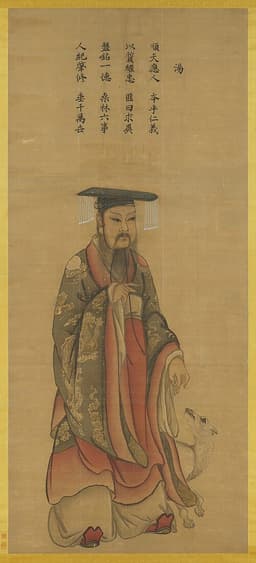
Cheng Tang of Shang
Emperor · Ancient
58.3Total

Marcian
Emperor · Ancient
55.0Total
Basic Information
Born
-1675
392
Died
-1646
457
Era
Ancient
Ancient
Nationality
Shang China
Byzantine Empire
Occupation
Emperor
Emperor
Civilization
Eastern
Western
Score Comparison
Military (10%)
63.3
47.5
Political (20%)
68.0
61.3
Influence (20%)
57.2
56.4
Legacy (20%)
58.0
48.3
Leadership (15%)
53.2
65.7
Strategy (15%)
50.0
50.0
TOTAL
58.3
55.0
Cheng Tang of Shang — Complete Timeline
1675 BC
Battle of MingtiaoWar
Cheng Tang led a coalition of tribes against the Xia dynasty at Mingtiao. The Shang forces defeated the Xia army, leading to the overthrow of King Jie. This battle established Cheng Tang as the first king of the Shang dynasty.
Founding BattleDynastic ChangeXia-Shang Transition
Impact: regional
Establishment of Shang Capital at BoPolitical Action◆ Major
After defeating the Xia, Cheng Tang established his capital at Bo (near modern-day Shangqiu, Henan). This city became the political and ritual center of the early Shang state, consolidating control over the Central Plains.
Capital FoundationState Building
Impact: regionalconstructive
Promulgation of Tang's EdictPolitical Action◆ Major
Cheng Tang issued a public edict justifying the overthrow of the Xia dynasty, accusing King Jie of moral depravity and misrule. This document established the concept of the 'Mandate of Heaven' as a justification for dynastic change.
Political PhilosophyMandate of HeavenPropaganda
Impact: regionalconstructive
1660 BC
Institution of Ritual ReformsCultural
Cheng Tang implemented new state rituals and sacrifices to Shangdi (the high god) and ancestral spirits. These reforms standardized religious practices across the Shang domain, reinforcing the king's role as chief priest.
ReligionRitualState Religion
Impact: regionalconstructive
Marcian — Complete Timeline
450 AD
Refused tribute to Attila the HunPolitical Action
Upon becoming Eastern Roman Emperor, Marcian reversed the policy of paying tribute to Attila the Hun. He declared that he had gold for his friends but iron for his enemies. This defiance marked a shift in Eastern policy and contributed to Attila's decision to invade the West.
Foreign PolicyHunnic Wars
Impact: regionalconstructive
451 AD
Convened the Council of ChalcedonCultural
Marcian convened the Council of Chalcedon, the fourth ecumenical council. The council condemned the Monophysite heresy and defined the Chalcedonian Creed, which affirmed the two natures of Christ. This decision had lasting theological and political consequences for the Christian world.
Ecumenical CouncilChristian TheologyReligious Policy
Impact: globalconstructive
452 AD
Stabilized the Eastern Empire's financesReform◆ Major
Marcian implemented fiscal reforms that stabilized the Eastern Roman Empire's economy. He abolished the tax on the city of Constantinople and reduced state expenditures, leaving a substantial treasury surplus upon his death.
Economic ReformFiscal Policy
Impact: nationalconstructive
Expert Analysis
Origins
**Cheng Tang** (c. 1675–1646 BCE) was the leader of the Shang tribe, a vassal state under the Xia dynasty. Born into the royal lineage of the Shang clan, he inherited a territory in the Yellow River valley. Little is known of his early life, but he was educated in statecraft and military command. The Shang were a bronze-age civilization with advanced agriculture and ritual practices. Tang's formative experience was witnessing the tyranny of King Jie of Xia, whose misrule alienated many tribes.
**Marcian** (c. 392–457 CE) was born in Thrace or Illyria, likely to a humble family. He served as a soldier and later as a domesticus (staff officer) under the general Aspar. His early career included diplomatic missions and military campaigns against the Persians and Huns. Marcian's marriage to Pulcheria, sister of Emperor Theodosius II, elevated him to the throne in 450 CE. He was a seasoned administrator and military leader before becoming emperor.
Rise to Power
Cheng Tang rose by uniting disaffected tribes against the Xia. Around 1600 BCE, he formed a coalition of nine tribes and defeated Xia forces at the Battle of Mingtiao. The Xia army collapsed, and King Jie was captured and exiled. Tang then proclaimed the Shang dynasty, establishing his capital at Bo (modern Shangqiu, Henan). His victory was justified through a public edict accusing Jie of moral depravity, a key political move that legitimized his rule.
Marcian's rise was more indirect. After Emperor Theodosius II died in 450, his sister Pulcheria needed a husband to secure the throne. She chose Marcian, a capable officer with no dynastic ties. He was crowned on August 25, 450. Marcian immediately faced the Hunnic threat. Attila demanded continued tribute, but Marcian refused, stating he had gold for friends but iron for enemies. This bold stance marked a decisive break from his predecessor's appeasement policy.
Leadership & Governance
Cheng Tang governed through a blend of military authority and ritual legitimacy. He instituted state sacrifices to Shangdi (the high god) and ancestral spirits, standardizing religious practices across his realm. Tang's edicts emphasized moral rule and the mandate of heaven—a concept that later became central to Chinese political thought. He also organized the Shang state into a feudal hierarchy, with loyal nobles governing regions. His leadership score of 53.2 reflects a competent but not transformative administrative style.
Marcian focused on financial stability and religious unity. He abolished the tax on Constantinople, reducing the burden on the capital's citizens. His fiscal reforms, including stricter tax collection and reduced spending, left a surplus of 7.8 million solidi at his death. Marcian convened the Council of Chalcedon in 451, which defined the nature of Christ as both fully divine and fully human, condemning Monophysitism. This council shaped Christian orthodoxy for centuries. His political score of 61.3 and leadership score of 65.7 indicate effective governance.
Triumph & Tragedy
Cheng Tang's greatest success was overthrowing the Xia and founding the Shang dynasty, which lasted over 500 years. His military score of 63.3 reflects his coalition-building and decisive victory at Mingtiao. However, his failures include incomplete consolidation: later Shang kings faced rebellions from former Xia allies. The historical record also suggests that Tang's ritual reforms may have alienated some local cults.
Marcian's triumph was defying Attila without immediate retaliation—Attila turned west, dying in 453. The Council of Chalcedon unified the church, though it also created lasting schisms with Monophysite churches. His fiscal stability strengthened the Eastern Empire. Yet, Marcian's refusal to aid the Western Roman Empire against the Vandals allowed the sack of Rome in 455. His military score of 47.5 reflects a lack of major campaigns.
Character & Destiny
Cheng Tang is depicted in Chinese historiography as a virtuous ruler who championed justice over tyranny. His decision to issue an edict justifying rebellion established a precedent for judging rulers by moral standards. This emphasis on legitimacy shaped China's dynastic cycle. Tang's strategy score of 50.0 suggests a balanced but unremarkable strategic vision.
Marcian was pragmatic and resolute. His refusal to pay tribute to Attila was a calculated risk that paid off. He prioritized internal stability over external adventures, which allowed the Eastern Empire to thrive while the West collapsed. His character—disciplined, fiscally prudent, and religiously orthodox—defined his reign. Modern historians rate him as a competent emperor who stabilized the realm.
Legacy
Cheng Tang's legacy is foundational. The Shang dynasty advanced bronze metallurgy, writing, and statecraft. The concept of the mandate of heaven—that rulers must be virtuous—originated in Tang's justification for overthrowing the Xia. This idea influenced every subsequent Chinese dynasty. His influence score of 57.2 reflects this enduring impact, though it is limited compared to later figures like Confucius.
Marcian's legacy is tied to the Council of Chalcedon, whose Christological definition remains central to Catholic, Orthodox, and Protestant churches. His fiscal reforms set a standard for Byzantine administration. However, his refusal to aid the West contributed to the fall of Rome. His legacy score of 48.3 is modest, as his achievements were largely institutional rather than transformative.
Conclusion
Cheng Tang had a greater overall impact, with a total score of 58.3 versus Marcian's 55.0. Tang's founding of a dynasty that lasted five centuries and his introduction of the mandate of heaven reshaped Chinese civilization. Marcian's contributions to Christian doctrine and Byzantine stability are significant but less far-reaching. Tang's political and military achievements—scoring 68.0 and 63.3 respectively—outweigh Marcian's higher leadership score (65.7). While Marcian was a capable administrator, Tang's actions set in motion a political philosophy that governed China for millennia. Thus, Cheng Tang emerges as the more consequential figure.
Rankings
🥇
Cheng Tang of ShangLeader
Mil: 63.3Pol: 68.0Inf: 57.2
58.3
🥈
Marcian
Mil: 47.5Pol: 61.3Inf: 56.4
55.0
+3.3 behind
How This Comparison Works
Algorithm
Each figure is scored on 6 dimensions (0—100 scale) based on structured historical data: Military (10%), Political (20%), Influence (20%), Legacy (20%), Leadership (15%), Strategy (15%). The weighted total produces the final ranking.
Data Sources
Scores are computed from structured sub-indicators in the database. Scale factors adjust for era (Ancient ×0.85, Modern ×1.0) and civilization size (Eastern ×1.05, Other ×0.80) to account for differences in population and military scale.
Maximum 3 Figures
Comparisons are limited to 2—3 figures to ensure readability and statistical meaningfulness.
Error Margins
±5 points per dimension — Sub-scores are derived from historical records with inherent uncertainty. Two figures within 5 points on a dimension should be considered roughly equivalent in that area.
Total Score Accuracy
±3 points overall — The weighted combination of 6 dimensions produces a total score with approximately ±3 points of uncertainty. Differences of less than 3 points are not statistically significant— the figures are effectively tied.
Known Limitations
- Historical records are incomplete and uneven across civilizations
- Figures from oral-tradition societies may be underrepresented
- Occupation labels can misclassify multi-role figures
- Scores measure capability and impact, not moral character
- Quantitative scoring is a comparison tool, not absolute truth
Capability Radar
Military (10%) — Battles & Warfare
Battles
60
20
Win Rate
70
30
Expansion
60
10
Political (20%) — Governance & Reform
Reform
60
50
Diplomacy
55
65
Economy
50
30
Influence (20%) — Cultural & Global Reach
Cultural
55
55
Global
50
45
Legacy (20%) — Historical Impact
Historical
70
60
Longevity
65
50
Leadership (15%) — Power & Stability
Tenure
65
40
Stability
55
45
Strategy (15%) — Tactics & Innovation
Strategy
65
35
Tactics
55
25
Reform
50
10
Similar Comparisons
Comments & Discussion
No comments yet. Be the first to share your thoughts!