Loading...
Charles VIII of France vs King Gwangjong
King Gwangjong leads by 11.6 pts · 2 figures compared
…
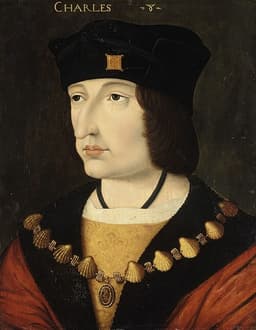
Charles VIII of France
Emperor · Medieval
45.9Total

King Gwangjong
Emperor · Medieval
57.5Total
Basic Information
Born
1470
925
Died
1498
975
Era
Medieval
Medieval
Nationality
France
Korea
Occupation
Emperor
Emperor
Civilization
Western
Eastern
Score Comparison
Military (10%)
40.0
50.0
Political (20%)
30.8
72.0
Influence (20%)
54.9
53.3
Legacy (20%)
49.2
50.0
Leadership (15%)
45.0
66.0
Strategy (15%)
45.0
60.0
TOTAL
45.9
57.5
Charles VIII of France — Complete Timeline
1494 AD
Invasion of ItalyWar
Charles VIII led a French army into Italy to claim the Kingdom of Naples, beginning the Italian Wars. He marched through Italy unopposed, entered Florence and Rome, and conquered Naples in 1495, but was forced to retreat by the League of Venice.
Italian WarsInvasionCapetian
Impact: global
1495 AD
Battle of FornovoWar◆ Major
Charles VIII's French army fought the League of Venice at Fornovo. Though technically a French victory as they broke through the enemy lines, Charles VIII lost his baggage train and was forced to withdraw from Italy, ending his Neapolitan adventure.
Italian WarsBattleCapetian
Impact: regional
1498 AD
Death by AccidentOther◆ Major
Charles VIII died after striking his head on a low door lintel while walking to watch a tennis match at the Ch
Accidental DeathSuccessionCapetian
Impact: nationaltragic
King Gwangjong — Complete Timeline
956 AD
Promulgation of Slave Emancipation EdictReform◆ Major
Gwangjong issued an edict freeing many slaves and reclassifying them as commoners. This measure aimed to undermine the economic base of powerful clans who relied on slave labor, while increasing the tax-paying population under direct royal control.
Social ReformSlaveryCentralization
Impact: nationalprogressive
Purge of Powerful ClansPolitical Action◆ Major
King Gwangjong initiated a systematic purge of powerful aristocratic clans that had dominated Goryeo politics. He ordered the execution or exile of many nobles, confiscated their lands, and freed thousands of slaves to weaken the old elite and strengthen royal authority.
CentralizationPurgeAristocracy
Impact: nationaldestructive
958 AD
Institution of Civil Service ExaminationsReform◆ Major
Gwangjong established the gwageo civil service examination system in Goryeo, based on the Chinese Tang model. This reform allowed talented individuals from lower social classes to enter government service, reducing the power of hereditary aristocrats and creating a merit-based bureaucracy.
MeritocracyBureaucracyConfucian Reform
Impact: nationalprogressive
960 AD
Enactment of Purple Robe EdictPolitical Action
Gwangjong decreed that only the king could grant the right to wear purple robes, a symbol of high office. This edict stripped powerful nobles of their self-assumed privileges and reinforced the king's sole authority to confer rank and status.
Royal AuthoritySumptuary LawCentralization
Impact: national
Expert Analysis
Origins
Charles VIII of France was born in 1470 at the Château d'Amboise, the only surviving son of King Louis XI. His childhood was marked by his father's authoritarian rule and his own frail health. He was raised in a court where political intrigue was constant, and he became king at age 13 upon Louis XI's death in 1483. His regency was controlled by his sister Anne de Beaujeu, who managed the kingdom until Charles took personal rule in 1492. Charles received a knightly education but was not deeply educated in statecraft.
King Gwangjong of Goryeo was born in 925, the fourth son of King Taejo, founder of the Goryeo dynasty. His early life was shaped by the turbulent unification wars of the Korean peninsula. He was appointed as a prince and later as crown prince, gaining experience in military campaigns. He ascended the throne in 949 after the death of his half-brother King Jeongjong. Gwangjong was educated in Confucian classics and Chinese administrative systems, which influenced his later reforms.
Rise to Power
Charles VIII's rise was largely inherited. He became king as a child, and his early reign was dominated by his sister Anne. In 1491, he married Anne of Brittany, securing the duchy of Brittany for France. His personal rule began in 1492, and he quickly turned his attention to Italy. Inspired by the Angevin claim to the Kingdom of Naples, Charles launched an invasion in 1494, crossing the Alps with a large army. He entered Italy unopposed, as Italian states were divided and fearful. He entered Florence in November 1494, forcing Piero de' Medici to flee, and marched on Rome. Pope Alexander VI allowed him passage, and Charles entered Naples in February 1495, crowning himself King of Naples.
Gwangjong rose to power through dynastic succession but faced immediate challenges from powerful clans that had helped his father found Goryeo. These clans held vast land and slaves, and they dominated the court. Gwangjong, determined to centralize power, began his reign by consolidating support among lesser nobles and Confucian scholars. He used the precedent of Chinese centralized bureaucracy to justify his reforms. His turning point came when he initiated the purge of powerful clans in 956, targeting those who opposed his authority.
Leadership & Governance
Charles VIII's leadership was impulsive and focused on chivalric glory. He governed France through a small council and spent little time on domestic reforms. His governance style was medieval: he relied on feudal levies and personal ambition. His Italian campaign was poorly planned strategically; he failed to secure supply lines or build alliances. After his initial success, he faced the League of Venice, a coalition of Milan, Venice, Spain, and the Holy Roman Empire. At the Battle of Fornovo in 1495, Charles's army fought to a draw but managed to retreat to France. His political score of 30.8 reflects his inability to sustain gains.
Gwangjong's leadership was methodical and reformist. He scored 72.0 in political acumen, reflecting his strategic use of edicts and purges. He established the gwageo civil service examinations in 958, opening government positions to talented individuals regardless of birth. This reduced the power of hereditary aristocrats. In 956, he issued the Slave Emancipation Edict, freeing many slaves and reclassifying them as commoners, which undermined clan economic power. He also enacted the Purple Robe Edict, reserving the right to grant high office symbols solely to the king. These reforms centralized authority and created a more meritocratic bureaucracy.
Triumph & Tragedy
Charles VIII's triumph was his swift conquest of Naples in 1495, a feat that stunned Europe. He marched through Italy with minimal resistance, showcasing French military power. However, his tragedy was the failure to hold Naples. The League of Venice forced his retreat, and French forces in Naples were soon expelled. His death in 1498 at age 27, from hitting his head on a low door lintel at Amboise, was an anticlimactic end. He left no male heir, leading to the Valois-Orléans succession and further Italian Wars.
Gwangjong's greatest triumph was the successful centralization of Goryeo's government. His purges eliminated many powerful rivals, and his examination system endured for centuries. The slave emancipation weakened the old aristocracy. However, his tragedy was the human cost: thousands were executed or exiled during the purges. The terror created a climate of fear, and some historians argue it destabilized the court. His reforms were partially rolled back by later kings, though the examination system remained a cornerstone.
Character & Destiny
Charles VIII was ambitious but naive. He was driven by a romantic vision of kingship and crusade, but he lacked strategic depth. His decision to invade Italy without securing alliances or a clear exit strategy shows his impulsiveness. His personality was described as good-natured but easily swayed. His early death sealed his legacy as a king of unrealized potential.
Gwangjong was calculating and ruthless. He carefully planned his purges and edicts, using Confucian ideology to legitimize his actions. He was determined to break the power of clans, even at the cost of bloodshed. His character was shaped by the instability of early Goryeo; he saw centralization as necessary for survival. His legacy as a strong reformer contrasts with his reputation for harshness.
Legacy
Charles VIII's legacy is primarily as the initiator of the Italian Wars, which lasted until 1559 and reshaped European power dynamics. He scored 49.2 in legacy. His invasion introduced France to Italian Renaissance culture, but his failures exposed French military weaknesses. He is often remembered as a king who 'died on a door lintel,' a symbol of futility.
Gwangjong's legacy is more substantial. He scored 50.0 in legacy, but his reforms had lasting impact. The gwageo system continued in Korea for nearly a thousand years, influencing later dynasties. His centralization efforts laid the groundwork for Goryeo's stability in the 11th century. He is remembered as a strong monarch who curbed aristocratic power, though his methods were harsh.
Conclusion
While Charles VIII's Italian adventure had European repercussions, Gwangjong's reforms had a deeper, longer-lasting impact on Korean governance. Gwangjong's total score of 57.5 against Charles's 45.9 reflects his greater effectiveness. Charles's military score of 40.0 and political 30.8 show his weaknesses, while Gwangjong's political 72.0 demonstrates his strategic acumen. Gwangjong's institutional reforms—civil service exams, slave emancipation, and centralization—created frameworks that outlasted his reign. Charles's legacy is tied to a single failed campaign. Therefore, King Gwangjong had greater impact as a ruler who fundamentally restructured his kingdom's power structures.
Rankings
🥇
King GwangjongLeader
Mil: 50.0Pol: 72.0Inf: 53.3
57.5
🥈
Charles VIII of France
Mil: 40.0Pol: 30.8Inf: 54.9
45.9
+11.6 behind
How This Comparison Works
Algorithm
Each figure is scored on 6 dimensions (0—100 scale) based on structured historical data: Military (10%), Political (20%), Influence (20%), Legacy (20%), Leadership (15%), Strategy (15%). The weighted total produces the final ranking.
Data Sources
Scores are computed from structured sub-indicators in the database. Scale factors adjust for era (Ancient ×0.85, Modern ×1.0) and civilization size (Eastern ×1.05, Other ×0.80) to account for differences in population and military scale.
Maximum 3 Figures
Comparisons are limited to 2—3 figures to ensure readability and statistical meaningfulness.
Error Margins
±5 points per dimension — Sub-scores are derived from historical records with inherent uncertainty. Two figures within 5 points on a dimension should be considered roughly equivalent in that area.
Total Score Accuracy
±3 points overall — The weighted combination of 6 dimensions produces a total score with approximately ±3 points of uncertainty. Differences of less than 3 points are not statistically significant— the figures are effectively tied.
Known Limitations
- Historical records are incomplete and uneven across civilizations
- Figures from oral-tradition societies may be underrepresented
- Occupation labels can misclassify multi-role figures
- Scores measure capability and impact, not moral character
- Quantitative scoring is a comparison tool, not absolute truth
Capability Radar
Military (10%) — Battles & Warfare
Battles
45
20
Win Rate
40
25
Expansion
50
15
Political (20%) — Governance & Reform
Reform
25
85
Diplomacy
30
60
Economy
20
55
Influence (20%) — Cultural & Global Reach
Cultural
25
40
Global
35
20
Legacy (20%) — Historical Impact
Historical
55
55
Longevity
30
50
Leadership (15%) — Power & Stability
Tenure
40
70
Stability
15
65
Strategy (15%) — Tactics & Innovation
Strategy
30
40
Tactics
35
30
Reform
20
45
Similar Comparisons
Comments & Discussion
No comments yet. Be the first to share your thoughts!