Loading...
Charles VIII of France vs Julius Caesar
Julius Caesar leads by 36.9 pts · 2 figures compared
…
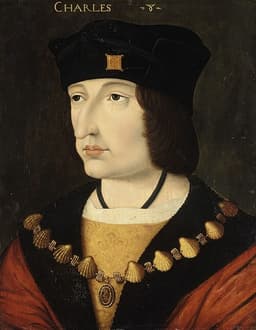
Charles VIII of France
Emperor · Medieval
45.9Total

Julius Caesar
General · Ancient
82.8Total
Basic Information
Born
1470
-100
Died
1498
-44
Era
Medieval
Ancient
Nationality
France
Roman Republic
Occupation
Emperor
General
Civilization
Western
Western
Score Comparison
Military (10%)
40.0
88.0
Political (20%)
30.8
78.0
Influence (20%)
54.9
85.0
Legacy (20%)
49.2
82.0
Leadership (15%)
45.0
80.0
Strategy (15%)
45.0
85.0
TOTAL
45.9
82.8
Charles VIII of France — Complete Timeline
1494 AD
Invasion of ItalyWar
Charles VIII led a French army into Italy to claim the Kingdom of Naples, beginning the Italian Wars. He marched through Italy unopposed, entered Florence and Rome, and conquered Naples in 1495, but was forced to retreat by the League of Venice.
Italian WarsInvasionCapetian
Impact: global
1495 AD
Battle of FornovoWar◆ Major
Charles VIII's French army fought the League of Venice at Fornovo. Though technically a French victory as they broke through the enemy lines, Charles VIII lost his baggage train and was forced to withdraw from Italy, ending his Neapolitan adventure.
Italian WarsBattleCapetian
Impact: regional
1498 AD
Death by AccidentOther◆ Major
Charles VIII died after striking his head on a low door lintel while walking to watch a tennis match at the Ch
Accidental DeathSuccessionCapetian
Impact: nationaltragic
Julius Caesar — Complete Timeline
58 BC
Gallic WarsWar◆ Major
Caesar, as proconsul of Gaul, launched a series of campaigns that conquered all of Gaul (modern France, Belgium, and parts of Switzerland). He fought numerous battles, including against the Helvetii, the Belgae, and the Gallic chieftain Vercingetorix. The wars brought immense wealth and a loyal army to Caesar.
Gallic WarsConquestRoman Expansion
Impact: regional
49 BC
Crossing the RubiconPolitical Action◆ Major
Caesar led Legio XIII across the Rubicon River into Italy, defying the Roman Senate's order to disband his army. This act triggered a civil war against Pompey and the Optimates, ultimately leading to Caesar's dictatorship and the end of the Roman Republic.
Roman Civil WarEnd of RepublicPower Struggle
Impact: global
48 BC
Battle of PharsalusWar◆ Major
Caesar's outnumbered army defeated the larger forces of Pompey the Great at Pharsalus in Greece. Caesar's tactical use of a reserve line to counter Pompey's cavalry charge proved decisive. Pompey fled to Egypt, where he was assassinated, leaving Caesar as the undisputed master of the Roman world.
Roman Civil WarBattleDecisive Victory
Impact: regional
44 BC
Appointment as Dictator for LifePolitical Action◆ Major
The Roman Senate appointed Caesar dictator perpetuo (dictator for life), granting him unprecedented personal power. This move concentrated military, legislative, and judicial authority in one person, effectively ending the Roman Republic's traditional system of checks and balances and alarming many senators.
DictatorshipEnd of RepublicPower Consolidation
Impact: regionaldestructive
Assassination on the Ides of MarchPolitical Action◆ Major
A group of Roman senators, led by Marcus Junius Brutus and Gaius Cassius Longinus, stabbed Caesar to death at a meeting of the Senate in the Theatre of Pompey. The assassination was intended to restore the Republic, but instead triggered another civil war that led to the rise of the Roman Empire.
AssassinationRoman PoliticsEnd of Republic
Impact: globaldestructive
Expert Analysis
charles-viii-of-france-vs-julius-caesar
# The Ides of March and the Low Door: Two Paths of Ambition and Fate
History has a cruel sense of humor. One man crosses a river and changes the world; another hits his head on a door and disappears from it. Julius Caesar and Charles VIII of France both inherited thrones of ambition, yet their names echo across millennia with vastly different resonance. What separates a legend from a footnote? The answer lies not in luck alone, but in the marrow of character, the shape of ambition, and the unforgiving judgment of circumstance.
Origins
Gaius Julius Caesar was born into a patrician family in 100 BCE, but his clan had long since lost its political luster. The Rome of his youth was a republic in convulsions—senatorial corruption, street violence, and the ghost of Sulla’s proscriptions hung over every ambitious man. Caesar’s aunt married Gaius Marius, the populist general, and his father died when he was sixteen. From the start, Caesar understood that survival meant playing a dangerous game. He refused Sulla’s order to divorce his wife, fled Rome, and spent years in the shadows of the eastern provinces, learning war and politics as a young officer.
Charles VIII was born in 1470 into a different world—medieval France, still shaking off the Hundred Years’ War. His father, Louis XI, the “Spider King,” had centralized royal power through cunning and fear, but died when Charles was just thirteen. The boy-king grew up in a court ruled by his elder sister Anne de Beaujeu, a regent who governed with iron discipline. Charles was small, sickly, and notoriously uneducated—he could barely read Latin, the language of diplomacy. Where Caesar learned to calculate odds in the Forum, Charles learned to follow orders.
Rise to Power
Caesar’s ascent was a masterclass in patience and audacity. He climbed the Roman political ladder step by step—quaestor, aedile, praetor—borrowing fortunes to fund games and bribe voters. In 60 BCE, he forged the First Triumvirate with Pompey and Crassus, an alliance that let him secure the governorship of Gaul. Then came the conquests: eight years of war that made him the richest man in Rome and gave him an army that worshipped him. When the Senate ordered him to disband, he crossed the Rubicon in 49 BCE with a single legion, knowing it meant civil war. “The die is cast,” he said—and the Republic died with it.
Charles VIII’s rise was accidental. He inherited a throne, not a destiny. At twenty-two, he was persuaded by his cousin, the Duke of Orléans, to claim the Kingdom of Naples—a distant inheritance from the Angevin dynasty. In 1494, he led a French army over the Alps into Italy, a land of city-states and shifting alliances. It was the beginning of the Italian Wars, a conflict that would consume Europe for decades. But Charles did not conquer so much as march. His army was large, his artillery powerful, and the Italian states—fearing each other more than France—opened their gates. He entered Florence, then Rome, then Naples, almost without a fight. It was less a campaign than a parade.
Leadership & Governance
Caesar governed like a force of nature. As dictator, he reformed the calendar, granted citizenship to provincials, launched public works, and planned a canal through the Isthmus of Corinth. He was ruthless—he executed enemies, confiscated property, and packed the Senate with his supporters—but he was also generous. He pardoned many of his former opponents, including Brutus and Cassius, a clemency that would prove fatal. His military genius was unmatched: at Alesia (52 BCE), he besieged 80,000 Gauls while simultaneously fending off a relief army of 250,000, building double fortifications that became a textbook siege. He wrote his own commentaries, shaping his legend in real time.
Charles VIII was no Caesar. At the Battle of Fornovo in 1495, his army fought the League of Venice to a tactical draw—he broke through enemy lines and escaped, but lost his baggage train and most of his Italian gains. He lacked the strategic vision to hold what he had taken. His governance was absentee: he returned to France, leaving garrisons that quickly crumbled. His only lasting reform was administrative—he died before he could implement much. His courtiers mocked his obsession with tennis and his clumsy gait.
Triumph & Tragedy
Caesar’s greatest triumph was his own survival—until it wasn’t. He defeated Pompey at Pharsalus in 48 BCE, crushed the remnants of the Optimates in Africa and Spain, and returned to Rome as dictator for life in 44 BCE. He was at the peak of his power, planning a war against Parthia, when the conspiracy struck. On the Ides of March, sixty senators surrounded him in the Curia of Pompey and stabbed him twenty-three times. He fell at the foot of a statue of his old rival. His tragedy was not failure, but success—he had destroyed the Republic and could not build the empire fast enough to save himself.
Charles VIII’s tragedy was anticlimax. He lost Naples within a year, his Italian dream shattered by the very alliances he had provoked. He returned to France in 1495, humiliated but still king. For three years, he brooded at the Château d’Amboise, planning a new campaign. Then, on April 7, 1498, walking to watch a tennis match, he struck his head on a low stone lintel. He died hours later, aged twenty-seven. His only son had died in infancy; the throne passed to his cousin, Louis XII. The Italian Wars continued without him.
Character & Destiny
Caesar was driven by an insatiable need for glory. He gambled constantly—on Gaul, on the Rubicon, on clemency—and won until he didn’t. His arrogance was his flaw: he believed his enemies would accept his mercy, that the Senate would tolerate a king in all but name. He ignored the omens, the soothsayers, the warnings of his wife. His character was his destiny: he could not stop climbing, and the fall was inevitable.
Charles VIII was driven by a dream of chivalry. He saw himself as a crusader king, marching to reclaim Jerusalem, but he had neither the intellect nor the ruthlessness to match his ambition. He was a puppet of his court, a boy playing at war. His death was not a tragedy of hubris but of absurdity—a low door, a careless step, and history moved on.
Legacy
Caesar’s legacy is foundational. His name became a title—Caesar, Kaiser, Tsar. His reforms shaped Roman law and administration for centuries. His assassination triggered the end of the Republic and the rise of the Empire. He is remembered as a military genius, a political revolutionary, and a cautionary tale. His story has been told by Shakespeare, by Plutarch, by every generation that wrestles with power.
Charles VIII started the Italian Wars, a conflict that would ravage Italy for sixty years and draw in Spain, France, the Holy Roman Empire, and the Papacy. That is his legacy—a match that lit a fire he could not control. He is remembered, if at all, as the king who died on a door. His scores—Military 34.6, Political 43.0, Leadership 38.0—tell the story of a man who occupied history without shaping it.
Conclusion
Standing at the crossroads of ambition and fate, Caesar and Charles VIII represent two poles of historical possibility. One seized power with both hands, bent the world to his will, and was destroyed by the force he unleashed. The other inherited a crown, chased a dream, and vanished in a moment of absurdity. Their stories remind us that greatness is not merely a matter of opportunity—it is a matter of nerve, of intellect, of the willingness to risk everything for a vision. Caesar crossed the Rubicon; Charles VIII walked into a door. The difference is not luck. It is the difference between a man who writes his own story and one who stumbles into someone else’s.
Rankings
🥇
Julius CaesarLeader
Mil: 88.0Pol: 78.0Inf: 85.0
82.8
🥈
Charles VIII of France
Mil: 40.0Pol: 30.8Inf: 54.9
45.9
+36.9 behind
How This Comparison Works
Algorithm
Each figure is scored on 6 dimensions (0—100 scale) based on structured historical data: Military (10%), Political (20%), Influence (20%), Legacy (20%), Leadership (15%), Strategy (15%). The weighted total produces the final ranking.
Data Sources
Scores are computed from structured sub-indicators in the database. Scale factors adjust for era (Ancient ×0.85, Modern ×1.0) and civilization size (Eastern ×1.05, Other ×0.80) to account for differences in population and military scale.
Maximum 3 Figures
Comparisons are limited to 2—3 figures to ensure readability and statistical meaningfulness.
Error Margins
±5 points per dimension — Sub-scores are derived from historical records with inherent uncertainty. Two figures within 5 points on a dimension should be considered roughly equivalent in that area.
Total Score Accuracy
±3 points overall — The weighted combination of 6 dimensions produces a total score with approximately ±3 points of uncertainty. Differences of less than 3 points are not statistically significant— the figures are effectively tied.
Known Limitations
- Historical records are incomplete and uneven across civilizations
- Figures from oral-tradition societies may be underrepresented
- Occupation labels can misclassify multi-role figures
- Scores measure capability and impact, not moral character
- Quantitative scoring is a comparison tool, not absolute truth
Capability Radar
Military (10%) — Battles & Warfare
Battles
45
95
Win Rate
40
92
Expansion
50
97
Political (20%) — Governance & Reform
Reform
25
90
Diplomacy
30
85
Economy
20
82
Influence (20%) — Cultural & Global Reach
Cultural
25
88
Global
35
94
Legacy (20%) — Historical Impact
Historical
55
95
Longevity
30
96
Leadership (15%) — Power & Stability
Tenure
40
75
Stability
15
60
Strategy (15%) — Tactics & Innovation
Strategy
30
94
Tactics
35
96
Reform
20
88
Similar Comparisons
Comments & Discussion
CRISPY_CROSSING6/17/2026
Caesar's crossing of the Rubicon was a deliberate, calculated act of treason that permanently shattered the Republic's constitutional fabric. Charles VIII stumbled into Italy like a medieval tourist who forgot his supply lines. The difference isn't luck—it's ruthlessness. Caesar killed a million Gauls and didn't lose sleep. Charles wrote poetry about chivalry while his army starved. One was a butcher who built an empire; the other was a daydreamer who built nothing.
数据拆解师6/17/2026
拿数据说话:凯撒的高卢战争打了8年,死亡率高达40%的罗马军队被他牢牢握在手里;查理八世进军那不勒斯,两万人马出发,半年就散了一半。一个是把每一步都算进概率的操盘手,一个是连补给帐篷都没数清就出门的少爷。别拿“意外”说事,门框不高是借口,真正的硬伤是根本不知道怎么打仗。
CLASSICS_DISSECTOR6/17/2026
Here's what the comparison misses: Caesar's real genius wasn't military—it was constitutional vandalism disguised as reform. He merged military command with tribunician power, making himself untouchable while pretending to respect Roman law. Charles VIII tried the same absolutist nonsense in France but lacked the political intellect to pull it off. Caesar seduced the Senate; Charles just annoyed the Pope. One rewrote the rules; the other couldn't even follow them.
历史打脸评论员6/17/2026
你们都在吹凯撒跨过卢比孔河,可别忘了,他跨过去后内战死了几十万罗马人,最后自己也被捅了23刀。查理八世打法国门框上摔死的死法确实滑稽,但至少没把整个国家拖进血海。凯撒的“传奇”是用别人的命堆出来的,查理八世的“失败”不过是年轻气盛加运气太差。谁更值得尊重?至少查理的锅没让全欧洲替他背。
IRON_LEGION6/17/2026
Let's get real about military competence: Caesar's sieges at Alesia and Dyrrhachium are still studied at war colleges. Charles VIII's siege of Naples in 1495? He took the city because the Neapolitans opened the gates for a negotiated surrender, then his army got routed at Fornovo by a coalition that barely tried. Caesar turned soldiers into legends; Charles turned a Renaissance army into a punchline. That's not bad luck—that's leadership bankruptcy.
门框观察员6/17/2026
最讽刺的细节:查理八世死的时候才27岁,凯撒56岁才被捅死。一个在人生一半的岁数就已经把自己摔没了,另一个花了一辈子死成神。时间不是公平的裁判——凯撒用30年把野心熬成制度,查理用十几年把运气挥霍成笑话。如果多