Loading...
Charles Theodore of Sulzbach vs Julius Caesar
Julius Caesar leads by 38.0 pts · 2 figures compared
…
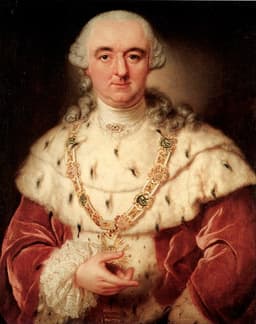
Charles Theodore of Sulzbach
Emperor · Modern
44.8Total

Julius Caesar
General · Ancient
82.8Total
Basic Information
Born
1724
-100
Died
1799
-44
Era
Modern
Ancient
Nationality
Sulzbach
Roman Republic
Occupation
Emperor
General
Civilization
Western
Western
Score Comparison
Military (10%)
14.9
88.0
Political (20%)
46.6
78.0
Influence (20%)
48.6
85.0
Legacy (20%)
38.3
82.0
Leadership (15%)
67.0
80.0
Strategy (15%)
45.0
85.0
TOTAL
44.8
82.8
Charles Theodore of Sulzbach — Complete Timeline
1742 AD
Inherited the Electorate of the PalatinatePolitical Action◆ Major
Charles Theodore inherited the Electorate of the Palatinate and the Duchies of J
SuccessionElectorate
Impact: regional
1777 AD
Inherited the Electorate of BavariaPolitical Action
Upon the death of Elector Maximilian III Joseph of Bavaria, Charles Theodore inherited the Electorate of Bavaria. This inheritance united Bavaria with the Palatinate, creating a large Wittelsbach state, but also triggered the War of the Bavarian Succession.
SuccessionBavariaUnification
Impact: regional
1779 AD
Treaty of TeschenPolitical Action◆ Major
Charles Theodore signed the Treaty of Teschen, ending the War of the Bavarian Succession. The treaty confirmed his inheritance of Bavaria but ceded the Innviertel region to Austria, a compromise that preserved the territorial unity of his new domains.
TreatyWar of the Bavarian SuccessionTerritorial Cession
Impact: regional
Julius Caesar — Complete Timeline
58 BC
Gallic WarsWar◆ Major
Caesar, as proconsul of Gaul, launched a series of campaigns that conquered all of Gaul (modern France, Belgium, and parts of Switzerland). He fought numerous battles, including against the Helvetii, the Belgae, and the Gallic chieftain Vercingetorix. The wars brought immense wealth and a loyal army to Caesar.
Gallic WarsConquestRoman Expansion
Impact: regional
49 BC
Crossing the RubiconPolitical Action◆ Major
Caesar led Legio XIII across the Rubicon River into Italy, defying the Roman Senate's order to disband his army. This act triggered a civil war against Pompey and the Optimates, ultimately leading to Caesar's dictatorship and the end of the Roman Republic.
Roman Civil WarEnd of RepublicPower Struggle
Impact: global
48 BC
Battle of PharsalusWar◆ Major
Caesar's outnumbered army defeated the larger forces of Pompey the Great at Pharsalus in Greece. Caesar's tactical use of a reserve line to counter Pompey's cavalry charge proved decisive. Pompey fled to Egypt, where he was assassinated, leaving Caesar as the undisputed master of the Roman world.
Roman Civil WarBattleDecisive Victory
Impact: regional
44 BC
Appointment as Dictator for LifePolitical Action◆ Major
The Roman Senate appointed Caesar dictator perpetuo (dictator for life), granting him unprecedented personal power. This move concentrated military, legislative, and judicial authority in one person, effectively ending the Roman Republic's traditional system of checks and balances and alarming many senators.
DictatorshipEnd of RepublicPower Consolidation
Impact: regionaldestructive
Assassination on the Ides of MarchPolitical Action◆ Major
A group of Roman senators, led by Marcus Junius Brutus and Gaius Cassius Longinus, stabbed Caesar to death at a meeting of the Senate in the Theatre of Pompey. The assassination was intended to restore the Republic, but instead triggered another civil war that led to the rise of the Roman Empire.
AssassinationRoman PoliticsEnd of Republic
Impact: globaldestructive
Expert Analysis
charles-theodore-of-sulzbach-vs-julius-caesar
# The Crossing and the Stagnation
On a raw January morning in 49 BCE, Julius Caesar stood at the banks of the Rubicon River, a small stream separating his province of Gaul from the Roman heartland. To cross was to declare war on the Republic itself. He hesitated, then uttered, “The die is cast,” and led his legion across. The world would never be the same. Nearly two millennia later, in 1777, Charles Theodore of Sulzbach inherited the throne of Bavaria, uniting it with the Palatinate in a moment that could have reshaped Central Europe. But where Caesar seized destiny with both hands, Charles Theodore let it slip through his fingers. Why did one man remake history while the other merely endured it?
Origins
Julius Caesar was born into a patrician family in 100 BCE, a time when the Roman Republic was bleeding from internal wounds. His father died when he was sixteen, leaving him to navigate a world of ruthless ambition. He was not wealthy, but he was brilliant, cunning, and possessed an almost inhuman drive. The Republic rewarded audacity, and Caesar learned early that fortune favors the bold.
Charles Theodore, born in 1724, inherited a very different world. The Electorate of the Palatinate was a patchwork of territories in the fragmented Holy Roman Empire, where diplomacy and marriage mattered more than military glory. His father was a count, his mother a princess, and his upbringing was one of courtly etiquette and careful maneuvering. The Empire was a cage of traditions, where even a prince could not move without consulting a dozen other princes.
Rise to Power
Caesar’s ascent was a masterclass in calculated risk. He borrowed fortunes to fund public spectacles, winning the love of the Roman mob. He formed the First Triumvirate with Pompey and Crassus, an alliance of convenience that made him consul in 59 BCE. Then he took command of Gaul, where over eight years he conquered a million people and built an army loyal to him alone, not to the Senate.
Charles Theodore’s rise was quieter. In 1742, at age eighteen, he inherited the Palatinate from a cousin. He was not elected; he was born into it. The turning point came in 1777, when the Bavarian Wittelsbach line died out, and he inherited that electorate too. For a moment, he controlled two of the largest states in Germany. The potential was immense: a unified Bavarian-Palatine power block that could challenge Prussia and Austria.
Leadership & Governance
Caesar governed like a storm. As dictator, he reformed the calendar, granted citizenship to Gauls, launched public works, and curbed the power of corrupt senators. He was a military genius who wrote his own commentaries, a politician who pardoned his enemies, and a strategist who saw that the old Republic was dying. His reforms were bold, sometimes brutal, and always aimed at centralizing power in his hands.
Charles Theodore governed like a caretaker. He was a patron of the arts—he founded the Mannheim court, which became a center of music and theater—but he showed little interest in statecraft. When he inherited Bavaria, he immediately tried to trade it to Austria for a chunk of the Netherlands, a deal that horrified his new subjects. The War of the Bavarian Succession (1778–1779) was a bloodless conflict, fought more by diplomats than soldiers. Charles Theodore signed the Treaty of Teschen in 1779, giving up most of his gains. He had no stomach for war, and no vision for his lands.
Triumph & Tragedy
Caesar’s greatest triumph was the conquest of Gaul, a feat that doubled Rome’s territory and made him the richest man in the world. His greatest tragedy was his assassination on the Ides of March, 44 BCE, when sixty senators stabbed him to death in the Senate chamber. He had centralized too much power, and the old elite struck back. But even in death, his legacy endured: his adopted heir, Octavian, became Augustus, the first Roman emperor.
Charles Theodore’s triumph was the union of Bavaria and the Palatinate, a diplomatic coup that should have made him a major figure. His tragedy was that he did nothing with it. He spent his later years in Munich, hosting operas and avoiding conflict. When he died in 1799, his territories were again divided, and the chance to build a strong southern German state vanished. He left no heir, no reforms, no legend.
Character & Destiny
Caesar was a man of fire. He was vain, ambitious, and ruthless, but also generous, clever, and charismatic. He believed that he was destined to rule, and he bent the world to his will. His personality drove his decisions: the crossing of the Rubicon, the clemency shown to rivals, the refusal to disband his army. He understood that history belongs to those who act.
Charles Theodore was a man of ice. He was cautious, comfortable, and content. He preferred the safety of diplomacy to the chaos of war, the pleasures of the court to the burdens of power. He believed that stability was the highest good, and he avoided risks at all costs. His personality shaped his decisions: the attempt to trade Bavaria, the surrender at Teschen, the quiet reign that changed nothing.
Legacy
Caesar’s legacy is stamped on the Western world. His name became a title—Kaiser, Tsar—and his calendar remained in use for sixteen centuries. He destroyed the Republic and built the Empire, for better or worse. He is remembered as a conqueror, a reformer, and a warning.
Charles Theodore’s legacy is a footnote. He is remembered, if at all, as the elector who almost united Bavaria but gave it away. His court in Mannheim is noted by music historians, but his political impact is nil. He is a cautionary tale of missed opportunity.
Conclusion
Caesar and Charles Theodore lived in different worlds, but they faced the same question: what do you do when power is placed in your hands? Caesar answered with a leap across a river; Charles Theodore answered with a signature on a treaty. One reshaped civilization; the other let it pass him by. Their stories remind us that history is not made by circumstances alone, but by the character of those who seize them—or fail to. The die is always cast, but not everyone is willing to throw it.
Rankings
🥇
Julius CaesarLeader
Mil: 88.0Pol: 78.0Inf: 85.0
82.8
🥈
Charles Theodore of Sulzbach
Mil: 14.9Pol: 46.6Inf: 48.6
44.8
+38.0 behind
How This Comparison Works
Algorithm
Each figure is scored on 6 dimensions (0—100 scale) based on structured historical data: Military (10%), Political (20%), Influence (20%), Legacy (20%), Leadership (15%), Strategy (15%). The weighted total produces the final ranking.
Data Sources
Scores are computed from structured sub-indicators in the database. Scale factors adjust for era (Ancient ×0.85, Modern ×1.0) and civilization size (Eastern ×1.05, Other ×0.80) to account for differences in population and military scale.
Maximum 3 Figures
Comparisons are limited to 2—3 figures to ensure readability and statistical meaningfulness.
Error Margins
±5 points per dimension — Sub-scores are derived from historical records with inherent uncertainty. Two figures within 5 points on a dimension should be considered roughly equivalent in that area.
Total Score Accuracy
±3 points overall — The weighted combination of 6 dimensions produces a total score with approximately ±3 points of uncertainty. Differences of less than 3 points are not statistically significant— the figures are effectively tied.
Known Limitations
- Historical records are incomplete and uneven across civilizations
- Figures from oral-tradition societies may be underrepresented
- Occupation labels can misclassify multi-role figures
- Scores measure capability and impact, not moral character
- Quantitative scoring is a comparison tool, not absolute truth
Capability Radar
Military (10%) — Battles & Warfare
Battles
5
95
Win Rate
5
92
Expansion
10
97
Political (20%) — Governance & Reform
Reform
30
90
Diplomacy
40
85
Economy
30
82
Influence (20%) — Cultural & Global Reach
Cultural
20
88
Global
10
94
Legacy (20%) — Historical Impact
Historical
20
95
Longevity
20
96
Leadership (15%) — Power & Stability
Tenure
50
75
Stability
20
60
Strategy (15%) — Tactics & Innovation
Strategy
5
94
Tactics
5
96
Reform
5
88
Similar Comparisons
Comments & Discussion
RubiconRider6/17/2026
Caesar crossed the Rubicon in 49 BCE with 5,000 legionaries, fully aware he was igniting a civil war that would end the Republic. Charles Theodore, in 1777, inherited Bavaria and the Palatinate with a peaceful union that could have rivaled Prussia. But he lacked the nerve to assert Bavarian independence against Austrian pressure. Caesar’s dice-throwing gave us the Roman Empire; Charles Theodore’s timidity gave us a footnote. True greatness demands a willingness to burn the ships.
PalatinusPonderer6/17/2026
说凯撒是“命运主人”太天真了。他越过卢比孔河并非果断,而是债务缠身、即将被起诉时的孤注一掷。查理·西奥多继承巴伐利亚时,面对的是神圣罗马帝国网络和奥地利与普鲁士的双重掣肘,一着不慎就会开战。他的选择并非懦弱,而是务实——保住了选帝侯头衔和领土完整性。凯撒赢了,但共和国也死了。有时候,“停滞”才是深谋远虑。
ClassicsCynic6/17/2026
We’re comparing apples to interstellar oranges. Caesar was a military commander leading a veteran legion in a targeted insurrection; Charles Theodore was a hereditary prince inheriting a composite state under the Holy Roman Empire’s web of treaties. Caesar’s “die” was cast on one riverbank; Charles Theodore faced a bureaucratic maze of imperial diets and family pacts. The only parallel is that both were born into systems that rewarded different games—one battlefield, the other ballroom.
历史重构者6/17/2026
查理·西奥多被低估了。他在1777-1778年巴伐利亚王位继承战争中,没有硬抗奥地利,而是通过外交和婚姻安排,确保了帕拉蒂纳特-巴伐利亚联合体的长期稳定。对比凯撒,他的“征服”带来了内战和独裁,而查理·西奥多的“忍耐”让巴伐利亚在拿破仑风暴中幸存。历史不是只有冲锋才叫伟大——有时候,守住一座城比攻下一座城需要更多勇气。
DataDevil6/17/2026
Numbers don’t lie: Caesar got 15 years of civil wars, purges, and the end of the Republic. Charles Theodore got 22 years of peace for Bavaria and the Palatinate, no major wars, and a stable succession. If we measure by lives saved and economies stabilized, Charles Theodore comes out ahead. Caesar’s “greatness” is a marketing campaign by later emperors—he was a brilliant self-promoter, not a better ruler. Crossing a river is easy; keeping a state intact is hard.