Loading...
Charles of Anjou vs Yelu Abaoji
Yelu Abaoji leads by 3.2 pts · 2 figures compared
…
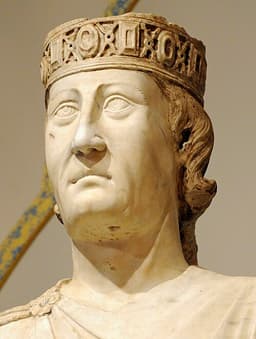
Charles of Anjou
Emperor · Medieval
59.5Total
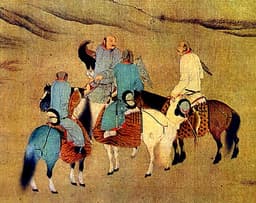
Yelu Abaoji
Emperor · Medieval
62.7Total
Basic Information
Born
1227
872
Died
1285
926
Era
Medieval
Medieval
Nationality
France
China
Occupation
Emperor
Emperor
Civilization
Western
Eastern
Score Comparison
Military (10%)
82.0
77.2
Political (20%)
48.5
59.6
Influence (20%)
56.7
68.0
Legacy (20%)
52.0
40.0
Leadership (15%)
68.0
80.3
Strategy (15%)
66.3
69.6
TOTAL
59.5
62.7
Charles of Anjou — Complete Timeline
1266 AD
Battle of BeneventoWar◆ Major
Charles of Anjou defeated Manfred of Hohenstaufen at Benevento. Manfred was killed in the battle, allowing Charles to take control of the Kingdom of Sicily. This victory established the Angevin dynasty in southern Italy.
Angevin ConquestHohenstaufenItaly
Impact: regional
1268 AD
Battle of TagliacozzoWar◆ Major
Charles of Anjou defeated Conradin, the last Hohenstaufen claimant, at Tagliacozzo. Conradin was captured and later executed in Naples. This victory secured Charles's control over Sicily and ended Hohenstaufen claims.
HohenstaufenExecutionItaly
Impact: regionaldestructive
1282 AD
Sicilian VespersWar
A rebellion broke out in Palermo against Angevin rule, leading to the massacre of French officials and soldiers. The revolt spread across Sicily, resulting in the loss of the island to Peter III of Aragon. This event ended Charles's control of Sicily.
RevoltAragonSicily
Impact: regionaldestructive
1284 AD
Crusade against AragonWar
Pope Martin IV declared a crusade against Peter III of Aragon, and Charles of Anjou led the campaign. The French invasion of Aragon failed, and Charles's fleet was defeated. This crusade drained Angevin resources and weakened his position.
CrusadeAragonFailure
Impact: regionaldestructive
Yelu Abaoji — Complete Timeline
907 AD
Unified Khitan tribesPolitical Action◆ Major
Yelu Abaoji was elected khagan of the Khitan tribes, unifying them under his leadership. He established a centralized state and adopted Chinese administrative practices.
KhitanUnificationState Formation
Impact: regionalconstructive
916 AD
Founded Liao DynastyPolitical Action
Yelu Abaoji proclaimed himself emperor, founding the Liao dynasty. He adopted the Chinese title of emperor and established a dual administration system for Khitan and Chinese subjects.
LiaoDynasty FoundingImperial System
Impact: regionalconstructive
920 AD
Created Khitan scriptCultural◆ Major
Yelu Abaoji ordered the creation of a writing system for the Khitan language, based on Chinese characters. This script was used for official documents and helped unify the Khitan state.
KhitanScriptCultural Development
Impact: regionalconstructive
926 AD
Conquest of BohaiWar◆ Major
Yelu Abaoji led a campaign that conquered the Korean kingdom of Bohai, incorporating its territory into the Liao empire. This expanded Liao's influence into Manchuria and Korea.
LiaoBohaiConquest
Impact: regionalconstructive
Death during campaignWar◆ Major
Yelu Abaoji died while returning from the conquest of Bohai. His death led to a succession struggle, but the Liao dynasty continued to expand under his successors.
LiaoDeathSuccession
Impact: regionaltragic
Expert Analysis
Yelu Abaoji vs Charles of Anjou
### The Conqueror and the Unifier: Charles of Anjou and Yelu Abaoji
History has a way of pairing figures who, though separated by continents and centuries, seem to mirror one another in ambition while diverging completely in outcome. Consider two men who rose to build empires in the medieval world: Charles of Anjou, a French prince who seized the throne of Sicily and Naples through blood and steel, and Yelu Abaoji, a Khitan chieftain who forged a dynasty from the steppes of northern China. One died in the midst of a crumbling dream, his realm shattered by rebellion; the other passed away at the height of his power, his creation enduring for centuries. What drove these two men along such different paths? The answer lies not only in their characters but in the worlds they sought to shape.
### Origins: The Prince and the Nomad
Charles of Anjou was born in 1227 into the royal House of Capet, the youngest son of King Louis VIII of France. He was a prince of privilege, raised in the shadow of his elder brother, the sainted Louis IX. France in the thirteenth century was a land of chivalry and crusade, where noble ambition found its outlet in holy war and dynastic expansion. Charles was given the county of Anjou as his inheritance—a modest domain by royal standards—but he burned with a hunger for more. His world was hierarchical, Christian, and saturated with the memory of Roman glory. He learned to command armies and navigate papal politics, but he was always a man of the Latin West, bound by its alliances and enmities.
Yelu Abaoji, born in 872, came from a vastly different world. He was a Khitan, a nomadic people of the Mongolian steppes, where power was earned through personal charisma and tribal loyalty. The Khitan tribes were fragmented, living in felt tents and herding horses, but they were surrounded by the immense civilization of Tang China. Abaoji was not a prince by blood—he was elected khagan by his peers, a tradition that reflected the steppe’s rough meritocracy. His upbringing taught him to ride before he could walk, to negotiate between clans, and to understand that empire required more than conquest; it demanded a system that could hold a people together. Where Charles inherited a throne of privilege, Abaoji earned his through persuasion and war.
### Rise to Power: The Cross and the Banner
Charles’s path to power was paved by the papacy. In the mid-thirteenth century, the popes were locked in a bitter struggle with the Hohenstaufen dynasty, which ruled the Holy Roman Empire and the Kingdom of Sicily. Pope Clement IV, desperate for a champion, offered the Sicilian crown to Charles. In 1266, Charles marched south with an army of French knights and mercenaries. At the Battle of Benevento, he met Manfred of Hohenstaufen, the illegitimate son of Emperor Frederick II. The battle was a clash of heavy cavalry and crossbowmen, and Charles’s discipline won the day. Manfred was killed on the field, and Charles entered Naples as king. Two years later, at Tagliacozzo in 1268, he crushed the last Hohenstaufen claimant, the teenage Conradin, who was captured and later executed in the marketplace of Naples. Charles had risen by the sword, and he intended to rule by it.
Abaoji’s rise was more gradual, but no less decisive. In 907, he was elected khagan of the Khitan tribes, a position that had traditionally been a primus inter pares. But Abaoji saw the power of Chinese models: a centralized bureaucracy, a hereditary throne, and a written law. He spent years consolidating his authority, suppressing rivals, and building a capital that blended steppe tents with Chinese palaces. In 916, he proclaimed himself emperor, founding the Liao dynasty. Where Charles seized a throne from a foreign pope, Abaoji created one from the fabric of his own people. His power was rooted in his ability to fuse nomadic mobility with Chinese governance—a synthesis that would define his reign.
### Leadership & Governance: The Iron Fist and the Silk Glove
Charles of Anjou ruled Sicily and Naples with a heavy hand. He was a capable administrator, reforming the kingdom’s finances and building a powerful fleet, but he treated his new subjects as conquered enemies. He imposed heavy taxes to fund his wars, quartered French troops in Italian cities, and appointed French officials who despised local customs. His leadership was that of a feudal overlord, not a unifier. He saw his kingdom as a base for further expansion—a launchpad for a crusade against the Byzantine Empire and a bid for Mediterranean supremacy. His military strategy was sound: he built castles, controlled the sea, and hired mercenaries. But his political wisdom was flawed. He never won the loyalty of the Sicilians, who saw him as a foreign tyrant.
Yelu Abaoji governed with a different vision. He understood that the Khitan tribes could not be ruled by force alone. He created a dual administration: one for the nomadic Khitans, based on tribal law and horse archers, and another for the conquered Chinese farmers, based on Confucian bureaucracy and taxation. He ordered the creation of a Khitan script in 920, a writing system that gave his people a cultural identity distinct from China. He conquered the Korean kingdom of Bohai in 926, but he integrated its elites rather than slaughtering them. His military strategy was brilliant—he used steppe cavalry to outmaneuver Chinese armies—but his political genius lay in his ability to balance tradition and innovation. He was a reformer who honored the past while building for the future.
### Triumph & Tragedy: Vespers and the Road Home
Charles’s greatest moment was the conquest of Sicily, but his tragedy was the Sicilian Vespers of 1282. On Easter Monday, a rebellion erupted in Palermo, sparked by a French soldier’s insult to a Sicilian woman. Within weeks, the entire island rose in revolt, massacring French officials and soldiers. The rebels invited Peter III of Aragon to take the crown, and Charles found himself fighting a war on two fronts. Pope Martin IV declared a crusade against Aragon, and Charles led a campaign in 1284 that ended in disaster. His fleet was destroyed, his son captured, and his kingdom reduced to the mainland. He died in 1285, a bitter old man, his dream of a Mediterranean empire in ruins.
Abaoji’s triumph was the conquest of Bohai, which doubled his territory and gave him access to Korean resources. But his tragedy came in the same year, 926, when he died suddenly while returning from the campaign. His death triggered a succession crisis, as his sons fought for the throne. Yet the Liao dynasty survived, because Abaoji had built institutions that could outlast any single ruler. His legacy was not a personal empire but a system that would endure for two centuries.
### Character & Destiny: The Crusader and the Architect
Charles of Anjou was a man of relentless ambition, driven by a vision of Christian empire that was both glorious and brittle. He trusted in the sword and the cross, but he never learned the art of persuasion. His personality was that of a crusader—pious, ruthless, and inflexible. He saw his enemies as heretics and his subjects as tools. This rigidity led to his downfall: he could not adapt to the rebellion of the Vespers, because he could not imagine that his rule might be unwelcome.
Abaoji was an architect of civilizations. He was pragmatic, curious, and patient. He borrowed from China without becoming Chinese, and he honored the steppe without being bound by its traditions. His personality was that of a unifier—ambitious but flexible, strong but willing to compromise. He understood that empire required not just conquest but consent, not just power but legitimacy. This wisdom allowed him to create a dynasty that would rule for over two hundred years.
### Legacy: The Forgotten King and the Eternal Dynasty
Today, Charles of Anjou is remembered as a footnote in Italian history, a foreign conqueror who briefly united the south before being driven out by a popular uprising. His Angevin dynasty survived in Naples, but his dream of a Mediterranean empire died with him. His legacy is cautionary: a tale of how military might cannot substitute for political wisdom.
Yelu Abaoji is remembered as the founder of the Liao dynasty, a state that ruled northern China and the steppes for two centuries. His Khitan script survives in inscriptions, his dual administration became a model for later conquest dynasties, and his name is honored in Chinese and Mongolian histories. His legacy is foundational: a story of how a nomadic leader can build a lasting empire by blending cultures.
### Conclusion
Two men, two empires, two fates. Charles of Anjou and Yelu Abaoji both sought to build something lasting, but one trusted in the sword and the other in the system. The difference was not in their ambition—both were driven—but in their understanding of power. Charles saw power as something to be imposed; Abaoji saw it as something to be woven. One died in defeat, his kingdom in revolt; the other died in triumph, his dynasty secure. History teaches us that the conqueror who learns to build is the one who endures. The rest are just names on a forgotten battlefield.
Rankings
🥇
Yelu AbaojiLeader
Mil: 77.2Pol: 59.6Inf: 68.0
62.7
🥈
Charles of Anjou
Mil: 82.0Pol: 48.5Inf: 56.7
59.5
+3.2 behind
How This Comparison Works
Algorithm
Each figure is scored on 6 dimensions (0—100 scale) based on structured historical data: Military (10%), Political (20%), Influence (20%), Legacy (20%), Leadership (15%), Strategy (15%). The weighted total produces the final ranking.
Data Sources
Scores are computed from structured sub-indicators in the database. Scale factors adjust for era (Ancient ×0.85, Modern ×1.0) and civilization size (Eastern ×1.05, Other ×0.80) to account for differences in population and military scale.
Maximum 3 Figures
Comparisons are limited to 2—3 figures to ensure readability and statistical meaningfulness.
Error Margins
±5 points per dimension — Sub-scores are derived from historical records with inherent uncertainty. Two figures within 5 points on a dimension should be considered roughly equivalent in that area.
Total Score Accuracy
±3 points overall — The weighted combination of 6 dimensions produces a total score with approximately ±3 points of uncertainty. Differences of less than 3 points are not statistically significant— the figures are effectively tied.
Known Limitations
- Historical records are incomplete and uneven across civilizations
- Figures from oral-tradition societies may be underrepresented
- Occupation labels can misclassify multi-role figures
- Scores measure capability and impact, not moral character
- Quantitative scoring is a comparison tool, not absolute truth
Capability Radar
Military (10%) — Battles & Warfare
Battles
75
75
Win Rate
70
80
Expansion
80
82
Political (20%) — Governance & Reform
Reform
60
88
Diplomacy
68
75
Economy
65
70
Influence (20%) — Cultural & Global Reach
Cultural
50
60
Global
45
55
Legacy (20%) — Historical Impact
Historical
60
70
Longevity
55
65
Leadership (15%) — Power & Stability
Tenure
70
72
Stability
55
65
Strategy (15%) — Tactics & Innovation
Strategy
78
78
Tactics
72
70
Reform
65
85
Similar Comparisons
Comments & Discussion
CrusaderKing6/16/2026
Yelu Abaoji actually had the tougher job. Charles of Anjou inherited a feudal system with established infrastructure, while Abaoji had to invent an empire from scratch on the steppe. The Khitan leader created a writing system, blended nomadic and Chinese administration, and built a dual government structure that lasted 200 years. Charles just imported French feudalism to Sicily and watched it collapse. Give me the innovator over the entitled prince.
西域铁骑6/16/2026
耶律阿保机制服了二十多个部落联盟建立契丹帝国,这比查理获得教皇支持征服西西里难十倍。游牧民族内部比欧洲封建领主复杂得多——光是处理可汗继承制度就够头疼的。查理·安茹只会屠戮,阿保机却懂得用"南北面官制"平衡汉人与契丹人的利益,这才是真正的政治智慧。
StatCounter6/16/2026
Let's look at the actual numbers. Charles of Anjou ruled for about 18 years before the Sicilian Vespers revolt shattered his kingdom. Yelu Abaoji reigned 20 years and his dynasty persisted over 200. Charles' tax base was limited to Sicily and parts of Italy, generating maybe 30,000 gold ounces annually. Abaoji controlled trade routes from the Pacific to Central Asia, giving him exponentially more economic power. The data doesn't lie: Abaoji's model was objectively more successful.
史海沉钩6/16/2026
很多人忽略了一个关键细节:耶律阿保机在称帝前被部落贵族逼退了九年,靠隐忍和计谋才重新夺回权力。而查理·安茹一上位就暴政横征,连西西里妇女都被征去当佣兵。历史证明,懂得在弱势时蛰伏的统治者,远比只会用铁腕的鲁莽武夫更有持久力——阿保机墓就在今内蒙古,契丹祭拜数百年,查理的尸体却被叛军扔进海里。