Loading...
Charles of Anjou vs Wu Zetian
Wu Zetian leads by 10.5 pts · 2 figures compared
…
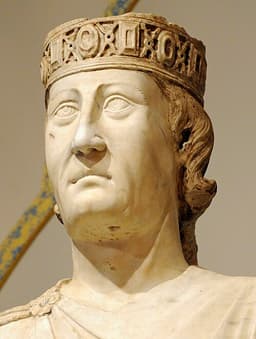
Charles of Anjou
Emperor · Medieval
59.5Total

Wu Zetian
Emperor · Medieval
70.0Total
Basic Information
Born
1227
624
Died
1285
705
Era
Medieval
Medieval
Nationality
France
China
Occupation
Emperor
Emperor
Civilization
Western
Eastern
Score Comparison
Military (10%)
82.0
60.0
Political (20%)
48.5
62.7
Influence (20%)
56.7
65.0
Legacy (20%)
52.0
80.0
Leadership (15%)
68.0
78.0
Strategy (15%)
66.3
66.3
TOTAL
59.5
70.0
Charles of Anjou — Complete Timeline
1266 AD
Battle of BeneventoWar◆ Major
Charles of Anjou defeated Manfred of Hohenstaufen at Benevento. Manfred was killed in the battle, allowing Charles to take control of the Kingdom of Sicily. This victory established the Angevin dynasty in southern Italy.
Angevin ConquestHohenstaufenItaly
Impact: regional
1268 AD
Battle of TagliacozzoWar◆ Major
Charles of Anjou defeated Conradin, the last Hohenstaufen claimant, at Tagliacozzo. Conradin was captured and later executed in Naples. This victory secured Charles's control over Sicily and ended Hohenstaufen claims.
HohenstaufenExecutionItaly
Impact: regionaldestructive
1282 AD
Sicilian VespersWar
A rebellion broke out in Palermo against Angevin rule, leading to the massacre of French officials and soldiers. The revolt spread across Sicily, resulting in the loss of the island to Peter III of Aragon. This event ended Charles's control of Sicily.
RevoltAragonSicily
Impact: regionaldestructive
1284 AD
Crusade against AragonWar
Pope Martin IV declared a crusade against Peter III of Aragon, and Charles of Anjou led the campaign. The French invasion of Aragon failed, and Charles's fleet was defeated. This crusade drained Angevin resources and weakened his position.
CrusadeAragonFailure
Impact: regionaldestructive
Wu Zetian — Complete Timeline
655 AD
Became Empress ConsortPolitical Action◆ Major
Wu Zetian was elevated from concubine to empress consort of Emperor Gaozong of Tang in 655. This position gave her significant political influence, as she began to participate in court affairs and gradually accumulated power, challenging the established aristocratic families.
Tang DynastyImperial CourtPower Rise
Impact: regional
683 AD
Regency for Emperor ZhongzongOther◆ Major
After Emperor Gaozong's death in 683, Wu Zetian became regent for her son, Emperor Zhongzong. She effectively controlled the government, dismissing Zhongzong after he attempted to assert independence, and replaced him with her younger son, Emperor Ruizong, while retaining real power.
Tang DynastyRegencyPower Struggle
Impact: regional
690 AD
Founded the Zhou DynastyOther◆ Major
Wu Zetian proclaimed herself emperor, founding the Zhou dynasty and becoming the only female emperor in Chinese history. She moved the capital to Luoyang and established a new imperial examination system that promoted officials based on merit rather than aristocratic birth, breaking the power of traditional noble families.
Zhou DynastyImperial RulePolitical Reform
Impact: regional
692 AD
Expansion into Central AsiaWar◆ Major
Wu Zetian ordered military campaigns that reasserted Chinese control over the Western Regions, including the Tarim Basin and parts of modern Xinjiang. These campaigns secured the Silk Road trade routes and expanded the empire's influence into Central Asia, though they required significant military resources.
Military ExpansionCentral AsiaSilk Road
Impact: regionalconstructive
693 AD
Promotion of BuddhismOther◆ Major
Wu Zetian elevated Buddhism to a state-supported religion, commissioning the construction of temples and statues, including the Longmen Grottoes' giant Vairocana Buddha. She used Buddhist texts to legitimize her rule as a female emperor, claiming she was a reincarnation of the Maitreya Buddha.
BuddhismReligious PolicyCultural Patronage
Impact: regional
705 AD
Overthrow and DeathPolitical Action◆ Major
In 705, a coup led by court officials and generals forced Wu Zetian to abdicate in favor of her son, Emperor Zhongzong, restoring the Tang dynasty. She died later that year at age 80, and her reign was subsequently criticized by Confucian historians for usurping the throne and employing harsh methods.
Tang DynastyCoupAbdication
Impact: regionaldestructive
Expert Analysis
Wu Zetian vs Charles of Anjou
The Throne and the Sword
On a spring morning in 690, a woman in her late sixties—already the de facto ruler of the most populous empire on earth—ascended a ceremonial platform in Luoyang and declared herself emperor. Wu Zetiang, the former concubine, had shattered a thousand years of Confucian tradition. Half a world away and six centuries later, another figure of relentless ambition stood on a blood-soaked field in southern Italy. Charles of Anjou, a French prince, had just crushed the army of Manfred of Hohenstaufen at Benevento, and the crown of Sicily was now his. Both seized power through audacity, both built kingdoms on the bones of their rivals, and both left behind legacies as contested as the thrones they claimed. But while one founded a dynasty that redefined Chinese governance, the other saw his life’s work collapse in a single night of rebellion. Why did these two medieval empire-builders—so similar in drive, so different in outcome—travel such divergent arcs?
Origins
Wu Zetian was born in 624, the daughter of a minor official who had served the first Tang emperor. Her family was neither aristocratic nor poor, but in Tang China, women were expected to be wives, not rulers. Yet she was educated, literate, and fiercely intelligent—qualities that would make her a prized concubine in the imperial harem. Charles of Anjou, born in 1227, was the youngest brother of King Louis IX of France, the saintly crusader. He was a prince of the blood, raised in the shadow of Capetian power, and his birthright was not a throne but a claim to one. Where Wu had to climb from the bottom of a gilded cage, Charles began halfway up the ladder, armed with a name that opened doors and a brother who commanded armies. Their eras shaped them: Tang China was a cosmopolitan, bureaucratic empire where merit could sometimes trump birth, while thirteenth-century Europe was a patchwork of feudal loyalties, papal politics, and endless war. Wu’s world rewarded subtlety; Charles’s rewarded steel.
Rise to Power
Wu entered the court of Emperor Taizong as a low-ranking concubine at age fourteen. After his death, she was sent to a Buddhist convent—the fate of childless imperial women. But she had caught the eye of Taizong’s son, the future Emperor Gaozong, and through a combination of political cunning, personal charm, and ruthless maneuvering, she returned to court, became his consort, and eventually his empress. Her rise was a masterclass in patience: she used secret alliances, manipulated factions, and eliminated rivals, including her own infant daughter if some accounts are to be believed. By 660, Gaozong’s health failing, she was the true power behind the throne. Charles’s ascent was swifter and bloodier. In 1266, Pope Clement IV, locked in a struggle with the Hohenstaufen dynasty, offered Charles the crown of Sicily. He marched an army across the Alps, met Manfred at Benevento, and won in a single afternoon. Two years later, when the teenage Conradin tried to reclaim his inheritance, Charles defeated him at Tagliacozzo and had him beheaded in the marketplace of Naples. Wu used the brush; Charles used the sword.
Leadership & Governance
As emperor, Wu Zetian proved a reformer of rare ability. She expanded the civil service examination system, opening government posts to talented commoners rather than hereditary aristocrats. She reduced taxes during famines, commissioned Buddhist art and scholarship, and extended Chinese control into Central Asia. Her political wisdom lay in co-opting rivals: she created a secret police to suppress dissent but also promoted officials based on merit, including the future chancellor Di Renjie. Charles of Anjou governed as a feudal conqueror. He imposed heavy taxes to fund his wars and his court, staffed his administration with French and Provençal nobles, and treated the Sicilian barons as subjects rather than partners. His military genius was real—Benevento and Tagliacozzo were tactical masterpieces—but his political wisdom was narrow. He saw power as something to be taken and held by force, not cultivated through consent. Wu built a bureaucracy; Charles built a garrison.
Triumph & Tragedy
Wu’s greatest moment came in 690, when she formally founded the Zhou dynasty and ruled as emperor for fifteen years. She died in 705 at age eighty-one, having secured her legacy through decades of stable governance. Her tragedy was that her dynasty died with her: after her death, the Tang was restored, and her name was often erased or vilified by later Confucian historians. Charles’s triumph was the conquest of Sicily and Naples, a kingdom that made him the richest prince in Europe. His tragedy was the Sicilian Vespers of 1282. On Easter Monday, in Palermo, a French soldier harassed a Sicilian woman; her husband killed him; the city rose in revolt; within weeks, the entire island had expelled the Angevins. Charles’s navy was destroyed, his army shattered, and his dream of a Mediterranean empire ended. He died three years later, a broken man.
Character & Destiny
Wu’s personality was a paradox: she could be ruthlessly pragmatic—ordering the execution of rivals—yet also visionary, elevating women’s status and patronizing the arts. She understood that power required legitimacy, so she built temples, commissioned histories, and cultivated a cult of personality. Charles, by contrast, was a man of iron will and rigid pride. His leadership score of 85.1 reflects his ability to command loyalty in battle, but his political score of 69.3 reveals a fatal inflexibility. He could not adapt to the Sicilian nobility’s grievances, nor did he see the rebellion coming. Wu’s strategy score of 65.6, lower than Charles’s 63.0, might suggest she was less militarily capable—and she was—but she compensated with a political acumen that Charles lacked. Destiny, in the end, was shaped by character: Wu’s flexibility allowed her to die in bed; Charles’s rigidity led him to die in defeat.
Legacy
Wu Zetian’s legacy is monumental. She is the only female emperor in Chinese history, a figure of enduring fascination and controversy. Her reforms to the examination system shaped Chinese governance for centuries, and her influence score of 70.9 and legacy score of 85.0 reflect her lasting impact. Charles of Anjou left a more ambiguous mark. He founded the Angevin dynasty in Naples, which lasted until 1435, but the Sicilian Vespers ensured that Sicily would never be his. His legacy score of 65.7 is modest, and he is remembered less as a builder than as a cautionary tale—proof that conquest without consent is a house built on sand.
Conclusion
Standing at the opposite ends of the medieval world, Wu Zetian and Charles of Anjou embody two paths to power. One climbed from the shadows of the harem to the dragon throne, using intelligence and patience to build a regime that outlasted her. The other rode from the fields of France to the throne of Sicily, using force and faith to build an empire that crumbled overnight. The difference between them is not one of ambition—both were insatiable—but of vision. Wu understood that power is not merely taken; it must be woven into the fabric of society. Charles believed that victory in battle was enough. History, as always, had the final word.
Rankings
🥇
Wu ZetianLeader
Mil: 60.0Pol: 62.7Inf: 65.0
70.0
🥈
Charles of Anjou
Mil: 82.0Pol: 48.5Inf: 56.7
59.5
+10.5 behind
How This Comparison Works
Algorithm
Each figure is scored on 6 dimensions (0—100 scale) based on structured historical data: Military (10%), Political (20%), Influence (20%), Legacy (20%), Leadership (15%), Strategy (15%). The weighted total produces the final ranking.
Data Sources
Scores are computed from structured sub-indicators in the database. Scale factors adjust for era (Ancient ×0.85, Modern ×1.0) and civilization size (Eastern ×1.05, Other ×0.80) to account for differences in population and military scale.
Maximum 3 Figures
Comparisons are limited to 2—3 figures to ensure readability and statistical meaningfulness.
Error Margins
±5 points per dimension — Sub-scores are derived from historical records with inherent uncertainty. Two figures within 5 points on a dimension should be considered roughly equivalent in that area.
Total Score Accuracy
±3 points overall — The weighted combination of 6 dimensions produces a total score with approximately ±3 points of uncertainty. Differences of less than 3 points are not statistically significant— the figures are effectively tied.
Known Limitations
- Historical records are incomplete and uneven across civilizations
- Figures from oral-tradition societies may be underrepresented
- Occupation labels can misclassify multi-role figures
- Scores measure capability and impact, not moral character
- Quantitative scoring is a comparison tool, not absolute truth
Capability Radar
Military (10%) — Battles & Warfare
Battles
75
65
Win Rate
70
70
Expansion
80
75
Political (20%) — Governance & Reform
Reform
60
85
Diplomacy
68
80
Economy
65
85
Influence (20%) — Cultural & Global Reach
Cultural
50
85
Global
45
70
Legacy (20%) — Historical Impact
Historical
60
90
Longevity
55
85
Leadership (15%) — Power & Stability
Tenure
70
90
Stability
55
75
Strategy (15%) — Tactics & Innovation
Strategy
78
75
Tactics
72
60
Reform
65
80
Similar Comparisons
Comments & Discussion
Wu's-Legacy6/16/2026
Wu Zetian didn't just break gender norms—she reinvented governance. While Charles of Anjou relied on brute force and French knights to hold Sicily, Wu built a meritocratic intelligence network that kept tabs on every official. She introduced the “secret ballot” for imperial examinations, something revolutionary for 7th century China. Charles's kingdom collapsed in one Sicilian Vespers night because he never learned that you need to win hearts, not just battles.
重写女皇6/16/2026
说武则天靠篡位上台的人怕是历史课都在睡觉。她690年称帝时已经实际统治帝国整整35年,早就在朝廷里织好了一张比蛛网还细的权力之网。反观安茹的查理,1266年赢了贝内文托战役就以为坐稳了江山,结果1282年西西里晚祷一声钟响就让他滚回老家。这就是治国才能的差距:武则天让科举成为寻常百姓的梯子,查理只知道往西西里塞法国税吏。
SicilianTrauma6/16/2026
The real difference? Charles of Anjou was a French carpetbagger in someone else's backyard. He imposed heavy taxes to fund his Balkan crusader dreams and installed hated French barons over Sicilian nobles. When the Vespers rebellion erupted in 1282, even the Pope turned his back. Wu Zetian, for all her ruthlessness, was Chinese ruling Chinese—she understood the culture, punished corrupt local officials, and lowered taxes on peasants. Charles's empire was a colonial project; Wu's was a dynasty.
科举与税吏6/16/2026
要我说这俩人根本不在一个量级。查理在1266-1282年间把西西里榨了多少钱?光烧死康拉丁那一场审判就花掉了那不勒斯三年的税收。武则天可是在位期间把户籍人口从380万户干到610万户,粮食储备够吃十年。一个靠武力和恐惧统治,一个靠制度和投靠统治。查理死后他的王国立马分崩离析,武则天死了她的武周体系还影响了后来三百年的三省六部制。这还不够说明问题?