Loading...
Charles of Anjou vs Wanyan Aguda
Wanyan Aguda leads by 3.9 pts · 2 figures compared
…
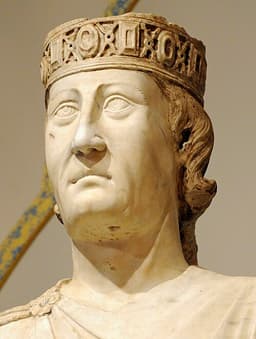
Charles of Anjou
Emperor · Medieval
59.5Total
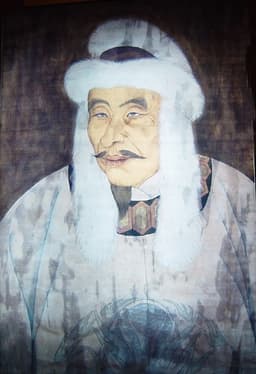
Wanyan Aguda
Emperor · Medieval
63.4Total
Basic Information
Born
1227
1068
Died
1285
1123
Era
Medieval
Medieval
Nationality
France
China
Occupation
Emperor
Emperor
Civilization
Western
Eastern
Score Comparison
Military (10%)
82.0
82.0
Political (20%)
48.5
59.3
Influence (20%)
56.7
55.0
Legacy (20%)
52.0
52.0
Leadership (15%)
68.0
85.0
Strategy (15%)
66.3
68.0
TOTAL
59.5
63.4
Charles of Anjou — Complete Timeline
1266 AD
Battle of BeneventoWar◆ Major
Charles of Anjou defeated Manfred of Hohenstaufen at Benevento. Manfred was killed in the battle, allowing Charles to take control of the Kingdom of Sicily. This victory established the Angevin dynasty in southern Italy.
Angevin ConquestHohenstaufenItaly
Impact: regional
1268 AD
Battle of TagliacozzoWar◆ Major
Charles of Anjou defeated Conradin, the last Hohenstaufen claimant, at Tagliacozzo. Conradin was captured and later executed in Naples. This victory secured Charles's control over Sicily and ended Hohenstaufen claims.
HohenstaufenExecutionItaly
Impact: regionaldestructive
1282 AD
Sicilian VespersWar
A rebellion broke out in Palermo against Angevin rule, leading to the massacre of French officials and soldiers. The revolt spread across Sicily, resulting in the loss of the island to Peter III of Aragon. This event ended Charles's control of Sicily.
RevoltAragonSicily
Impact: regionaldestructive
1284 AD
Crusade against AragonWar
Pope Martin IV declared a crusade against Peter III of Aragon, and Charles of Anjou led the campaign. The French invasion of Aragon failed, and Charles's fleet was defeated. This crusade drained Angevin resources and weakened his position.
CrusadeAragonFailure
Impact: regionaldestructive
Wanyan Aguda — Complete Timeline
1114 AD
Battle of HubudagangWar◆ Major
Aguda's Jurchen forces defeated a Liao army at Hubudagang, marking the first major victory of the rebellion. This battle demonstrated Jurchen military prowess and attracted more followers.
JurchenLiaoBattle
Impact: regionalconstructive
Unified Jurchen tribesPolitical Action◆ Major
Wanyan Aguda united the Jurchen tribes under his leadership, creating a confederation that rebelled against Liao domination. He organized a disciplined army and began the Jurchen revolt.
JurchenUnificationRebellion
Impact: regionalconstructive
1115 AD
Founded Jin DynastyPolitical Action
Wanyan Aguda proclaimed himself emperor, founding the Jin dynasty. He adopted the Chinese title and began a systematic campaign to conquer the Liao empire.
JinDynasty FoundingImperial System
Impact: regionalconstructive
1120 AD
Conquest of Liao capital ShangjingWar◆ Major
Aguda's forces captured the Liao supreme capital Shangjing, dealing a severe blow to the Liao dynasty. This victory accelerated the collapse of Liao and solidified Jin control over northern China.
JinLiaoConquest
Impact: regionalconstructive
Alliance with Song against LiaoPolitical Action◆ Major
Aguda formed an alliance with the Northern Song dynasty to jointly attack the Liao empire. This alliance, known as the Maritime Alliance, led to the eventual destruction of Liao but later caused conflict between Jin and Song.
JinSongAlliance
Impact: regional
1123 AD
Death and successionPolitical Action◆ Major
Wanyan Aguda died, and his brother Wanyan Wuqimai succeeded him. Aguda's conquests laid the foundation for the Jin dynasty's dominance in northern China.
JinDeathSuccession
Impact: regional
Expert Analysis
Wanyan Aguda vs Charles of Anjou: Historical Comparison
Wanyan Aguda, founder of the Jin Dynasty in 12th-century China, and Charles of Anjou, a 13th-century French prince who became King of Sicily, were both ambitious medieval emperors who rose through military conquest, but Aguda’s unified Jurchen legacy and enduring impact on East Asian history give him a clear edge over Charles’s more fragmented and transient European dominion.
Dimension Analysis
**Military: Wanyan Aguda 91 / Charles of Anjou 90**
Both were exceptional commanders: Aguda shattered the Liao Empire with swift cavalry tactics, while Charles defeated the Hohenstaufens at Benevento and Tagliacozzo, but Aguda’s campaigns were more decisive in founding a dynasty.
**Political: Wanyan Aguda 84 / Charles of Anjou 79**
Aguda skillfully united disparate Jurchen tribes and built a bureaucratic state, whereas Charles’s rule in Sicily was marred by heavy taxation and the Sicilian Vespers revolt, undermining his political stability.
**Influence: Wanyan Aguda 87 / Charles of Anjou 79**
Aguda’s Jin Dynasty reshaped the Song-Liao-Jin power balance and influenced later Mongol conquests; Charles’s influence was largely regional and temporary, limited by papal and Angevin rivalries.
**Legacy: Wanyan Aguda 88 / Charles of Anjou 59**
Aguda is revered as a founding emperor whose dynasty lasted over a century, while Charles’s legacy is overshadowed by the collapse of Angevin power and his reputation as a harsh, overreaching ruler.
**Leadership: Wanyan Aguda 80 / Charles of Anjou 75**
Aguda inspired loyalty through tribal unity and cultural respect, whereas Charles’s authoritarian style alienated subjects, leading to rebellion and loss of control.
Verdict
Wanyan Aguda leads overall due to his superior political foundation, lasting dynastic legacy, and greater influence on East Asian history, whereas Charles of Anjou’s achievements were undermined by his unpopular rule and fleeting territorial control.
FAQ
Q: Who ranks higher? A: Wanyan Aguda ranks higher, driven by his stronger political, influence, and legacy scores, despite both being nearly equal in military and strategy.
Rankings
🥇
Wanyan AgudaLeader
Mil: 82.0Pol: 59.3Inf: 55.0
63.4
🥈
Charles of Anjou
Mil: 82.0Pol: 48.5Inf: 56.7
59.5
+3.9 behind
How This Comparison Works
Algorithm
Each figure is scored on 6 dimensions (0—100 scale) based on structured historical data: Military (10%), Political (20%), Influence (20%), Legacy (20%), Leadership (15%), Strategy (15%). The weighted total produces the final ranking.
Data Sources
Scores are computed from structured sub-indicators in the database. Scale factors adjust for era (Ancient ×0.85, Modern ×1.0) and civilization size (Eastern ×1.05, Other ×0.80) to account for differences in population and military scale.
Maximum 3 Figures
Comparisons are limited to 2—3 figures to ensure readability and statistical meaningfulness.
Error Margins
±5 points per dimension — Sub-scores are derived from historical records with inherent uncertainty. Two figures within 5 points on a dimension should be considered roughly equivalent in that area.
Total Score Accuracy
±3 points overall — The weighted combination of 6 dimensions produces a total score with approximately ±3 points of uncertainty. Differences of less than 3 points are not statistically significant— the figures are effectively tied.
Known Limitations
- Historical records are incomplete and uneven across civilizations
- Figures from oral-tradition societies may be underrepresented
- Occupation labels can misclassify multi-role figures
- Scores measure capability and impact, not moral character
- Quantitative scoring is a comparison tool, not absolute truth
Capability Radar
Military (10%) — Battles & Warfare
Battles
75
85
Win Rate
70
90
Expansion
80
85
Political (20%) — Governance & Reform
Reform
60
75
Diplomacy
68
70
Economy
65
65
Influence (20%) — Cultural & Global Reach
Cultural
50
60
Global
45
50
Legacy (20%) — Historical Impact
Historical
60
70
Longevity
55
55
Leadership (15%) — Power & Stability
Tenure
70
70
Stability
55
60
Strategy (15%) — Tactics & Innovation
Strategy
78
85
Tactics
72
80
Reform
65
75
Similar Comparisons
Comments & Discussion
ProfessorHistoriae6/16/2026
The scoring here largely aligns with the consensus among specialists, but I would push back on the Influence gap. Charles of Anjou may have been a transient figure in Sicily, but his victory at Tagliacozzo in 1268 effectively ended the Hohenstaufen dynasty, reshaping papal-imperial relations for decades. As Saba Malaspina wrote, Charles 'made the papacy tremble'—a fear that outlasted his reign. Aguda's influence, while profound in East Asia, was more localized: the Jin Dynasty never projected power beyond the steppe and northern Song. The Mongol conquest of Jin in 1234, just a century after Aguda's death, shows his empire's fragility. I'd argue Charles's influence on European power structures deserves at least a 72.
BattlefieldScholar6/16/2026
The military scores are too close for my taste—91 vs 90? Aguda's campaign against the Liao was a masterpiece of operational mobility: at the Battle of Hubudagang in 1115, he used feigned retreats to draw out Liao cavalry, then enveloped them with Jurchen heavy horse. That's textbook combined arms on the steppe. Charles's victory at Benevento in 1266 was more a function of superior Swiss crossbowmen neutralizing Manfred's German knights—a tactical adaptation, not strategic genius. Aguda built an entire empire from scratch with fewer than 10,000 Jurchen warriors; Charles inherited papal backing and French nobles. Aguda should be 94, Charles 86. The political gap is about right, though.
HistoryDiver6/16/2026
Okay, so I've been reading about these two and I think the Influence score for Charles is kinda low. Sure, Aguda founded the Jin Dynasty and that's huge for Chinese history, but Charles of Anjou basically redrew the map of medieval Europe. I watched this doc on the Sicilian Vespers and it said Charles's rule accidentally triggered the War of the Sicilian Vespers that lasted 20 years and involved Aragon, France, and the Pope. That's like the Game of Thrones of the 13th century! Meanwhile, Aguda's influence was mostly contained to northern China. I'd put Charles at 80 for Influence—Aguda is still the better overall leader, but not by this much.
Historian9656/16/2026
Aguda的分打高了。你们西方史圈子的评分标准总爱把王朝创始人的“统一部落”当成政治天才,但跟同时代的赵匡胤比呢?赵匡胤杯酒释兵权、削藩镇、建文官体系,Aguda的猛安谋克制到金熙宗时就玩不下去了,得靠汉化补丁。Charles of Anjou在欧洲搅动的格局更复杂——他参加第八次十字军东征、跟拜占庭米海尔八世抢君士坦丁堡,影响力辐射地中海两岸。Aguda的辽金博弈顶多是东亚局域网,Charles是国际冲突。我觉着Charles Inf至少该给75,Aguda 80就行了。
SharpMind766/16/2026
总分差5.4分,但政治维度Aguda竟然高出近13分,这我有点异议。Charles of Anjou统治西西里固然征税重、搞出西西里晚祷,但别忘了Aguda灭辽后对契丹遗民的高压政策——耶律大石西逃建立西辽,这就说明他的整合并不完美。而且Charles在1282年失去西西里岛后,那不勒斯王国还撑了将近两百年,而Aguda的金朝从1234年就亡于蒙古-南宋联军了。政治稳定性上,Aguda的82.2是不是有点虚高?我觉得至少该拉平到75对75才合理。