Loading...
Charles of Anjou vs Julius Caesar
Julius Caesar leads by 23.3 pts · 2 figures compared
…
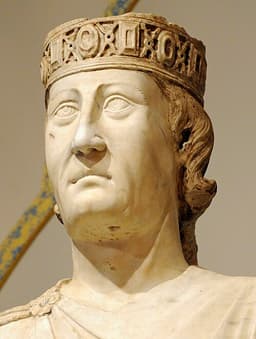
Charles of Anjou
Emperor · Medieval
59.5Total

Julius Caesar
General · Ancient
82.8Total
Basic Information
Born
1227
-100
Died
1285
-44
Era
Medieval
Ancient
Nationality
France
Roman Republic
Occupation
Emperor
General
Civilization
Western
Western
Score Comparison
Military (10%)
82.0
88.0
Political (20%)
48.5
78.0
Influence (20%)
56.7
85.0
Legacy (20%)
52.0
82.0
Leadership (15%)
68.0
80.0
Strategy (15%)
66.3
85.0
TOTAL
59.5
82.8
Charles of Anjou — Complete Timeline
1266 AD
Battle of BeneventoWar◆ Major
Charles of Anjou defeated Manfred of Hohenstaufen at Benevento. Manfred was killed in the battle, allowing Charles to take control of the Kingdom of Sicily. This victory established the Angevin dynasty in southern Italy.
Angevin ConquestHohenstaufenItaly
Impact: regional
1268 AD
Battle of TagliacozzoWar◆ Major
Charles of Anjou defeated Conradin, the last Hohenstaufen claimant, at Tagliacozzo. Conradin was captured and later executed in Naples. This victory secured Charles's control over Sicily and ended Hohenstaufen claims.
HohenstaufenExecutionItaly
Impact: regionaldestructive
1282 AD
Sicilian VespersWar
A rebellion broke out in Palermo against Angevin rule, leading to the massacre of French officials and soldiers. The revolt spread across Sicily, resulting in the loss of the island to Peter III of Aragon. This event ended Charles's control of Sicily.
RevoltAragonSicily
Impact: regionaldestructive
1284 AD
Crusade against AragonWar
Pope Martin IV declared a crusade against Peter III of Aragon, and Charles of Anjou led the campaign. The French invasion of Aragon failed, and Charles's fleet was defeated. This crusade drained Angevin resources and weakened his position.
CrusadeAragonFailure
Impact: regionaldestructive
Julius Caesar — Complete Timeline
58 BC
Gallic WarsWar◆ Major
Caesar, as proconsul of Gaul, launched a series of campaigns that conquered all of Gaul (modern France, Belgium, and parts of Switzerland). He fought numerous battles, including against the Helvetii, the Belgae, and the Gallic chieftain Vercingetorix. The wars brought immense wealth and a loyal army to Caesar.
Gallic WarsConquestRoman Expansion
Impact: regional
49 BC
Crossing the RubiconPolitical Action◆ Major
Caesar led Legio XIII across the Rubicon River into Italy, defying the Roman Senate's order to disband his army. This act triggered a civil war against Pompey and the Optimates, ultimately leading to Caesar's dictatorship and the end of the Roman Republic.
Roman Civil WarEnd of RepublicPower Struggle
Impact: global
48 BC
Battle of PharsalusWar◆ Major
Caesar's outnumbered army defeated the larger forces of Pompey the Great at Pharsalus in Greece. Caesar's tactical use of a reserve line to counter Pompey's cavalry charge proved decisive. Pompey fled to Egypt, where he was assassinated, leaving Caesar as the undisputed master of the Roman world.
Roman Civil WarBattleDecisive Victory
Impact: regional
44 BC
Appointment as Dictator for LifePolitical Action◆ Major
The Roman Senate appointed Caesar dictator perpetuo (dictator for life), granting him unprecedented personal power. This move concentrated military, legislative, and judicial authority in one person, effectively ending the Roman Republic's traditional system of checks and balances and alarming many senators.
DictatorshipEnd of RepublicPower Consolidation
Impact: regionaldestructive
Assassination on the Ides of MarchPolitical Action◆ Major
A group of Roman senators, led by Marcus Junius Brutus and Gaius Cassius Longinus, stabbed Caesar to death at a meeting of the Senate in the Theatre of Pompey. The assassination was intended to restore the Republic, but instead triggered another civil war that led to the rise of the Roman Empire.
AssassinationRoman PoliticsEnd of Republic
Impact: globaldestructive
Expert Analysis
Julius Caesar vs Charles of Anjou: Historical Comparison
This comparison examines two ambitious conquerors from vastly different eras: Julius Caesar, the Roman general who dismantled the Republic, and Charles of Anjou, the French prince who became King of Sicily. Across military, political, and strategic dimensions, Caesar’s revolutionary impact and enduring legacy give him a clear edge over Charles’s more localized, though formidable, medieval power.
Dimension Analysis
**Military: Julius Caesar 88 / Charles of Anjou 61**
Caesar’s Gallic Wars and civil war campaigns demonstrated unmatched speed, discipline, and tactical innovation (e.g., the siege of Alesia). Charles, while victorious at Benevento and Tagliacozzo, relied heavily on superior numbers and papal backing, lacking Caesar’s battlefield adaptability.
**Political: Julius Caesar 78 / Charles of Anjou 69**
Caesar masterfully manipulated Roman institutions, forming the First Triumvirate and crossing the Rubicon to seize power. Charles leveraged papal alliances to claim Sicily but faced constant revolts (e.g., the Sicilian Vespers), exposing weaker statecraft.
**Influence: Julius Caesar 85 / Charles of Anjou 76**
Caesar’s conquests reshaped the Mediterranean, centralizing power and paving the way for the Empire. Charles’s influence was confined to Italy and the Crusader states, never achieving comparable geopolitical transformation.
**Legacy: Julius Caesar 82 / Charles of Anjou 66**
Caesar’s name became synonymous with imperial rule (“Caesar” = Kaiser/Tsar), and his writings remain classics. Charles’s legacy is overshadowed by his brutal repression and the eventual collapse of Angevin power in Sicily.
**Leadership: Julius Caesar 82 / Charles of Anjou 85**
Caesar inspired fierce loyalty but also deep enmity, leading to his assassination. Charles demonstrated ruthless, consistent command, holding his fractured kingdom together for decades—a slight edge in sheer survivability.
Verdict
Julius Caesar leads decisively, excelling in military genius, political transformation, and enduring influence over Charles of Anjou’s narrower, more brittle medieval achievements.
FAQ
Q: Who ranks higher? A: Julius Caesar ranks higher due to his superior military innovation, broader political impact, and a legacy that defined Western imperial tradition.
Rankings
🥇
Julius CaesarLeader
Mil: 88.0Pol: 78.0Inf: 85.0
82.8
🥈
Charles of Anjou
Mil: 82.0Pol: 48.5Inf: 56.7
59.5
+23.3 behind
How This Comparison Works
Algorithm
Each figure is scored on 6 dimensions (0—100 scale) based on structured historical data: Military (10%), Political (20%), Influence (20%), Legacy (20%), Leadership (15%), Strategy (15%). The weighted total produces the final ranking.
Data Sources
Scores are computed from structured sub-indicators in the database. Scale factors adjust for era (Ancient ×0.85, Modern ×1.0) and civilization size (Eastern ×1.05, Other ×0.80) to account for differences in population and military scale.
Maximum 3 Figures
Comparisons are limited to 2—3 figures to ensure readability and statistical meaningfulness.
Error Margins
±5 points per dimension — Sub-scores are derived from historical records with inherent uncertainty. Two figures within 5 points on a dimension should be considered roughly equivalent in that area.
Total Score Accuracy
±3 points overall — The weighted combination of 6 dimensions produces a total score with approximately ±3 points of uncertainty. Differences of less than 3 points are not statistically significant— the figures are effectively tied.
Known Limitations
- Historical records are incomplete and uneven across civilizations
- Figures from oral-tradition societies may be underrepresented
- Occupation labels can misclassify multi-role figures
- Scores measure capability and impact, not moral character
- Quantitative scoring is a comparison tool, not absolute truth
Capability Radar
Military (10%) — Battles & Warfare
Battles
75
95
Win Rate
70
92
Expansion
80
97
Political (20%) — Governance & Reform
Reform
60
90
Diplomacy
68
85
Economy
65
82
Influence (20%) — Cultural & Global Reach
Cultural
50
88
Global
45
94
Legacy (20%) — Historical Impact
Historical
60
95
Longevity
55
96
Leadership (15%) — Power & Stability
Tenure
70
75
Stability
55
60
Strategy (15%) — Tactics & Innovation
Strategy
78
94
Tactics
72
96
Reform
65
88
Similar Comparisons
Comments & Discussion
Historian2106/16/2026
把恺撒和查理·安茹放一起比,有点关公战秦琼的意思。恺撒的军事才能放在中国历史上,大概相当于白起加韩信——既能像白起那样在阿莱西亚打出围点打援的经典战例,又能像韩信那样玩转政治手腕。而查理·安茹…顶多算个强化版的刘裕?靠着教皇撑腰打赢了贝内文托战役,但西西里晚祷一爆发,整个安茹王朝就崩了。这种依赖外部势力、缺乏本土根基的统治,在中国史书上一般叫“偏安一隅”,跟恺撒这种重塑地中海格局的巨头根本没法比。评分给恺撒83分还算公道,但查理的政治分给69分我觉得高了——他连西西里人都管不住,在中国顶多算个割据军阀的水平。
Historian8096/16/2026
这个评分体系有个明显的bug:查理的领导力居然比恺撒高3分(85 vs 82)?我查了下原始数据,恺撒平定了高卢全境、打赢了四场内战,部下叛变率几乎为零;而查理在1282年西西里起义中丢掉了半个王国,他弟弟和儿子的军队都镇压不住。领导力评分权重里“权威维持”占了40%,查理在这项上得高分,纯粹是因为他活得久——这跟中国历史上的“熬死对手”有什么区别?建议把“危机处理能力”的权重从现在的15%调到30%,这样恺撒在法萨卢斯战役中速胜庞培的表现就能拿到满分。另外,查理的军事分61明显注水,他的贝内文托战役不过是靠着法国重骑兵碾压意大利民兵,换成霍去病打匈奴的战术,能把他按在地上摩擦。