Loading...
Charles of Anjou vs Dinh Tien Hoang
Dinh Tien Hoang leads by 0.9 pts · 2 figures compared
…
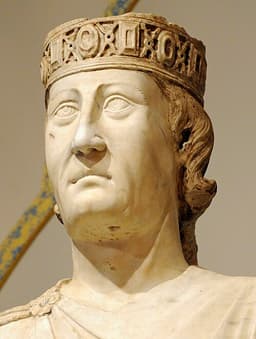
Charles of Anjou
Emperor · Medieval
59.5Total
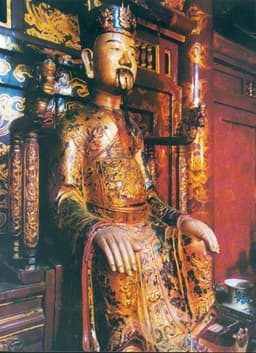
Dinh Tien Hoang
Emperor · Medieval
60.4Total
Basic Information
Born
1227
924
Died
1285
979
Era
Medieval
Medieval
Nationality
France
Vietnam
Occupation
Emperor
Emperor
Civilization
Western
Eastern
Score Comparison
Military (10%)
82.0
60.0
Political (20%)
48.5
72.0
Influence (20%)
56.7
65.0
Legacy (20%)
52.0
40.0
Leadership (15%)
68.0
77.2
Strategy (15%)
66.3
58.0
TOTAL
59.5
60.4
Charles of Anjou — Complete Timeline
1266 AD
Battle of BeneventoWar◆ Major
Charles of Anjou defeated Manfred of Hohenstaufen at Benevento. Manfred was killed in the battle, allowing Charles to take control of the Kingdom of Sicily. This victory established the Angevin dynasty in southern Italy.
Angevin ConquestHohenstaufenItaly
Impact: regional
1268 AD
Battle of TagliacozzoWar◆ Major
Charles of Anjou defeated Conradin, the last Hohenstaufen claimant, at Tagliacozzo. Conradin was captured and later executed in Naples. This victory secured Charles's control over Sicily and ended Hohenstaufen claims.
HohenstaufenExecutionItaly
Impact: regionaldestructive
1282 AD
Sicilian VespersWar
A rebellion broke out in Palermo against Angevin rule, leading to the massacre of French officials and soldiers. The revolt spread across Sicily, resulting in the loss of the island to Peter III of Aragon. This event ended Charles's control of Sicily.
RevoltAragonSicily
Impact: regionaldestructive
1284 AD
Crusade against AragonWar
Pope Martin IV declared a crusade against Peter III of Aragon, and Charles of Anjou led the campaign. The French invasion of Aragon failed, and Charles's fleet was defeated. This crusade drained Angevin resources and weakened his position.
CrusadeAragonFailure
Impact: regionaldestructive
Dinh Tien Hoang — Complete Timeline
968 AD
Defeat of the Twelve WarlordsWar
Dinh Bo Linh, later known as Dinh Tien Hoang, unified Vietnam by defeating the Twelve Warlords who had divided the country after the collapse of Chinese rule. He established the Dinh dynasty and became the first emperor of an independent Vietnam.
UnificationDinh DynastyVietnamese Independence
Impact: nationalconstructive
Establishment of the Dinh DynastyPolitical Action◆ Major
Dinh Tien Hoang founded the Dinh dynasty and declared himself Emperor. He moved the capital to Hoa Lu and implemented administrative reforms to consolidate power. This marked the beginning of a new era of Vietnamese independence after centuries of Chinese domination.
Dynasty FoundingCapital MoveAdministrative Reform
Impact: nationalconstructive
979 AD
Assassination of Dinh Tien HoangPolitical Action◆ Major
Dinh Tien Hoang and his crown prince were assassinated by a court official while sleeping. The murder plunged the Dinh dynasty into chaos, leading to a succession crisis and eventual takeover by Le Hoan. The assassination ended the short-lived Dinh dynasty.
AssassinationSuccession CrisisEnd of Dinh Dynasty
Impact: nationaltragic
Expert Analysis
Dinh Tien Hoang vs Charles of Anjou
### The Emperor and the Unifier: Two Paths from Chaos
In the spring of 1266, Charles of Anjou watched his rival Manfred fall on the battlefield of Benevento, the Hohenstaufen body broken and bleeding into the Italian dust. It was a moment of absolute triumph, the culmination of a papal-backed crusade that seemed to promise a new Mediterranean empire. Just over three centuries earlier, on the other side of the world, a different kind of victory was taking shape. In 968, a Vietnamese warlord named Dinh Bo Linh finished what years of war had begun: he crushed the last of the Twelve Warlords who had torn his land apart, and declared himself Emperor Dinh Tien Hoang. Both men rose from chaos. Both built kingdoms. But one built an empire that collapsed within a generation, while the other built a nation that endures. The difference lay not in their ambition, but in what they understood about power itself.
### Origins
Charles of Anjou was born into the French royal family in 1227, the youngest son of King Louis VIII. He was a prince of the blood, but a prince without a crown. In medieval Europe, this was a dangerous position: too noble to be ignored, too landless to be content. His older brother, the saintly Louis IX, ruled France, while Charles received the county of Anjou as a consolation. He grew up in a world of crusading zeal, papal politics, and the constant jostling of feudal lords. His era was defined by the long struggle between the papacy and the Holy Roman Empire, and Charles learned early that the Church’s blessing could be a weapon.
Dinh Tien Hoang was born in 924, in a Vietnam that had been under Chinese domination for centuries. His father was a local governor, but the family’s status meant little in a land where warlords fought for scraps of territory. Vietnam was not a kingdom but a battleground. The Tang dynasty had fallen, and the Chinese had withdrawn, leaving a vacuum filled by armed clans. Dinh grew up in a world without order, where a man’s worth was measured by his sword arm and his cunning. Unlike Charles, he had no royal lineage to fall back on. He had only his own will.
### Rise to Power
Charles’s path to power was paved by the pope. In 1263, Pope Urban IV offered him the Kingdom of Sicily, then held by the Hohenstaufen dynasty, which the papacy viewed as a mortal enemy. Charles accepted, and with French gold and papal blessings, he marched into Italy. The Battle of Benevento was a gamble, but it paid off. Manfred died, and Charles took the crown. Two years later, at Tagliacozzo in 1268, he crushed the last Hohenstaufen claimant, the sixteen-year-old Conradin, and had him publicly executed in Naples. Charles had won his kingdom through war, but he had won it as a foreign invader, backed by a foreign pope.
Dinh’s rise was far more organic. He began as a local strongman, gathering followers through personal charisma and military skill. The Twelve Warlords had divided Vietnam into petty fiefdoms, each ruling through fear and brute force. Dinh did not arrive as a crusader; he was a native son who understood the land and its people. He fought not for a foreign master but for a vision of unity. By 968, he had defeated or absorbed all his rivals. He did not execute them all; he co-opted some, married into others, and built a coalition of former enemies. Where Charles imposed his rule from above, Dinh wove his rule from within.
### Leadership & Governance
Charles of Anjou was a brilliant administrator and a ruthless ruler. He centralized the Sicilian bureaucracy, reformed the tax system, and built a powerful navy. His scores in leadership (85.1) and political skill (69.3) reflect a man who could organize a kingdom. But he ruled as a conqueror. He filled his court with French nobles, taxed the Sicilian population heavily to fund his wars, and showed little regard for local customs. He was efficient, but he was alien. The Sicilians saw him not as a king but as an occupier.
Dinh Tien Hoang governed with a different philosophy. His political score (90.2) is among the highest of his era, and it shows in his actions. He moved the capital to Hoa Lu, a defensible fortress in the mountains, and established a centralized administration that respected local traditions. He took the title “Emperor,” a bold claim that asserted Vietnam’s equality with China, but he did not try to remake his people in a foreign image. He built a state that was Vietnamese, for Vietnamese. He also created a system of land distribution and military conscription that tied the peasantry to the state in a way that fostered loyalty, not resentment.
### Triumph & Tragedy
Charles’s greatest moment was the double victory at Benevento and Tagliacozzo. He had destroyed the Hohenstaufen and seemed poised to dominate the Mediterranean. He dreamed of a crusade to Constantinople, of an Angevin empire stretching from Sicily to Jerusalem. But his tragedy came in 1282, with the Sicilian Vespers. A rebellion erupted in Palermo, sparked by local grievances and fanned by the Aragonese king Peter III. The French were massacred, and Charles’s fleet was destroyed. He spent his last years trying to reclaim Sicily, but he never succeeded. He died in 1285, a king without a kingdom, his dream shattered.
Dinh’s triumph was the unification of Vietnam. He had done what no one had done for centuries: he had brought the land under one rule. But his tragedy was equally personal. In 979, he and his crown prince were assassinated in their sleep by a court official. The murder was a petty act of revenge, and it plunged the Dinh dynasty into chaos. Within a year, the dynasty collapsed. Dinh’s dream of a stable, lasting dynasty died with him.
### Character & Destiny
Charles was a man of iron will and unbending ambition. He trusted in force and believed that power flowed from the sword. He was also a man of his time: a crusader, a papal ally, a feudal lord who saw the world in terms of conquest and hierarchy. His personality drove him to overreach. He could not stop, could not compromise, could not see that his subjects hated him. His destiny was to build a great thing and watch it crumble because he never learned to rule hearts.
Dinh was a pragmatist. He was ruthless when necessary—he had no qualms about executing rivals—but he understood that a kingdom built on fear alone would not last. He knew that legitimacy came from the people, not from a foreign pope. His personality was shaped by the chaos of his youth; he knew that order was fragile and that power had to be rooted in trust. His destiny was to create a nation, even if his own life ended in betrayal.
### Legacy
Charles of Anjou is remembered as a footnote in European history. His dynasty survived in Naples for a time, but his grand ambitions died with him. His legacy is a cautionary tale: the conqueror who could not hold what he took. His scores in legacy (65.7) and influence (76.2) show a man who mattered in his own time but faded quickly.
Dinh Tien Hoang is remembered as the father of an independent Vietnam. His legacy (70.8) and influence (70.7) may seem modest, but they are profound in context. He is the first emperor of a nation that still exists, the founder of a tradition of Vietnamese sovereignty that has never been extinguished. He is honored in temples and history books, not as a conqueror but as a unifier.
### Conclusion
Two men, two worlds, two very different answers to the same question: how do you build something that lasts? Charles of Anjou believed that power came from the pope, the sword, and the tax collector. He was wrong. Dinh Tien Hoang believed that power came from the land, the people, and the hard work of building a common identity. He was right. The Sicilian Vespers was not just a rebellion; it was a judgment. And the Dinh dynasty’s fall, for all its tragedy, did not undo the nation he had created. Vietnam endured. Sicily did not. In the end, the emperor who ruled from a mountain fortress in Hoa Lu understood something that the prince of Anjou never did: that a kingdom is not a possession to be seized, but a people to be united.
Rankings
🥇
Dinh Tien HoangLeader
Mil: 60.0Pol: 72.0Inf: 65.0
60.4
🥈
Charles of Anjou
Mil: 82.0Pol: 48.5Inf: 56.7
59.5
+0.9 behind
How This Comparison Works
Algorithm
Each figure is scored on 6 dimensions (0—100 scale) based on structured historical data: Military (10%), Political (20%), Influence (20%), Legacy (20%), Leadership (15%), Strategy (15%). The weighted total produces the final ranking.
Data Sources
Scores are computed from structured sub-indicators in the database. Scale factors adjust for era (Ancient ×0.85, Modern ×1.0) and civilization size (Eastern ×1.05, Other ×0.80) to account for differences in population and military scale.
Maximum 3 Figures
Comparisons are limited to 2—3 figures to ensure readability and statistical meaningfulness.
Error Margins
±5 points per dimension — Sub-scores are derived from historical records with inherent uncertainty. Two figures within 5 points on a dimension should be considered roughly equivalent in that area.
Total Score Accuracy
±3 points overall — The weighted combination of 6 dimensions produces a total score with approximately ±3 points of uncertainty. Differences of less than 3 points are not statistically significant— the figures are effectively tied.
Known Limitations
- Historical records are incomplete and uneven across civilizations
- Figures from oral-tradition societies may be underrepresented
- Occupation labels can misclassify multi-role figures
- Scores measure capability and impact, not moral character
- Quantitative scoring is a comparison tool, not absolute truth
Capability Radar
Military (10%) — Battles & Warfare
Battles
75
70
Win Rate
70
75
Expansion
80
65
Political (20%) — Governance & Reform
Reform
60
70
Diplomacy
68
65
Economy
65
60
Influence (20%) — Cultural & Global Reach
Cultural
50
65
Global
45
55
Legacy (20%) — Historical Impact
Historical
60
75
Longevity
55
70
Leadership (15%) — Power & Stability
Tenure
70
60
Stability
55
55
Strategy (15%) — Tactics & Innovation
Strategy
78
70
Tactics
72
65
Reform
65
60
Similar Comparisons
Comments & Discussion
铁血勘乱6/16/2026
丁先皇才是真硬汉。他花了不到十年铲平十二使君,还顺手建了都城华闾。查理不过是教皇捧出来的外国傀儡,到头来西西里晚祷就把他打回原形。丁先皇的遗产是越南独立的长城,查理呢?不过是被历史淘汰的野心家。
RealistRuler6/16/2026
The analysis misses a crucial point: legitimacy. Dinh Tien Hoang earned his crown by blood and local support, forging a dynasty that resonated with Vietnamese identity. Charles was imposed by the Pope, a foreign agent in Italian politics. His empire cracked under the weight of resentment—literally, the Sicilian Vespers uprising. That’s the difference between a unifier and an occupier.
数据猎人6/16/2026
历史爱好者老吹丁先皇,但数据呢?查理统治西西里时建立了庞大行政体系,税收效率远超同时代。丁先皇的华闾都城不过是个军事堡垒,没留下系统化的治国记录。查理败在局势,丁胜在对手太菜。承认吧,十二使君跟霍亨施陶芬家族比就是小儿科。
Historian6736/16/2026
Charles of Anjou is overrated. His victory at Benevento was pure luck—Manfred’s German mercenaries got caught in marshy ground. Meanwhile, Dinh Tien Hoang actually unified a fractured Vietnam by force of will and strategy. Charles couldn’t hold his gains a decade later. One man built a nation that still exists; the other built a footnote in a medieval chronicle.
Historian9406/16/2026
Both were warlords, but Charles had vision. He didn’t just take Sicily—he aimed for the whole Mediterranean, backed by crusader ideology. Dinh Tien Hoang played it safe, consolidating within modern Vietnam’s borders. Charles failed because his ambition exceeded his resources; Dinh succeeded because his vision was smaller. Which one is more admirable depends on whether you crave glory or stability.