Loading...
Charles IV of Spain vs Frederick Francis IV
Charles IV of Spain leads by 1.8 pts · 2 figures compared
…

Charles IV of Spain
Emperor · Modern
42.5Total
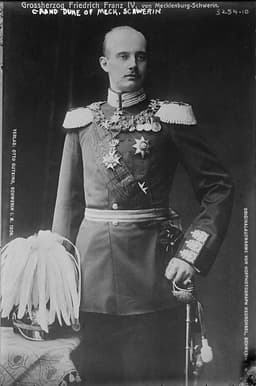
Frederick Francis IV
Emperor · Modern
40.7Total
Basic Information
Born
1748
1882
Died
1819
1945
Era
Modern
Modern
Nationality
Spain
Mecklenburg
Occupation
Emperor
Emperor
Civilization
Western
Western
Score Comparison
Military (10%)
20.0
21.1
Political (20%)
29.3
30.8
Influence (20%)
48.6
45.5
Legacy (20%)
37.5
33.3
Leadership (15%)
67.0
55.3
Strategy (15%)
45.0
60.0
TOTAL
42.5
40.7
Charles IV of Spain — Complete Timeline
1788 AD
Accession to the thronePolitical Action◆ Major
Charles IV became King of Spain upon the death of his father Charles III. His reign was marked by reliance on his wife Maria Luisa and her favorite Manuel Godoy, leading to ineffective governance and growing discontent.
SuccessionMonarchy
Impact: national
1807 AD
Treaty of FontainebleauPolitical Action◆ Major
Charles IV signed the Treaty of Fontainebleau with Napoleon, allowing French troops to cross Spain to invade Portugal. This agreement led to the French occupation of Spain and triggered the Peninsular War.
Napoleonic WarsTreatyOccupation
Impact: regionaldestructive
1808 AD
Abdication at BayonnePolitical Action
Under pressure from Napoleon, Charles IV abdicated the Spanish throne in favor of his son Ferdinand VII at Bayonne, France. This abdication was part of Napoleon's plan to install his brother Joseph as king of Spain.
AbdicationNapoleonic WarsSuccession
Impact: nationaltragic
Exile in FrancePolitical Action
After abdication, Charles IV lived in exile in France under Napoleon's supervision. He remained there until his death in 1819, never returning to Spain, while the Peninsular War raged.
ExileNapoleonic Wars
Impact: nationaltragic
Frederick Francis IV — Complete Timeline
1897 AD
Accession as Grand Duke of Mecklenburg-SchwerinPolitical Action◆ Major
Frederick Francis IV became Grand Duke of Mecklenburg-Schwerin on 10 April 1897, succeeding his father Frederick Francis III. He ruled as a minor until 1901 under a regency.
Mecklenburg-SchwerinSuccession
Impact: national
1918 AD
World War I abdicationPolitical Action
On 14 November 1918, during the German Revolution, Frederick Francis IV abdicated the throne of Mecklenburg-Schwerin. He was the last grand duke, and his abdication ended the House of Mecklenburg-Schwerin's rule.
German RevolutionEnd of monarchyMecklenburg
Impact: nationaltragic
1945 AD
Death in exileOther
Frederick Francis IV died on 17 November 1945 at Flensburg, Germany, shortly after the end of World War II. He had lived in retirement since his abdication.
DeathExile
Expert Analysis
Origins
Charles IV of Spain (1748–1819) was born into the Spanish Bourbon dynasty, the second son of Charles III. He received a limited education, focusing on hunting and religious devotion rather than statecraft. His father's death in 1788 unexpectedly placed him on the throne at age 40, ill-prepared for the challenges of the French Revolution era.
Frederick Francis IV (1882–1945) was born in Palermo as the son of Frederick Francis III, Grand Duke of Mecklenburg-Schwerin. He was raised in a minor German princely state, educated in law and military affairs, and inherited the throne at age 15 in 1897, ruling under a regency until 1901.
Rise to Power
Charles IV ascended to the Spanish throne on 14 December 1788, succeeding his father. His rise was unremarkable—simply dynastic succession. He relied heavily on his wife, Maria Luisa of Parma, and her favorite, Manuel Godoy, who became prime minister and effectively ruled Spain from 1792 onward. Their influence grew as Charles avoided political decision-making.
Frederick Francis IV became Grand Duke on 10 April 1897, at age 15, following his father's death. A regency council governed until his 21st birthday in 1903. He then assumed personal rule but remained a constitutional monarch within the German Empire, with limited authority as the federal structure empowered the Kaiser and chancellor.
Leadership & Governance
Charles IV's governance was characterized by delegation to Godoy, who pursued policies alternating between alliance with Revolutionary France and resistance. Spain declared war on France in 1793 (War of the Pyrenees) but was defeated, leading to the Treaty of Basel (1795) and a subsequent alliance. Godoy's mismanagement and corruption eroded royal authority. The economy declined, and the navy was shattered at Trafalgar (1805). Charles scored 67.0 in leadership, but his political score of 29.3 reflects his passive style.
Frederick Francis IV ruled as a constitutional monarch with limited powers. His government was stable but unremarkable. He supported modernization, including railway expansion and education reforms, but his state was overshadowed by Prussia. His leadership score of 55.3 indicates competent but uninspired rule. He scored 60.0 in strategy, higher than Charles's 45.0, suggesting better decision-making within his constraints.
Triumph & Tragedy
Charles IV's greatest triumph was surviving the initial chaos of the French Revolution and maintaining his throne for 19 years. However, his greatest failure was the Treaty of Fontainebleau (1807), which allowed French troops into Spain. This led to the Peninsular War and his forced abdication at Bayonne in 1808. He spent his final years in exile in France, dying in 1819.
Frederick Francis IV's triumph was maintaining neutrality for Mecklenburg-Schwerin during World War I until 1918, avoiding destruction. But his tragedy was the abdication on 14 November 1918 during the German Revolution, ending the dynasty. He lived in retirement until his death in 1945, just after WWII.
Character & Destiny
Charles IV was indecisive and dominated by his wife and Godoy. His character—pious, weak-willed, and averse to conflict—led him to cede power, resulting in national disaster. Historians view him as a well-meaning but incompetent ruler who failed to adapt to revolutionary times.
Frederick Francis IV was more pragmatic, accepting his limited role. He abdicated without resistance, recognizing the futility of opposition. His destiny was to be a footnote in the collapse of German monarchies. He scored 55.3 in leadership vs. Charles's 67.0, but his political score (30.8) was slightly higher, indicating better situational awareness.
Legacy
Charles IV's legacy is negative: his reign weakened Spain, leading to the loss of its American colonies (though independence movements accelerated after his abdication). He is remembered as a symbol of Bourbon ineptitude. His total score of 42.5 reflects this.
Frederick Francis IV's legacy is minor: he was the last grand duke, and his abdication marked the end of feudal rule in Mecklenburg. The state became part of the Weimar Republic. His total score of 40.7 is slightly lower, but his impact was less consequential.
Conclusion
Charles IV had greater impact on history, despite his lower competence, because his reign directly enabled Napoleon's invasion of Spain, triggering the Peninsular War that drained French resources and contributed to Napoleon's downfall. Frederick Francis IV's abdication was a local event in a larger revolution. Charles's total score of 42.5 vs. 40.7 reflects this larger influence. However, neither ruler was effective; their combined average of 41.6 underscores their mediocrity.
Rankings
🥇
Charles IV of SpainLeader
Mil: 20.0Pol: 29.3Inf: 48.6
42.5
🥈
Frederick Francis IV
Mil: 21.1Pol: 30.8Inf: 45.5
40.7
+1.8 behind
How This Comparison Works
Algorithm
Each figure is scored on 6 dimensions (0—100 scale) based on structured historical data: Military (10%), Political (20%), Influence (20%), Legacy (20%), Leadership (15%), Strategy (15%). The weighted total produces the final ranking.
Data Sources
Scores are computed from structured sub-indicators in the database. Scale factors adjust for era (Ancient ×0.85, Modern ×1.0) and civilization size (Eastern ×1.05, Other ×0.80) to account for differences in population and military scale.
Maximum 3 Figures
Comparisons are limited to 2—3 figures to ensure readability and statistical meaningfulness.
Error Margins
±5 points per dimension — Sub-scores are derived from historical records with inherent uncertainty. Two figures within 5 points on a dimension should be considered roughly equivalent in that area.
Total Score Accuracy
±3 points overall — The weighted combination of 6 dimensions produces a total score with approximately ±3 points of uncertainty. Differences of less than 3 points are not statistically significant— the figures are effectively tied.
Known Limitations
- Historical records are incomplete and uneven across civilizations
- Figures from oral-tradition societies may be underrepresented
- Occupation labels can misclassify multi-role figures
- Scores measure capability and impact, not moral character
- Quantitative scoring is a comparison tool, not absolute truth
Capability Radar
Military (10%) — Battles & Warfare
Battles
5
35
Win Rate
5
41
Expansion
5
41
Political (20%) — Governance & Reform
Reform
15
10
Diplomacy
10
20
Economy
15
15
Influence (20%) — Cultural & Global Reach
Cultural
10
5
Global
10
5
Legacy (20%) — Historical Impact
Historical
15
5
Longevity
10
5
Leadership (15%) — Power & Stability
Tenure
60
30
Stability
10
20
Strategy (15%) — Tactics & Innovation
Strategy
5
43
Tactics
5
47
Reform
5
53
Similar Comparisons
Comments & Discussion
No comments yet. Be the first to share your thoughts!