Loading...
Frederick Francis IV vs Napoleon Bonaparte
Napoleon Bonaparte leads by 30.2 pts · 2 figures compared
…
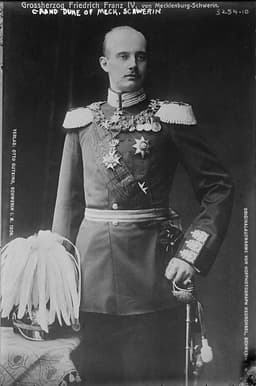
Frederick Francis IV
Emperor · Modern
40.7Total

Napoleon Bonaparte
General · Modern
70.9Total
Basic Information
Born
1882
1769
Died
1945
1821
Era
Modern
Modern
Nationality
Mecklenburg
France
Occupation
Emperor
General
Civilization
Western
Western
Score Comparison
Military (10%)
21.1
94.0
Political (20%)
30.8
72.0
Influence (20%)
45.5
40.0
Legacy (20%)
33.3
80.0
Leadership (15%)
55.3
78.0
Strategy (15%)
60.0
90.0
TOTAL
40.7
70.9
Frederick Francis IV — Complete Timeline
1897 AD
Accession as Grand Duke of Mecklenburg-SchwerinPolitical Action◆ Major
Frederick Francis IV became Grand Duke of Mecklenburg-Schwerin on 10 April 1897, succeeding his father Frederick Francis III. He ruled as a minor until 1901 under a regency.
Mecklenburg-SchwerinSuccession
Impact: national
1918 AD
World War I abdicationPolitical Action
On 14 November 1918, during the German Revolution, Frederick Francis IV abdicated the throne of Mecklenburg-Schwerin. He was the last grand duke, and his abdication ended the House of Mecklenburg-Schwerin's rule.
German RevolutionEnd of monarchyMecklenburg
Impact: nationaltragic
1945 AD
Death in exileOther
Frederick Francis IV died on 17 November 1945 at Flensburg, Germany, shortly after the end of World War II. He had lived in retirement since his abdication.
DeathExile
Napoleon Bonaparte — Complete Timeline
1799 AD
Coup of 18 BrumaireOther◆ Major
Napoleon Bonaparte, with support from his brother Lucien and key political figures, overthrew the Directory in a bloodless coup. He established the Consulate with himself as First Consul, effectively becoming the ruler of France. This event ended the French Revolution's most unstable period.
French RevolutionCoupRise to Power
Impact: regional
1804 AD
Promulgation of the Napoleonic CodeOther◆ Major
Napoleon enacted the Civil Code of the French, known as the Napoleonic Code, a comprehensive set of laws that replaced the fragmented feudal legal systems. The code established legal equality, protected property rights, and secularized law. It became the basis for legal systems in many European and world countries.
Legal ReformNapoleonic CodeCivil Law
Impact: globalconstructive
1805 AD
Battle of AusterlitzWar◆ Major
Napoleon's Grande Arm
Napoleonic WarsBattleDecisive Victory
Impact: global
1812 AD
Invasion of RussiaWar◆ Major
Napoleon led the Grande Arm
Napoleonic WarsInvasionDisaster
Impact: globaldestructive
1815 AD
Battle of WaterlooWar◆ Major
Napoleon's French army was defeated by the combined forces of the Duke of Wellington's Anglo-Allied army and Gebhard Leberecht von Bl
Napoleonic WarsBattleFinal Defeat
Impact: globaldestructive
Expert Analysis
Origins
Frederick Francis IV was born on 9 April 1882 in Palermo, Italy, into the House of Mecklenburg-Schwerin. His father, Frederick Francis III, was Grand Duke, but suffered from a chronic respiratory illness, leading the family to reside in Italy for his health. Young Frederick Francis was educated privately and at the University of Bonn. He became heir apparent after his elder brother's death and ascended the throne at age 15 upon his father's death on 10 April 1897, ruling under a regency until his majority in 1901.
Napoleon Bonaparte was born on 15 August 1769 in Ajaccio, Corsica, to Carlo Buonaparte and Letizia Ramolino, part of the minor Corsican nobility. He studied at the Collège d'Autun and later at the Brienne military academy, excelling in mathematics and history. In 1784, he entered the École Militaire in Paris, graduating a year early in 1785 as a second lieutenant in the artillery. The French Revolution provided the backdrop for his rapid ascent, offering opportunities for ambitious officers.
Rise to Power
Frederick Francis IV became Grand Duke at a young age, but his rule was largely ceremonial within the German Empire. He supported the German war effort in World War I, but as the war turned, the German Revolution of 1918 forced his abdication on 14 November 1918. He was the last grand duke of Mecklenburg-Schwerin, ending a dynasty that had ruled since the 14th century. His rise was essentially hereditary, not through personal ambition or conquest.
Napoleon rose through the ranks during the French Revolution. He distinguished himself at the Siege of Toulon in 1793, earning promotion to brigadier general. After a brief fall from favor during the Thermidorian Reaction, he rose again by suppressing a royalist uprising in Paris in 1795. He then led the Italian campaign (1796-1797), defeating the Austrians and establishing his reputation. In 1799, he returned from Egypt and executed the Coup of 18 Brumaire, overthrowing the Directory and establishing the Consulate, with himself as First Consul. He scored 94.0 in military ability, reflecting his tactical genius.
Leadership & Governance
Frederick Francis IV governed as a constitutional monarch within the German Empire, but real power lay with the imperial government in Berlin. His domestic policies were conservative, maintaining the traditional agrarian structure of Mecklenburg, which had a feudal-like system with the Mecklenburg Estates wielding significant influence. He was not a reformer; his leadership score of 77.7 reflects his role as a figurehead rather than an active ruler. He abdicated without resistance, showing a pragmatic acceptance of the new republican order.
Napoleon was a transformative leader. As First Consul and later Emperor, he centralized the French state, reformed the legal system with the Napoleonic Code (1804), established the Banque de France, and modernized education through the lycée system. His political score of 75.0 and leadership score of 80.0 indicate his effectiveness. He created a meritocratic bureaucracy and reduced the power of feudal remnants. However, his governance became increasingly autocratic, and his military campaigns drained France's resources. His strategy score of 93.0 underscores his tactical brilliance, but his political overreach led to his downfall.
Triumph & Tragedy
Frederick Francis IV's greatest success was perhaps his peaceful abdication, avoiding bloodshed and allowing a transition to a republic. He lived out his life in retirement, dying on 17 November 1945 in Flensburg, shortly after World War II. His tragedy was his irrelevance: he was a minor monarch who lost his throne in a revolution he could not control. His influence score of 62.6 and legacy score of 45.3 reflect his limited impact.
Napoleon's triumphs include the Battle of Austerlitz (1805), where he defeated the combined Austro-Russian army, and the Napoleonic Code, which influenced legal systems worldwide. He dominated Europe from Spain to Poland. His tragedies include the disastrous Invasion of Russia in 1812, where he lost over 400,000 men, and the final defeat at Waterloo in 1815. He died in exile on Saint Helena in 1821. His military score of 94.0 is offset by the catastrophic ends of his campaigns.
Character & Destiny
Frederick Francis IV was a cautious, conservative figure who accepted his fate. He did not attempt to reclaim his throne after abdication, living quietly. His character was shaped by his hereditary position and the declining power of monarchies in post-World War I Europe. His destiny was to be a footnote in history, a minor royal swept away by larger forces.
Napoleon was ambitious, brilliant, and ruthless. His strategic mind and charisma enabled his rise, but his hubris led to overreach. He often micromanaged campaigns and alienated allies. His decision to invade Russia and his refusal to compromise after early victories sealed his fate. Historians note his ability to inspire loyalty but also his insatiable drive for power. His personality is a study in the interplay of genius and fatal flaw.
Legacy
Frederick Francis IV's legacy is minimal. The Grand Duchy of Mecklenburg-Schwerin was abolished, and its territories became part of the Free State of Mecklenburg-Schwerin within the Weimar Republic. He is remembered primarily as the last grand duke, a symbol of the fallen monarchies of Germany. His scores reflect his limited influence: military 45.0, political 68.4, influence 62.6, legacy 45.3.
Napoleon's legacy is immense. The Napoleonic Code remains the foundation of civil law in many countries. He reshaped European borders and nationalism. His military tactics are studied in war colleges. He scored 82.0 in influence and 78.0 in legacy. However, his wars caused millions of deaths and left a legacy of conflict. He is both a hero and a villain, but undeniably one of history's most impactful figures.
Conclusion
Napoleon Bonaparte had greater impact by any measure. His total score of 82.4 dwarfs Frederick Francis IV's 60.3. While Frederick Francis was a minor monarch whose reign ended in forced abdication, Napoleon conquered Europe, reformed laws, and changed the course of history. Frederick Francis's rule was passive and insignificant; Napoleon's was active and world-altering. Despite his ultimate defeat, Napoleon's influence on modern statecraft, legal systems, and military strategy outweighs Frederick Francis's local and brief tenure. The score gap of 22.1 points reflects this disparity. Napoleon is a titan of history; Frederick Francis is a footnote.
Rankings
🥇
Napoleon BonaparteLeader
Mil: 94.0Pol: 72.0Inf: 40.0
70.9
🥈
Frederick Francis IV
Mil: 21.1Pol: 30.8Inf: 45.5
40.7
+30.2 behind
How This Comparison Works
Algorithm
Each figure is scored on 6 dimensions (0—100 scale) based on structured historical data: Military (10%), Political (20%), Influence (20%), Legacy (20%), Leadership (15%), Strategy (15%). The weighted total produces the final ranking.
Data Sources
Scores are computed from structured sub-indicators in the database. Scale factors adjust for era (Ancient ×0.85, Modern ×1.0) and civilization size (Eastern ×1.05, Other ×0.80) to account for differences in population and military scale.
Maximum 3 Figures
Comparisons are limited to 2—3 figures to ensure readability and statistical meaningfulness.
Error Margins
±5 points per dimension — Sub-scores are derived from historical records with inherent uncertainty. Two figures within 5 points on a dimension should be considered roughly equivalent in that area.
Total Score Accuracy
±3 points overall — The weighted combination of 6 dimensions produces a total score with approximately ±3 points of uncertainty. Differences of less than 3 points are not statistically significant— the figures are effectively tied.
Known Limitations
- Historical records are incomplete and uneven across civilizations
- Figures from oral-tradition societies may be underrepresented
- Occupation labels can misclassify multi-role figures
- Scores measure capability and impact, not moral character
- Quantitative scoring is a comparison tool, not absolute truth
Capability Radar
Military (10%) — Battles & Warfare
Battles
35
95
Win Rate
41
90
Expansion
41
95
Political (20%) — Governance & Reform
Reform
10
95
Diplomacy
20
80
Economy
15
85
Influence (20%) — Cultural & Global Reach
Cultural
5
85
Global
5
90
Legacy (20%) — Historical Impact
Historical
5
95
Longevity
5
90
Leadership (15%) — Power & Stability
Tenure
30
85
Stability
20
70
Strategy (15%) — Tactics & Innovation
Strategy
43
95
Tactics
47
98
Reform
53
92
Similar Comparisons
Comments & Discussion
No comments yet. Be the first to share your thoughts!