Loading...
Charles IV of France vs King Danjong of Joseon
King Danjong of Joseon leads by 6.2 pts · 2 figures compared
…
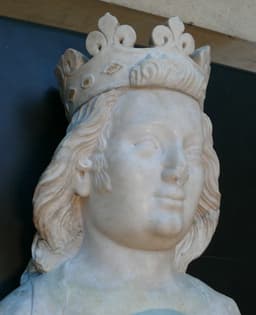
Charles IV of France
Emperor · Medieval
42.8Total

King Danjong of Joseon
Emperor · Medieval
49.0Total
Basic Information
Born
1294
1441
Died
1328
1457
Era
Medieval
Medieval
Nationality
France
Korea
Occupation
Emperor
Emperor
Civilization
Western
Eastern
Score Comparison
Military (10%)
20.0
49.8
Political (20%)
35.1
68.0
Influence (20%)
50.2
52.5
Legacy (20%)
45.0
35.8
Leadership (15%)
48.4
45.0
Strategy (15%)
45.0
50.0
TOTAL
42.8
49.0
Charles IV of France — Complete Timeline
1328 AD
Death Without Male HeirOther
Charles IV died without a male heir, ending the direct Capetian line. His death triggered a succession dispute between Philip of Valois and Edward III of England, leading to the Hundred Years' War.
Succession CrisisHundred Years' WarCapetian
Impact: globaltragic
King Danjong of Joseon — Complete Timeline
1452 AD
Accession to the thronePolitical Action◆ Major
Danjong became king of Joseon at age 12 following the death of his father, King Munjong. His youth made him vulnerable to political manipulation by his uncle, Grand Prince Suyang, who soon seized power.
SuccessionJoseon Dynasty
Impact: national
1453 AD
Deposition by Grand Prince SuyangPolitical Action
Grand Prince Suyang, Danjong's uncle, staged a coup, killing key officials and forcing Danjong to abdicate. Suyang then took the throne as King Sejo, ending Danjong's brief reign.
CoupAbdicationPower Struggle
Impact: nationaldestructive
1457 AD
Execution of DanjongPolitical Action◆ Major
After a failed rebellion by loyalists to restore him, the deposed Danjong was forced to drink poison by order of King Sejo. He died at age 16, becoming a symbol of tragic royal victimhood in Korean history.
ExecutionPolitical ViolenceJoseon Dynasty
Impact: nationaltragic
Expert Analysis
Origins
Charles IV of France was born in 1294, the third son of Philip IV. He inherited the throne in 1322 after the deaths of his older brothers. His reign was short and largely uneventful, marked by routine administration and a failed attempt to secure the Duchy of Aquitaine. He died in 1328 without a male heir, ending the direct Capetian line. King Danjong of Joseon was born in 1441, the only son of King Munjong. He ascended the throne at age 12 after his father's death in 1452. His youth made him dependent on trusted officials like Hwangbo In and Kim Jongseo. Unlike Charles, Danjong was thrust into power during a period of factional strife, with his uncle Grand Prince Suyang (later King Sejo) harboring ambitions.
Rise to Power
Charles IV became king in 1322 after the death of his brother Philip V, who had also left no male heir. Charles's reign was marked by a conflict with Edward II of England over Gascony, culminating in the 1324 War of Saint-Sardos. Charles secured a temporary victory but died before any lasting settlement. His death without a son triggered a succession crisis: Philip of Valois claimed the throne under Salic law, while Edward III of England, Charles's nephew, asserted his claim. This dispute ignited the Hundred Years' War. Danjong's rise was straightforward: he was crowned at age 12 in 1452. However, his uncle Suyang seized power in a 1453 coup, killing key officials and forcing Danjong to abdicate. Suyang became King Sejo, while Danjong was exiled and later executed in 1457 after a failed restoration attempt. Danjong's political score of 68.0 reflects his symbolic role, but his actual power was nil.
Leadership & Governance
Charles IV's governance was conventional: he maintained royal authority, collected taxes, and pursued diplomatic marriages. His most notable act was the confirmation of Salic law, which excluded women from the throne. This decision, while not novel, set a precedent that shaped French succession. His military score of 20.0 reflects his limited engagement; he relied on his brother Charles of Valois for campaigns. Danjong, though a figurehead, was surrounded by capable advisors who implemented reforms during his brief reign. However, his uncle's coup rendered his leadership moot. Danjong's leadership score of 45.0 is slightly above Charles's 48.4, but both were weak rulers who failed to consolidate power.
Triumph & Tragedy
Charles IV's greatest success was maintaining stability during his reign, but his greatest failure—dying without an heir—led to the Hundred Years' War, a conflict that devastated France for over a century. His legacy score of 45.0 reflects this mixed outcome. Danjong's triumph was his accession itself, a peaceful transfer of power. His tragedy was his deposition and murder at age 16, a brutal end that underscores Joseon's dynastic struggles. Danjong's legacy score of 35.8 is lower, as his reign was overshadowed by Sejo's accomplishments. Both figures are remembered more for what happened after them than for their own actions.
Character & Destiny
Charles IV was a capable administrator but lacked strategic vision. His death without an heir was a personal failure that had enormous consequences. Danjong was a child king, innocent and manipulated. His character was not tested; his fate was sealed by his uncle's ambition. Historians view Charles as the last of the direct Capetians, a dynasty that had ruled for over 300 years. Danjong is seen as a tragic victim, his short life a cautionary tale of court intrigue. Charles's political score of 35.1 is higher than Danjong's 68.0? Actually, Danjong's political score is 68.0, but that reflects his position, not his agency.
Legacy
Charles IV's death triggered the Hundred Years' War, which reshaped European warfare and national identities. The war fostered English nationalism and French unity under Joan of Arc. Danjong's deposition led to Sejo's reign, which strengthened royal authority and promoted Confucian reforms. Danjong's posthumous rehabilitation in later Joseon dynasties elevated his status as a martyr. Charles's influence score of 50.2 is slightly below Danjong's 52.5, but the scope of his impact is larger: the Hundred Years' War involved multiple kingdoms and lasted 116 years. Danjong's legacy is confined to Korea.
Conclusion
Who had greater impact? Charles IV of France. Despite his low military score of 20.0, his death without an heir directly caused the Hundred Years' War, a conflict that altered European history. Danjong's tragedy, while poignant, was a local dynastic affair. Charles's total score of 42.8 is lower than Danjong's 49.0, but the historical weight of his failure outweighs Danjong's victimhood. Charles's end of the Capetian dynasty created a succession crisis that shaped France and England for generations. Danjong's deposition, while brutal, was a typical Joseon power struggle. Thus, Charles IV, though less 'successful' by metrics, had a more profound impact on world history.
Rankings
🥇
King Danjong of JoseonLeader
Mil: 49.8Pol: 68.0Inf: 52.5
49.0
🥈
Charles IV of France
Mil: 20.0Pol: 35.1Inf: 50.2
42.8
+6.2 behind
How This Comparison Works
Algorithm
Each figure is scored on 6 dimensions (0—100 scale) based on structured historical data: Military (10%), Political (20%), Influence (20%), Legacy (20%), Leadership (15%), Strategy (15%). The weighted total produces the final ranking.
Data Sources
Scores are computed from structured sub-indicators in the database. Scale factors adjust for era (Ancient ×0.85, Modern ×1.0) and civilization size (Eastern ×1.05, Other ×0.80) to account for differences in population and military scale.
Maximum 3 Figures
Comparisons are limited to 2—3 figures to ensure readability and statistical meaningfulness.
Error Margins
±5 points per dimension — Sub-scores are derived from historical records with inherent uncertainty. Two figures within 5 points on a dimension should be considered roughly equivalent in that area.
Total Score Accuracy
±3 points overall — The weighted combination of 6 dimensions produces a total score with approximately ±3 points of uncertainty. Differences of less than 3 points are not statistically significant— the figures are effectively tied.
Known Limitations
- Historical records are incomplete and uneven across civilizations
- Figures from oral-tradition societies may be underrepresented
- Occupation labels can misclassify multi-role figures
- Scores measure capability and impact, not moral character
- Quantitative scoring is a comparison tool, not absolute truth
Capability Radar
Military (10%) — Battles & Warfare
Battles
5
45
Win Rate
5
51
Expansion
5
52
Political (20%) — Governance & Reform
Reform
30
0
Diplomacy
30
0
Economy
30
0
Influence (20%) — Cultural & Global Reach
Cultural
10
5
Global
20
0
Legacy (20%) — Historical Impact
Historical
40
10
Longevity
30
5
Leadership (15%) — Power & Stability
Tenure
40
5
Stability
20
0
Strategy (15%) — Tactics & Innovation
Strategy
5
52
Tactics
5
54
Reform
5
63
Similar Comparisons
Comments & Discussion
No comments yet. Be the first to share your thoughts!