Loading...
Charles II of Spain vs Muhammad VIII al-Amin
Charles II of Spain leads by 4.9 pts · 2 figures compared
…
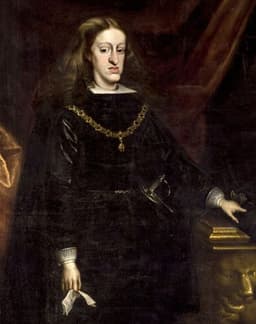
Charles II of Spain
Emperor · Modern
44.9Total
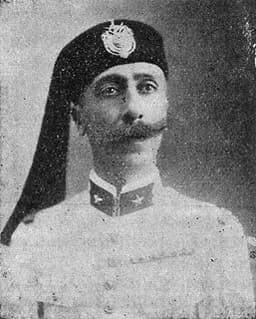
Muhammad VIII al-Amin
Emperor · Modern
40.0Total
Basic Information
Born
1661
1881
Died
1700
1962
Era
Modern
Modern
Nationality
Spain
Tunisia
Occupation
Emperor
Emperor
Civilization
Western
Middle Eastern
Score Comparison
Military (10%)
15.0
21.1
Political (20%)
26.4
26.4
Influence (20%)
53.3
51.8
Legacy (20%)
52.0
39.2
Leadership (15%)
48.4
34.6
Strategy (15%)
58.4
60.0
TOTAL
44.9
40.0
Charles II of Spain — Complete Timeline
1661 AD
Suffered from Severe Physical and Mental DisabilitiesOther◆ Major
Charles II was born with numerous health problems due to Habsburg inbreeding, including a deformed jaw, epilepsy, and intellectual disabilities. He was unable to walk until age eight and was considered unfit to rule, leading to a regency throughout his life.
InbreedingDisabilityHabsburg Dynasty
Impact: nationaltragic
1665 AD
Became King of SpainPolitical Action
Charles II inherited the Spanish throne at age four upon the death of his father Philip IV. His reign was marked by severe physical and mental disabilities due to generations of inbreeding, leading to a regency government.
SuccessionHabsburg DynastyRegency
Impact: global
1697 AD
Signed the Treaty of RyswickPolitical Action
Charles II's government signed the Treaty of Ryswick, ending the Nine Years' War with France. Spain ceded territories in the Caribbean and Europe to France, but the treaty temporarily stabilized relations before the succession crisis.
TreatyNine Years' WarDiplomacy
Impact: regional
1700 AD
Death Without Heir Triggered War of Spanish SuccessionPolitical Action
Charles II died without an heir, leaving his throne to Philip of Anjou (grandson of Louis XIV) in his will. This sparked the War of Spanish Succession (1701-1714) as European powers contested the Bourbon succession to the Spanish throne.
Succession CrisisWar of Spanish SuccessionBourbon Dynasty
Impact: global
Muhammad VIII al-Amin — Complete Timeline
1943 AD
Accession as Bey of TunisPolitical Action◆ Major
Muhammad VIII al-Amin became the Bey of Tunis in 1943, ruling under the French protectorate. His reign coincided with the rise of Tunisian nationalism and the Neo Destour party's demands for independence.
Tunisian monarchyFrench protectorate
Impact: national
1956 AD
Signing of the Tunisian Independence AccordsPolitical Action
As Bey, Muhammad VIII al-Amin formally signed the agreements that ended the French protectorate and granted Tunisia independence on March 20, 1956. This made him the last monarch of an independent Tunisia.
IndependenceDecolonization
Impact: nationalconstructive
1957 AD
Deposition and Abolition of the MonarchyPolitical Action
On July 25, 1957, the Tunisian Constituent Assembly voted to abolish the monarchy and declare a republic. Muhammad VIII al-Amin was deposed and placed under house arrest, ending the Husainid dynasty's rule.
Monarchy abolishedRepublic declared
Impact: nationaldestructive
Expert Analysis
Origins
Charles II of Spain was born on November 6, 1661, in Madrid, the son of Philip IV and Mariana of Austria. He was the product of generations of Habsburg intermarriage, resulting in severe inbreeding. His family tree showed uncle-niece marriages and first-cousin unions, leading to genetic disorders. Charles was physically weak, with a deformed jaw (the Habsburg jaw), epilepsy, and intellectual disabilities. He was unable to speak clearly until age four and walked late. His mother, Mariana, served as regent until he came of age, but her influence persisted throughout his life.
Muhammad VIII al-Amin was born on September 4, 1881, in Tunis, into the Husainid dynasty that had ruled Tunisia since 1705. He was educated at the Sadiki College and received traditional Islamic instruction. His family had long collaborated with the French protectorate, established in 1881. Muhammad served as a prince and held various ceremonial roles before becoming Bey in 1943. Unlike Charles, he was physically healthy and mentally competent, but his authority was severely limited under French control.
Rise to Power
Charles II became king at age four upon his father's death in 1665. His mother Mariana acted as regent, but her rule was contested by nobles and her half-brother John Joseph of Austria. The Spanish Empire was vast but declining, facing wars with France and revolts. Charles's physical and mental health prevented him from governing effectively; he was often described as 'bewitched' or 'incapable.' His reign saw power struggles among court factions, with the king as a passive figure.
Muhammad VIII al-Amin became Bey of Tunis on May 14, 1943, after the Allied liberation of North Africa. He was chosen by the French because of his perceived loyalty and lack of nationalist fervor. However, his reign coincided with the rise of the Neo Destour party led by Habib Bourguiba, who demanded independence. Muhammad tried to balance between French demands and growing nationalism, but he lacked real power. His position became increasingly ceremonial as Bourguiba's movement gained strength.
Leadership & Governance
Charles II's governance was characterized by paralysis. He had no direct role in decision-making; instead, his mother and later his wife, Marie Louise of Orléans, and the Count of Oropesa managed affairs. The Spanish treasury was bankrupt, and the army was weak. Charles signed the Treaty of Ryswick in 1697, ceding territories to France, but he did not understand its implications. His leadership score of 48.4 reflects his symbolic kingship rather than active rule. His only significant political act was his will, which bequeathed the throne to Philip of Anjou, a grandson of Louis XIV, triggering the War of Spanish Succession.
Muhammad VIII al-Amin was a constitutional figurehead under the French protectorate. He had limited authority, but he did sign the Tunisian Independence Accords on March 20, 1956, which ended French rule. However, the real power had already shifted to Bourguiba's government. Muhammad's political score of 26.4 reflects his inability to shape events. He was deposed on July 25, 1957, when the monarchy was abolished and a republic declared. He was placed under house arrest and died in obscurity.
Triumph & Tragedy
Charles II's greatest success was surviving as king for 35 years despite his disabilities, preserving the Spanish Empire intact until his death. However, his greatest failure was his inability to produce an heir, leading to the War of Spanish Succession (1701-1714) that cost Spain its European possessions and ended Habsburg rule. His physical and mental condition was a direct result of Habsburg inbreeding, with a coefficient of inbreeding of 0.254, higher than that of offspring of sibling unions.
Muhammad VIII al-Amin's triumph was his role in the peaceful transition to independence, as he signed the accords without resistance. His tragedy was the abolition of the monarchy and his own deposition. He lived the rest of his life under house arrest, forgotten by most Tunisians. His legacy score of 39.2 reflects the ephemeral nature of his reign; he is often overlooked in favor of Bourguiba.
Character & Destiny
Charles II was described as kind but mentally feeble. He was deeply religious, spending hours in prayer, and was convinced he was possessed by demons. His character made him dependent on others, and his destiny was sealed by genetics. Historians note that his reign was a slow decline; he scored 58.4 in strategy, but this likely reflects the actions of his advisors rather than his own decisions.
Muhammad VIII al-Amin was cautious and diplomatic, but passive. He lacked the charisma of Bourguiba and was seen as a relic of the old order. His character made him a tool of the French, and his destiny was to be the last Bey. His strategy score of 60.0 indicates some ability to navigate complex politics, but ultimately he could not prevent the republic.
Legacy
Charles II's legacy is twofold: he is remembered as the tragic end of the Spanish Habsburgs, and his death triggered a war that reshaped Europe. The War of Spanish Succession established the Bourbon dynasty in Spain and led to the Treaty of Utrecht in 1713, which reduced Spanish power. His genetic disabilities are a case study in the dangers of inbreeding. His influence score of 53.3 and legacy score of 52.0 reflect these historical impacts.
Muhammad VIII al-Amin is a footnote in Tunisian history. His main legacy is the signing of independence, but he is overshadowed by Bourguiba. The monarchy was abolished and never restored. His legacy score of 39.2 indicates limited enduring impact.
Conclusion
Charles II of Spain had a greater impact on world history than Muhammad VIII al-Amin, as measured by their total scores (44.9 vs 40.0). Charles's death directly caused a major European war that redrew borders and established a new dynasty. Muhammad's role was symbolic; the real change was driven by nationalists. While both were last rulers of their lines, Charles's story is more consequential. The War of Spanish Succession involved multiple powers and had lasting effects on the balance of power. Muhammad's deposition was a local event. Thus, Charles II, despite his disabilities, had a more significant historical footprint.
Rankings
🥇
Charles II of SpainLeader
Mil: 15.0Pol: 26.4Inf: 53.3
44.9
🥈
Muhammad VIII al-Amin
Mil: 21.1Pol: 26.4Inf: 51.8
40.0
+4.9 behind
How This Comparison Works
Algorithm
Each figure is scored on 6 dimensions (0—100 scale) based on structured historical data: Military (10%), Political (20%), Influence (20%), Legacy (20%), Leadership (15%), Strategy (15%). The weighted total produces the final ranking.
Data Sources
Scores are computed from structured sub-indicators in the database. Scale factors adjust for era (Ancient ×0.85, Modern ×1.0) and civilization size (Eastern ×1.05, Other ×0.80) to account for differences in population and military scale.
Maximum 3 Figures
Comparisons are limited to 2—3 figures to ensure readability and statistical meaningfulness.
Error Margins
±5 points per dimension — Sub-scores are derived from historical records with inherent uncertainty. Two figures within 5 points on a dimension should be considered roughly equivalent in that area.
Total Score Accuracy
±3 points overall — The weighted combination of 6 dimensions produces a total score with approximately ±3 points of uncertainty. Differences of less than 3 points are not statistically significant— the figures are effectively tied.
Known Limitations
- Historical records are incomplete and uneven across civilizations
- Figures from oral-tradition societies may be underrepresented
- Occupation labels can misclassify multi-role figures
- Scores measure capability and impact, not moral character
- Quantitative scoring is a comparison tool, not absolute truth
Capability Radar
Military (10%) — Battles & Warfare
Battles
37
41
Win Rate
41
46
Expansion
45
49
Political (20%) — Governance & Reform
Reform
5
15
Diplomacy
10
20
Economy
5
10
Influence (20%) — Cultural & Global Reach
Cultural
10
10
Global
40
10
Legacy (20%) — Historical Impact
Historical
60
15
Longevity
50
10
Leadership (15%) — Power & Stability
Tenure
35
10
Stability
5
10
Strategy (15%) — Tactics & Innovation
Strategy
45
48
Tactics
50
51
Reform
49
55
Similar Comparisons
Comments & Discussion
No comments yet. Be the first to share your thoughts!