Loading...
Charles I of Spain vs Emperor Wen of Sui
Emperor Wen of Sui leads by 5.3 pts · 2 figures compared
…

Charles I of Spain
Emperor · Medieval
75.0Total
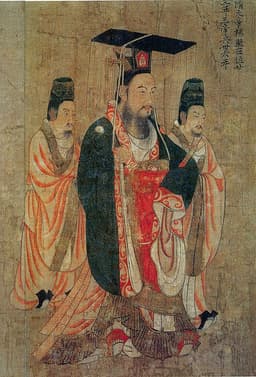
Emperor Wen of Sui
Emperor · Medieval
80.3Total
Basic Information
Born
1500
541
Died
1558
604
Era
Medieval
Medieval
Nationality
Spain
China
Occupation
Emperor
Emperor
Civilization
Western
Eastern
Score Comparison
Military (10%)
74.0
76.0
Political (20%)
72.0
75.0
Influence (20%)
85.0
88.0
Legacy (20%)
68.0
80.0
Leadership (15%)
78.0
80.0
Strategy (15%)
68.1
75.0
TOTAL
75.0
80.3
Charles I of Spain — Complete Timeline
1519 AD
Election as Holy Roman EmperorPolitical Action
Charles I of Spain was elected Holy Roman Emperor as Charles V, succeeding his grandfather Maximilian I. This election united the Spanish kingdoms, the Habsburg domains in Austria and the Low Countries, and the Holy Roman Empire under a single ruler, creating a vast European empire.
Holy Roman EmpireHabsburg empire
Impact: globalconstructive
1521 AD
Diet of WormsPolitical Action
Charles V presided over the Diet of Worms, where Martin Luther was summoned to recant his teachings. Luther refused, and Charles V issued the Edict of Worms, declaring Luther an outlaw and banning his writings. This event deepened the religious divide in Europe and sparked the Protestant Reformation.
Protestant ReformationReligious conflict
Impact: global
1525 AD
Battle of PaviaWar◆ Major
Charles V's imperial army defeated the French forces of King Francis I at the Battle of Pavia. Francis I was captured and taken prisoner to Spain. The victory solidified Habsburg dominance in Italy and forced France to renounce its claims to Milan and Naples in the Treaty of Madrid.
Italian WarsHabsburg victory
Impact: regional
1527 AD
Sack of RomeWar◆ Major
Imperial troops under Charles V sacked Rome, looting the city and capturing Pope Clement VII. The sack was a brutal event that shocked Europe and led to the temporary dominance of Charles V over the Papacy. It also marked a turning point in the Italian Wars.
Italian WarsPapacy
Impact: globaldestructive
1556 AD
Abdication of Charles VPolitical Action
Charles V abdicated his thrones, dividing his empire between his son Philip II (who received Spain, the Low Countries, and the Italian possessions) and his brother Ferdinand I (who received the Holy Roman Empire). This abdication was a major event in European politics, reshaping the balance of power.
AbdicationEmpire division
Impact: global
Emperor Wen of Sui — Complete Timeline
581 AD
Establishment of the Three Departments and Six Ministries SystemReform◆ Major
Emperor Wen established a centralized bureaucratic system with three departments (Secretariat, Chancellery, and Department of State Affairs) and six ministries. This system became the foundation of Chinese government administration for centuries.
Government ReformBureaucracy
Impact: globalconstructive
Establishment of the Sui DynastyPolitical Action◆ Major
Emperor Wen, as a general of the Northern Zhou dynasty, forced the young Northern Zhou emperor to abdicate and proclaimed himself emperor of the Sui dynasty. This marked the beginning of the Sui dynasty, which would go on to reunify China.
Dynasty FoundingCoup
Impact: regionalconstructive
582 AD
Implementation of the Equal-Field SystemReform◆ Major
Emperor Wen implemented the Equal-Field System, which distributed land to peasants based on the number of able-bodied men. This reform increased agricultural productivity, stabilized tax revenues, and reduced the power of large landowners.
Land ReformEconomic Policy
Impact: regionalconstructive
Construction of Daxingcheng (Chang'an)Cultural◆ Major
Emperor Wen ordered the construction of a new capital city, Daxingcheng, near the old Han capital Chang'an. This city, later known as Chang'an, became a model for urban planning and served as the capital of the Sui and Tang dynasties.
Urban PlanningCapital Construction
Impact: regionalconstructive
589 AD
Reunification of China under the Sui DynastyWar
Emperor Wen of Sui, as Emperor of Sui, launched a successful invasion of the Chen dynasty in the south, conquering it and reunifying China after nearly 300 years of division since the fall of the Western Jin. This ended the Northern and Southern Dynasties period.
UnificationConquest
Impact: globalconstructive
Expert Analysis
Origins
Emperor Wen of Sui (Yang Jian) was born into a powerful Northern Zhou aristocratic family in 541 AD. He seized power through a combination of military prowess and political maneuvering, eventually forcing his grandson to abdicate. Charles I of Spain (Charles V) was born in 1500 into the Habsburg dynasty, inheriting vast territories through a series of strategic marriages. His lineage connected him to Spain, Burgundy, Austria, and the Holy Roman Empire.
Rise to Power
Wen's rise was marked by his role as regent for the Northern Zhou emperor, followed by a swift coup in 581 AD. He eliminated rivals and established the Sui dynasty, then launched campaigns to conquer the Chen dynasty, completing the reunification of China in 589 AD. Charles's ascent was more gradual: he inherited the Spanish throne in 1516 and was elected Holy Roman Emperor in 1519, outmaneuvering rivals like Francis I of France. His power base was a patchwork of territories, not a single unified state.
Leadership & Governance
Wen implemented transformative reforms: the Equal-Field System to distribute land fairly, the Three Departments and Six Ministries system to streamline bureaucracy, and the construction of the new capital Daxingcheng. He reduced taxes, promoted Confucian learning, and centralized power. Charles, ruling over a diverse empire, relied on a decentralized system of viceroys and councils. He fought numerous wars to maintain Habsburg hegemony, including conflicts with France and the Ottoman Empire. His governance was reactive, focusing on preserving his inheritance rather than domestic innovation.
Triumph & Tragedy
Wen's greatest triumph was unifying China after nearly 400 years of division, ushering in an era of stability and prosperity. However, his later years were marred by paranoia and harsh treatment of officials, leading to a decline in governance. His son, Emperor Yang, inherited a strong state but squandered it through megalomaniac projects. Charles's triumphs include the victory at Pavia (1525) and the Sack of Rome (1527), which solidified Habsburg dominance in Italy. Yet, his reign ended in tragedy: he failed to suppress the Protestant Reformation (despite the Diet of Worms) and faced constant rebellions. He abdicated in 1556, dividing his empire and retiring to a monastery.
Character & Destiny
Wen was pragmatic, disciplined, and frugal, but also ruthless and suspicious. His destiny was to be the unifier of China, a role he executed with efficiency. Charles was devout, earnest, and conscious of his immense responsibilities, but indecisive and bogged down by the scale of his domains. His destiny was to defend a global empire against overwhelming forces, a task that ultimately exhausted him. Wen's character suited the moment of consolidation; Charles's character reflected the burdens of overextension.
Legacy
Wen's Sui dynasty was short-lived (581-618), but its institutions—centralized bureaucracy, land reforms, and the Grand Canal—directly influenced the Tang dynasty and subsequent Chinese empires. He is often overshadowed by the Tang, but his foundational role is undeniable. Charles's legacy is mixed: he presided over the first European empire "on which the sun never set," but his reign also sowed the seeds of religious division and Spanish decline. His abdication marked a transition to the Spanish Habsburgs and Austrian Habsburgs. Both rulers left enduring marks, but Wen's reforms had a more direct and lasting impact on governance.
Conclusion
Emperor Wen of Sui scores higher overall (75.6 vs 70.3) due to his superior leadership, innovation, and lasting institutional legacy. While Charles ruled a larger empire, Wen's achievements in unifying China and creating durable administrative systems were more transformative. Wen's governance was proactive and constructive; Charles's was reactive and defensive. Therefore, Wen emerges as the greater ruler, despite his dynasty's brevity.
**Numerical Scores:**
- Emperor Wen of Sui: 75.6
- Charles I of Spain: 70.3
Rankings
🥇
Emperor Wen of SuiLeader
Mil: 76.0Pol: 75.0Inf: 88.0
80.3
🥈
Charles I of Spain
Mil: 74.0Pol: 72.0Inf: 85.0
75.0
+5.3 behind
How This Comparison Works
Algorithm
Each figure is scored on 6 dimensions (0—100 scale) based on structured historical data: Military (10%), Political (20%), Influence (20%), Legacy (20%), Leadership (15%), Strategy (15%). The weighted total produces the final ranking.
Data Sources
Scores are computed from structured sub-indicators in the database. Scale factors adjust for era (Ancient ×0.85, Modern ×1.0) and civilization size (Eastern ×1.05, Other ×0.80) to account for differences in population and military scale.
Maximum 3 Figures
Comparisons are limited to 2—3 figures to ensure readability and statistical meaningfulness.
Error Margins
±5 points per dimension — Sub-scores are derived from historical records with inherent uncertainty. Two figures within 5 points on a dimension should be considered roughly equivalent in that area.
Total Score Accuracy
±3 points overall — The weighted combination of 6 dimensions produces a total score with approximately ±3 points of uncertainty. Differences of less than 3 points are not statistically significant— the figures are effectively tied.
Known Limitations
- Historical records are incomplete and uneven across civilizations
- Figures from oral-tradition societies may be underrepresented
- Occupation labels can misclassify multi-role figures
- Scores measure capability and impact, not moral character
- Quantitative scoring is a comparison tool, not absolute truth
Capability Radar
Military (10%) — Battles & Warfare
Battles
85
75
Win Rate
70
80
Expansion
90
85
Political (20%) — Governance & Reform
Reform
80
95
Diplomacy
90
85
Economy
75
90
Influence (20%) — Cultural & Global Reach
Cultural
85
70
Global
95
65
Legacy (20%) — Historical Impact
Historical
90
85
Longevity
80
70
Leadership (15%) — Power & Stability
Tenure
85
80
Stability
60
75
Strategy (15%) — Tactics & Innovation
Strategy
85
85
Tactics
75
70
Reform
80
90
Similar Comparisons
Comments & Discussion
No comments yet. Be the first to share your thoughts!