Loading...
Charlemagne vs Dinh Tien Hoang
Charlemagne leads by 10.6 pts · 2 figures compared
…
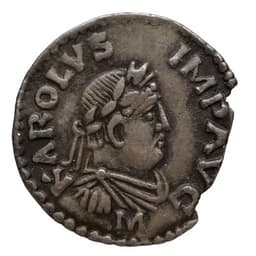
Charlemagne
Emperor · Medieval
71.0Total
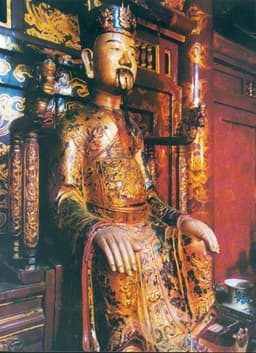
Dinh Tien Hoang
Emperor · Medieval
60.4Total
Basic Information
Born
748
924
Died
814
979
Era
Medieval
Medieval
Nationality
Frankish Empire
Vietnam
Occupation
Emperor
Emperor
Civilization
Western
Eastern
Score Comparison
Military (10%)
80.0
60.0
Political (20%)
78.0
72.0
Influence (20%)
65.0
65.0
Legacy (20%)
65.0
40.0
Leadership (15%)
80.0
77.2
Strategy (15%)
68.0
58.0
TOTAL
71.0
60.4
Charlemagne — Complete Timeline
772 AD
Saxon WarsWar◆ Major
Charlemagne launched a series of campaigns against the Saxons lasting over three decades. He forcibly converted them to Christianity, incorporated their territory into the Frankish Empire, and ordered the execution of thousands at the Massacre of Verden in 782.
ConquestChristianizationWar
Impact: regionaldestructive
774 AD
Conquest of the Lombard KingdomWar◆ Major
Charlemagne answered Pope Adrian I's call for aid against the Lombards. He besieged and captured Pavia, deposed King Desiderius, and annexed the Lombard Kingdom into his domain, assuming the title 'King of the Lombards' and solidifying Frankish control over Italy.
ConquestItalyPapal Alliance
Impact: regional
779 AD
Capitulary of HerstalReform
Charlemagne issued a series of legal and administrative reforms at the assembly in Herstal. He standardized weights and measures, reformed the coinage system, and strengthened the authority of royal officials (missi dominici) to oversee local governance and justice.
Legal ReformAdministrationStandardization
Impact: nationalconstructive
780 AD
Carolingian Renaissance ReformsCultural◆ Major
Charlemagne initiated a program of educational and cultural revival, inviting scholars like Alcuin of York to his court. He standardized Latin script (Carolingian minuscule), established palace schools, and promoted the copying of classical texts, preserving ancient knowledge.
EducationCultural RevivalScript
Impact: globalprogressive
800 AD
Coronation as Holy Roman EmperorPolitical Action
Pope Leo III crowned Charlemagne as Emperor of the Romans in St. Peter's Basilica on Christmas Day. This act revived the Western Roman Empire, established a precedent for papal authority over imperial titles, and created a political entity that shaped medieval European politics.
CoronationHoly Roman EmpirePapacy
Impact: globalconstructive
Dinh Tien Hoang — Complete Timeline
968 AD
Defeat of the Twelve WarlordsWar
Dinh Bo Linh, later known as Dinh Tien Hoang, unified Vietnam by defeating the Twelve Warlords who had divided the country after the collapse of Chinese rule. He established the Dinh dynasty and became the first emperor of an independent Vietnam.
UnificationDinh DynastyVietnamese Independence
Impact: nationalconstructive
Establishment of the Dinh DynastyPolitical Action◆ Major
Dinh Tien Hoang founded the Dinh dynasty and declared himself Emperor. He moved the capital to Hoa Lu and implemented administrative reforms to consolidate power. This marked the beginning of a new era of Vietnamese independence after centuries of Chinese domination.
Dynasty FoundingCapital MoveAdministrative Reform
Impact: nationalconstructive
979 AD
Assassination of Dinh Tien HoangPolitical Action◆ Major
Dinh Tien Hoang and his crown prince were assassinated by a court official while sleeping. The murder plunged the Dinh dynasty into chaos, leading to a succession crisis and eventual takeover by Le Hoan. The assassination ended the short-lived Dinh dynasty.
AssassinationSuccession CrisisEnd of Dinh Dynasty
Impact: nationaltragic
Expert Analysis
Dinh Tien Hoang vs Charlemagne
# The Emperor and the Unifier
On Christmas Day in the year 800, in the candlelit splendor of St. Peter’s Basilica, Pope Leo III placed a golden crown upon the head of a Frankish king named Charles, declaring him Emperor of the Romans. The congregation erupted in acclamation, and a new epoch in Western history began. Just over a century and a half later, on the other side of the world, a Vietnamese warlord named Dinh Bo Linh crushed the last of his rivals, proclaimed himself Emperor Dinh Tien Hoang, and declared his land free from a thousand years of Chinese domination. Both men forged nations from chaos. Both wore the title of emperor. Yet their paths, their methods, and their legacies could not be more different. What drove one to build an empire that would shape Europe for a millennium, while the other created a dynasty that lasted barely a decade?
Origins
Charlemagne was born in 748 into the Carolingian dynasty, a family already accustomed to power. His father, Pepin the Short, had deposed the last Merovingian king with the Pope’s blessing, establishing a partnership between Frankish swords and Roman miters that would define Charlemagne’s life. Raised in a world of constant warfare and feudal loyalty, he learned to read Latin but never mastered writing—a detail that reveals much about a man who valued learning but lived by action.
Dinh Tien Hoang, born Dinh Bo Linh in 924, emerged from a very different crucible. Vietnam had been under Chinese rule for nearly a thousand years, but by the tenth century, that grip was weakening. Local lords—the so-called Twelve Warlords—had carved the country into feuding territories. Dinh’s father was a regional governor, but young Dinh grew up among buffalo herders, reportedly organizing the village children into mock armies. His rise was not a matter of inheritance but of raw ambition in a land where power was up for grabs.
Rise to Power
Charlemagne ascended to the throne in 768 upon his father’s death, co-ruling with his brother Carloman until the latter’s sudden demise in 771. The path was smoothed by family legitimacy and papal alliances. His first great turning point came in 774, when he answered Pope Adrian I’s call for aid against the Lombards. Charlemagne besieged Pavia, deposed King Desiderius, and annexed the Lombard kingdom. In one stroke, he doubled his territory and secured the Pope as his most influential ally.
Dinh Tien Hoang’s rise was bloodier and more personal. In 968, after years of campaigning, he defeated the last of the Twelve Warlords, unifying a fractured Vietnam through sheer military force. Unlike Charlemagne, he had no pope to crown him, no ancient lineage to invoke. He simply declared himself emperor, moved his capital to the mountain fortress of Hoa Lu, and dared anyone to challenge him. Where Charlemagne’s legitimacy flowed from Rome, Dinh’s flowed from his sword.
Leadership & Governance
As ruler, Charlemagne was a reformer on a grand scale. In 779, he issued the Capitulary of Herstal, standardizing weights, measures, and legal procedures across his realm. He launched the Carolingian Renaissance in 780, inviting the scholar Alcuin of York to his court to revive Latin learning, establish schools, and copy ancient manuscripts. He reorganized the Church, appointed bishops, and insisted on better education for clergy. His empire was held together by a network of counts and missi dominici—royal agents who traveled the realm enforcing his will.
Dinh Tien Hoang governed differently. His rule was pragmatic and local. He built a strong central government in Hoa Lu, but his reforms were aimed at consolidating power rather than transforming culture. He minted coins bearing his name, established a rudimentary bureaucracy, and secured recognition from the Song Dynasty in China—a diplomatic masterstroke that bought his young nation breathing room. His political score of 90.2 reflects a shrewdness that belies his short reign.
Yet Dinh lacked Charlemagne’s vision. The Frankish emperor saw himself as the shepherd of Christendom, a ruler responsible not just for territory but for souls. Dinh’s ambition was more immediate: to keep Vietnam free and himself alive. One sought to build a civilization; the other, a nation.
Triumph & Tragedy
Charlemagne’s greatest triumph was his coronation in 800—a moment that fused Roman imperial tradition with Christian kingship and created the Holy Roman Empire, an institution that would shape European politics until Napoleon. His greatest failure was the Saxon Wars, launched in 772 and lasting over three decades. He forcibly converted the Saxons, massacred thousands at Verden in 782, and imposed Frankish law on a people who resisted with desperate fury. It was conquest by fire and baptismal font—effective, but brutal.
Dinh Tien Hoang’s triumph was the unification of Vietnam itself, an achievement that earned him the title “Tien Hoang” (First Emperor). His tragedy came in 979, when he and his crown prince were assassinated in their sleep by a court official. The murder plunged the Dinh dynasty into chaos; within a year, the kingdom passed to the Le dynasty. Charlemagne’s empire endured for centuries after his death in 814. Dinh’s vanished with his blood.
Character & Destiny
Charlemagne was restless, curious, and deeply religious. He slept little, hunted often, and surrounded himself with scholars. He saw himself as God’s instrument on earth, and that conviction gave him the confidence to conquer, reform, and command. His personality—driven, expansive, and systematic—matched the scale of his ambitions.
Dinh Tien Hoang was a survivor. He had clawed his way to power in a land where betrayal was the norm. His shrewdness kept him alive through years of civil war, but it could not save him from the very court politics he had created. His story is one of a man who built a kingdom but not a system—a brilliant tactician who failed to become a strategist of legacy.
Legacy
Charlemagne’s legacy is written into the DNA of Europe. He is remembered as the Father of Europe, a unifier who gave the continent a shared identity rooted in Latin Christianity and classical learning. His Carolingian Renaissance preserved the works of antiquity and laid the groundwork for medieval scholarship. His empire fractured, but his idea endured.
Dinh Tien Hoang is revered in Vietnam as the founding father of national independence. His statue stands in Hoa Lu, and his name is taught in every school. But his legacy is symbolic rather than institutional. He proved that Vietnam could stand alone, but he did not build the structures that would keep it standing. That task fell to his successors.
Conclusion
Charlemagne and Dinh Tien Hoang both heard the same call—to forge order from chaos, to turn fragments into a whole. One answered with an empire that spanned a continent and a vision that spanned centuries. The other answered with a kingdom that barely outlived him. The difference lies not in their courage or their ambition, but in the worlds they inhabited. Charlemagne inherited a tradition of Roman law, Christian faith, and literate administration. Dinh inherited a battlefield. One built a cathedral; the other built a fortress. Both were necessary. But only one was built to last.
Rankings
🥇
CharlemagneLeader
Mil: 80.0Pol: 78.0Inf: 65.0
71.0
🥈
Dinh Tien Hoang
Mil: 60.0Pol: 72.0Inf: 65.0
60.4
+10.6 behind
How This Comparison Works
Algorithm
Each figure is scored on 6 dimensions (0—100 scale) based on structured historical data: Military (10%), Political (20%), Influence (20%), Legacy (20%), Leadership (15%), Strategy (15%). The weighted total produces the final ranking.
Data Sources
Scores are computed from structured sub-indicators in the database. Scale factors adjust for era (Ancient ×0.85, Modern ×1.0) and civilization size (Eastern ×1.05, Other ×0.80) to account for differences in population and military scale.
Maximum 3 Figures
Comparisons are limited to 2—3 figures to ensure readability and statistical meaningfulness.
Error Margins
±5 points per dimension — Sub-scores are derived from historical records with inherent uncertainty. Two figures within 5 points on a dimension should be considered roughly equivalent in that area.
Total Score Accuracy
±3 points overall — The weighted combination of 6 dimensions produces a total score with approximately ±3 points of uncertainty. Differences of less than 3 points are not statistically significant— the figures are effectively tied.
Known Limitations
- Historical records are incomplete and uneven across civilizations
- Figures from oral-tradition societies may be underrepresented
- Occupation labels can misclassify multi-role figures
- Scores measure capability and impact, not moral character
- Quantitative scoring is a comparison tool, not absolute truth
Capability Radar
Military (10%) — Battles & Warfare
Battles
85
70
Win Rate
90
75
Expansion
88
65
Political (20%) — Governance & Reform
Reform
90
70
Diplomacy
80
65
Economy
75
60
Influence (20%) — Cultural & Global Reach
Cultural
85
65
Global
80
55
Legacy (20%) — Historical Impact
Historical
90
75
Longevity
85
70
Leadership (15%) — Power & Stability
Tenure
85
60
Stability
70
55
Strategy (15%) — Tactics & Innovation
Strategy
85
70
Tactics
75
65
Reform
80
60
Similar Comparisons
Comments & Discussion
No comments yet. Be the first to share your thoughts!