Loading...
Chandragupta II vs King Huiwen of Zhao
Chandragupta II leads by 15.8 pts · 2 figures compared
…
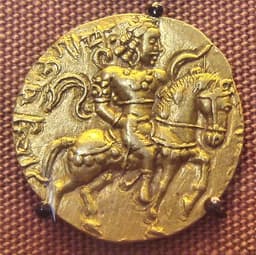
Chandragupta II
Emperor · Ancient
74.7Total

King Huiwen of Zhao
Emperor · Ancient
58.9Total
Basic Information
Born
380
-310
Died
415
-266
Era
Ancient
Ancient
Nationality
India
China
Occupation
Emperor
Emperor
Civilization
Indian
Eastern
Score Comparison
Military (10%)
74.0
80.0
Political (20%)
78.0
60.0
Influence (20%)
88.0
56.4
Legacy (20%)
65.0
48.3
Leadership (15%)
72.0
66.0
Strategy (15%)
65.4
58.0
TOTAL
74.7
58.9
Chandragupta II — Complete Timeline
380 AD
Accession to the Gupta ThronePolitical Action
Chandragupta II succeeded his father Samudragupta as emperor of the Gupta Empire. He inherited a vast territory and continued the expansionist policies, further consolidating Gupta power in northern India.
Gupta EmpireSuccessionExpansion
Impact: regional
385 AD
Marriage Alliance with the VakatakasPolitical Action◆ Major
Chandragupta II married his daughter Prabhavatigupta to the Vakataka king Rudrasena II. After Rudrasena's death, Prabhavatigupta ruled as regent, effectively bringing the Vakataka kingdom under Gupta influence and securing the Deccan frontier.
VakatakaAllianceDeccan
Impact: regionalconstructive
395 AD
Conquest of the Western SatrapsWar◆ Major
Chandragupta II defeated the Western Kshatrapas (Saka rulers) in Gujarat and Malwa, annexing their territories. This conquest gave the Gupta Empire access to the Arabian Sea ports and control over lucrative trade routes with the Roman Empire.
Western SatrapsGujaratTrade
Impact: regional
400 AD
Patronage of the Golden Age of Gupta CultureCultural◆ Major
Chandragupta II's court included the poet Kalidasa, the astronomer Varahamihira, and other scholars. This period saw the flourishing of Sanskrit literature, art, and science, often considered the peak of classical Indian culture.
Golden AgeKalidasaSanskrit Literature
Impact: regionalconstructive
405 AD
Visit of the Chinese Pilgrim FaxianCultural
The Chinese Buddhist monk Faxian visited the Gupta Empire during Chandragupta II's reign. Faxian recorded the prosperity, religious tolerance, and efficient administration of the empire, providing valuable historical documentation.
FaxianChinese PilgrimBuddhism
Impact: regionalconstructive
King Huiwen of Zhao — Complete Timeline
280 BC
Reached the height of Zhao's powerPolitical Action◆ Major
Under King Huiwen, Zhao became the most powerful state in the Warring States period. His reign saw the consolidation of the military reforms of his father, King Wuling, and Zhao's army became a formidable force, capable of challenging Qin.
Zhao HegemonyMilitary PowerWarring States
Impact: regionalconstructive
279 BC
Appointed Lin Xiangru as chancellorPolitical Action
King Huiwen appointed the diplomat Lin Xiangru as chancellor after his successful missions to Qin. Lin Xiangru's policies promoted internal harmony and effective governance, contributing to Zhao's stability and prosperity.
AppointmentDiplomacyGovernance
Impact: nationalconstructive
Hosted the Mianchi ConferencePolitical Action
King Huiwen met with King Zhaoxiang of Qin at Mianchi to negotiate a truce. The conference, mediated by Lin Xiangru, temporarily eased tensions between Zhao and Qin, though it did not lead to a lasting peace.
DiplomacySummitQin-Zhao Relations
Impact: regional
269 BC
Defeated Qin at the Battle of YiqueWar◆ Major
Zhao forces under General Zhao She defeated a Qin army at Yique, inflicting heavy casualties. This victory checked Qin's eastward expansion and demonstrated Zhao's military strength during its peak.
BattleZhao VictoryQin Defeat
Impact: regional
Expert Analysis
Origins
Chandragupta II, born around 330 CE, was the son of Samudragupta, the second Gupta emperor. He belonged to the Gupta dynasty, which originated in Magadha (modern Bihar). His mother was Dattadevi, a queen of modest background. Chandragupta II received a princely education in statecraft, warfare, and the arts, typical for a Gupta heir. The Gupta Empire, founded by his grandfather Chandragupta I, had already established a strong foundation.
King Huiwen of Zhao, born around 310 BCE, was the son of King Wuling of Zhao, famous for adopting 'barbarian' cavalry tactics. He inherited the throne in 298 BCE after his father's abdication. The Zhao state was one of the Seven Warring States, located in northern China. Huiwen was educated in Confucian classics and military strategy. His father's reforms had transformed Zhao into a military power, but internal factionalism remained.
Rise to Power
Chandragupta II ascended the Gupta throne around 375 CE after his father Samudragupta's death. Samudragupta had expanded the empire through conquests, and Chandragupta II continued this policy. His first major campaign was against the Western Kshatrapas (Saka rulers) in Gujarat and Malwa. By 395 CE, he had defeated them, annexing their territories and gaining access to the Arabian Sea for trade. This conquest significantly boosted Gupta wealth and influence. He also secured the Vakataka alliance by marrying his daughter Prabhavatigupta to their king, effectively controlling central India.
King Huiwen became ruler of Zhao after his father's abdication in 298 BCE. His father had been assassinated by palace factions, leaving a volatile court. Huiwen's early reign focused on consolidating power. He appointed capable ministers like Lin Xiangru and generals like Zhao She. His most significant military achievement was the Battle of Yique (293 BCE), where Zhao forces defeated a Qin army, killing over 100,000 soldiers. This victory made Zhao the dominant state in the Warring States period. He also hosted the Mianchi Conference (279 BCE) with Qin, securing a temporary truce through diplomacy.
Leadership & Governance
Chandragupta II ruled as a centralized monarch, relying on a bureaucracy and provincial governors. He maintained religious tolerance, patronizing both Hinduism and Buddhism. His court was a center of learning, with scholars like Kalidasa and Varahamihira. He issued gold coins depicting himself and deities, showcasing prosperity. His governance emphasized dharma (righteousness) and efficient administration, as noted by Chinese pilgrim Faxian, who praised the empire's peace and low crime.
King Huiwen of Zhao governed a feudal state with powerful nobles. He focused on military strength, continuing his father's reforms. He promoted meritocracy, appointing Lin Xiangru from humble origins. His reign saw the completion of the Zhao Great Wall. However, his rule was marked by court intrigues, including conflicts between the 'Hu' faction (barbarian adopters) and conservative Confucians. His governance scored 60.0 politically, lower than Chandragupta II's 78.0, due to less stable institutions.
Triumph & Tragedy
Chandragupta II's greatest triumph was the conquest of the Western Satraps, which expanded the Gupta Empire to its greatest extent. He also fostered the Gupta Golden Age, with advances in literature, science, and art. His patronage of Kalidasa produced classics like 'Shakuntala'. However, his reign saw no major military disasters, but his successors faced invasions from the Huns, suggesting he may have neglected frontier defenses. His total score of 74.7 reflects balanced achievements.
King Huiwen's triumph was the defeat of Qin at Yique, which halted Qin expansion for decades. His diplomatic success at Mianchi also preserved Zhao's independence. However, his greatest failure was the mishandling of the 'Revolt of the Four Princes' (a rebellion by his brothers), which weakened the state. His military score of 80.0 is high, but his political score of 60.0 shows instability. His legacy score of 48.3 indicates limited long-term impact.
Character & Destiny
Chandragupta II was a shrewd strategist and patron of culture. He used marriage alliances to expand influence without war. His character was marked by ambition and foresight, as seen in his conquests and cultural investments. Historical assessments praise his administrative skills. His destiny was to rule during India's golden age, but his empire declined after his death due to weak successors.
King Huiwen was a capable military leader but struggled with internal politics. He relied heavily on generals like Zhao She and diplomats like Lin Xiangru. His decision-making was often reactive, as seen in the Mianchi Conference. His character was cautious yet firm, but he failed to secure a stable succession. His fate was to see Zhao's power peak and then wane after his death.
Legacy
Chandragupta II's legacy is immense: the Gupta Golden Age is considered a classical period of Indian civilization. Sanskrit literature, mathematics (concept of zero), and astronomy flourished. His reign set standards for Hindu kingship. The Gupta Empire's influence spread to Southeast Asia. His legacy score of 65.0 reflects enduring cultural impact.
King Huiwen's legacy is more limited. Zhao's military innovations influenced later Chinese warfare, but the state was conquered by Qin in 222 BCE. His reign is remembered as a high point of Zhao power, but his accomplishments were overshadowed by the Qin unification. His legacy score of 48.3 is lower due to the ephemeral nature of Zhao's dominance.
Conclusion
Chandragupta II had a greater impact on history than King Huiwen of Zhao. With a total score of 74.7 against 58.9, the gap of 15.8 points reflects broader influence. Chandragupta II's cultural and political achievements shaped Indian civilization for centuries, while Huiwen's military victories did not prevent Zhao's collapse. The Gupta Golden Age left a lasting legacy in literature, science, and governance, whereas Zhao's power was fleeting. Therefore, Chandragupta II stands as the more significant historical figure.
Rankings
🥇
Chandragupta IILeader
Mil: 74.0Pol: 78.0Inf: 88.0
74.7
🥈
King Huiwen of Zhao
Mil: 80.0Pol: 60.0Inf: 56.4
58.9
+15.8 behind
How This Comparison Works
Algorithm
Each figure is scored on 6 dimensions (0—100 scale) based on structured historical data: Military (10%), Political (20%), Influence (20%), Legacy (20%), Leadership (15%), Strategy (15%). The weighted total produces the final ranking.
Data Sources
Scores are computed from structured sub-indicators in the database. Scale factors adjust for era (Ancient ×0.85, Modern ×1.0) and civilization size (Eastern ×1.05, Other ×0.80) to account for differences in population and military scale.
Maximum 3 Figures
Comparisons are limited to 2—3 figures to ensure readability and statistical meaningfulness.
Error Margins
±5 points per dimension — Sub-scores are derived from historical records with inherent uncertainty. Two figures within 5 points on a dimension should be considered roughly equivalent in that area.
Total Score Accuracy
±3 points overall — The weighted combination of 6 dimensions produces a total score with approximately ±3 points of uncertainty. Differences of less than 3 points are not statistically significant— the figures are effectively tied.
Known Limitations
- Historical records are incomplete and uneven across civilizations
- Figures from oral-tradition societies may be underrepresented
- Occupation labels can misclassify multi-role figures
- Scores measure capability and impact, not moral character
- Quantitative scoring is a comparison tool, not absolute truth
Capability Radar
Military (10%) — Battles & Warfare
Battles
75
75
Win Rate
80
70
Expansion
80
75
Political (20%) — Governance & Reform
Reform
80
65
Diplomacy
75
75
Economy
90
70
Influence (20%) — Cultural & Global Reach
Cultural
95
55
Global
70
45
Legacy (20%) — Historical Impact
Historical
90
60
Longevity
85
50
Leadership (15%) — Power & Stability
Tenure
85
70
Stability
85
65
Strategy (15%) — Tactics & Innovation
Strategy
75
70
Tactics
70
65
Reform
65
60
Similar Comparisons
Comments & Discussion
No comments yet. Be the first to share your thoughts!