Loading...
Ashoka the Great vs Chandragupta II
Ashoka the Great leads by 1.6 pts · 2 figures compared
…

Ashoka the Great
Emperor · Ancient
76.3Total
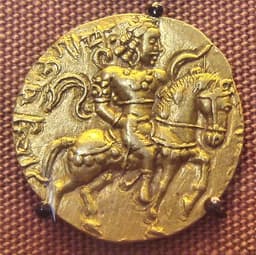
Chandragupta II
Emperor · Ancient
74.7Total
Basic Information
Born
-304
380
Died
-232
415
Era
Ancient
Ancient
Nationality
India
India
Occupation
Emperor
Emperor
Civilization
Indian
Indian
Score Comparison
Military (10%)
72.0
74.0
Political (20%)
82.0
78.0
Influence (20%)
71.0
88.0
Legacy (20%)
90.0
65.0
Leadership (15%)
72.0
72.0
Strategy (15%)
58.0
65.4
TOTAL
76.3
74.7
Ashoka the Great — Complete Timeline
261 BC
Kalinga WarWar
Ashoka launched a brutal conquest of the Kalinga region (modern Odisha). The war caused massive casualties, with over 100,000 killed and 150,000 deported. The suffering witnessed during this campaign led Ashoka to renounce military conquest and embrace Buddhism.
ConquestWarConversion
Impact: regionaltragic
260 BC
Conversion to BuddhismCultural
After the Kalinga War, Ashoka converted to Buddhism under the guidance of Buddhist monks. He adopted the principle of Dhamma (righteous law) and began promoting non-violence, vegetarianism, and religious tolerance throughout his empire.
ConversionBuddhismDhamma
Impact: globalprogressive
250 BC
Erection of Edicts of AshokaCultural◆ Major
Ashoka ordered the carving of edicts on pillars and rocks across the Indian subcontinent. These inscriptions, written in Prakrit and other languages, proclaimed his policies of non-violence, social welfare, and religious harmony. They are the earliest deciphered written records from ancient India.
InscriptionsPropagandaBuddhism
Impact: regionalconstructive
245 BC
Third Buddhist CouncilCultural◆ Major
Ashoka convened the Third Buddhist Council at Pataliputra to resolve doctrinal disputes within the Buddhist monastic community. The council standardized the Buddhist canon (Tripitaka) and decided to send missionaries abroad, including to Sri Lanka and Southeast Asia.
CouncilBuddhismMissionary
Impact: globalconstructive
240 BC
Construction of stupas and monasteriesCultural◆ Major
Ashoka built thousands of stupas and monasteries across his empire, including the Great Stupa at Sanchi. These structures became centers of Buddhist worship and pilgrimage, spreading Buddhist art and architecture throughout Asia.
ArchitectureBuddhismPatronage
Impact: regionalconstructive
Chandragupta II — Complete Timeline
380 AD
Accession to the Gupta ThronePolitical Action
Chandragupta II succeeded his father Samudragupta as emperor of the Gupta Empire. He inherited a vast territory and continued the expansionist policies, further consolidating Gupta power in northern India.
Gupta EmpireSuccessionExpansion
Impact: regional
385 AD
Marriage Alliance with the VakatakasPolitical Action◆ Major
Chandragupta II married his daughter Prabhavatigupta to the Vakataka king Rudrasena II. After Rudrasena's death, Prabhavatigupta ruled as regent, effectively bringing the Vakataka kingdom under Gupta influence and securing the Deccan frontier.
VakatakaAllianceDeccan
Impact: regionalconstructive
395 AD
Conquest of the Western SatrapsWar◆ Major
Chandragupta II defeated the Western Kshatrapas (Saka rulers) in Gujarat and Malwa, annexing their territories. This conquest gave the Gupta Empire access to the Arabian Sea ports and control over lucrative trade routes with the Roman Empire.
Western SatrapsGujaratTrade
Impact: regional
400 AD
Patronage of the Golden Age of Gupta CultureCultural◆ Major
Chandragupta II's court included the poet Kalidasa, the astronomer Varahamihira, and other scholars. This period saw the flourishing of Sanskrit literature, art, and science, often considered the peak of classical Indian culture.
Golden AgeKalidasaSanskrit Literature
Impact: regionalconstructive
405 AD
Visit of the Chinese Pilgrim FaxianCultural
The Chinese Buddhist monk Faxian visited the Gupta Empire during Chandragupta II's reign. Faxian recorded the prosperity, religious tolerance, and efficient administration of the empire, providing valuable historical documentation.
FaxianChinese PilgrimBuddhism
Impact: regionalconstructive
Expert Analysis
Origins
Ashoka the Great (304–232 BCE) was born into the Maurya dynasty, the grandson of Chandragupta Maurya. His father, Bindusara, ruled a vast empire. Ashoka's early life was marked by princely education and military training. He served as governor of Ujjain and Taxila, gaining administrative experience. In contrast, Chandragupta II (reigned c. 375–415 CE) was the son of Samudragupta, the Gupta emperor who expanded the empire through conquest. Chandragupta II inherited a stable realm and was groomed for rule from a young age. Both were born into imperial families, but Ashoka's path was shaped by the violent consolidation of the Mauryan empire, while Chandragupta II's came during a period of established Gupta dominance.
Rise to Power
Ashoka's rise was contested. After Bindusara's death, Ashoka fought his brothers for the throne, reportedly killing 99 of them to secure power. His early reign was aggressive, continuing the expansionist policies of his predecessors. The turning point came with the Kalinga War (c. 261 BCE), where Ashoka's army inflicted massive casualties—over 100,000 killed and 150,000 deported. Horrified by the bloodshed, Ashoka converted to Buddhism and adopted the policy of Dhamma. Chandragupta II's accession was smoother; he succeeded his father without known conflict. His major conquest was the defeat of the Western Kshatrapas (Saka rulers) in Gujarat and Malwa around 395–409 CE, which gave the Gupta Empire access to western trade routes. He also secured a marriage alliance with the Vakatakas by marrying his daughter Prabhavatigupta to Rudrasena II, effectively extending Gupta influence into the Deccan.
Leadership & Governance
Ashoka's governance transformed after his conversion. He replaced military conquest with moral conquest (Dhamma-vijaya). He erected edicts on pillars and rocks across the subcontinent, inscribed in Prakrit, Greek, and Aramaic, promoting non-violence, religious tolerance, and social welfare. He appointed Dhamma-mahamattas (officers of righteousness) to spread these principles. His rule was centralized but benevolent, with hospitals, rest houses, and tree planting along roads. Chandragupta II, by contrast, presided over a decentralized feudal system. He patronized culture and learning, with his court hosting the poet Kalidasa and astronomer Varahamihira. The Gupta period saw the flourishing of Sanskrit literature, art, and science. Chandragupta II's administration was efficient but less interventionist than Ashoka's; taxes were moderate, and local rulers enjoyed autonomy. Ashoka scored 82.0 in political skills versus Chandragupta II's 78.0, reflecting his innovative but sometimes impractical policies.
Triumph & Tragedy
Ashoka's greatest triumph was the establishment of Buddhism as a major world religion. He sent missionaries to Sri Lanka, Southeast Asia, and the Hellenistic world. He built thousands of stupas, including the Great Stupa at Sanchi. His edicts remain a unique historical record. However, his pacifism may have weakened the Mauryan military, contributing to the empire's decline after his death. The empire fragmented within 50 years. Chandragupta II's triumph was the cultural zenith of the Gupta Empire, known as India's 'Golden Age'. The Chinese pilgrim Faxian visited during his reign and recorded prosperity, efficient justice, and religious tolerance. Yet, Chandragupta II's legacy is less enduring: the Gupta Empire declined under later rulers due to Hunnic invasions and internal decay. Ashoka's influence on Buddhism outlasted his empire, while Chandragupta II's cultural achievements, though impressive, were confined to a shorter period.
Character & Destiny
Ashoka was initially ruthless, then deeply remorseful. His conversion was sincere; he personally practiced and propagated Buddhism. He was introspective, as shown in his edicts where he expresses regret and a desire for moral governance. His character shaped his destiny: his turn to non-violence ensured his legacy as a philosopher-king but also ended Mauryan expansion. Chandragupta II was a capable administrator and patron, but less is known of his personality. He was pragmatic, using marriage alliances to secure influence. His court's brilliance was due to his patronage, but he lacked Ashoka's transformative vision. Historians note that Ashoka's scores in influence (71.0) and legacy (90.0) reflect his long-term impact, while Chandragupta II's influence (88.0) is high for his era but legacy (65.0) is lower.
Legacy
Ashoka's legacy is global. The Ashoka Chakra (wheel) is on India's national flag. His edicts were the first written records in India. He is revered as a model of righteous rule. Buddhism spread across Asia due to his efforts. Chandragupta II's legacy is cultural. The Gupta period produced works like Kalidasa's 'Shakuntala' and the Ajanta caves. The decimal numeral system and zero were developed during this time. However, his political structures did not survive. In terms of lasting impact, Ashoka scored 90.0 in legacy, while Chandragupta II scored 65.0. Ashoka's influence on governance and religion dwarfs Chandragupta II's cultural contributions.
Conclusion
Ashoka the Great had a greater impact on world history. His total score of 76.3 versus Chandragupta II's 74.7 reflects this. Ashoka's transformation from conqueror to pacifist set a moral precedent that influenced later leaders, including Mahatma Gandhi. His propagation of Buddhism shaped Asia for millennia. Chandragupta II's Gupta Golden Age was magnificent but ephemeral. While Chandragupta II excelled in cultural patronage, Ashoka's legacy of peace, religious tolerance, and social welfare is more enduring and universal. Therefore, Ashoka stands as the more significant historical figure.
Rankings
🥇
Ashoka the GreatLeader
Mil: 72.0Pol: 82.0Inf: 71.0
76.3
🥈
Chandragupta II
Mil: 74.0Pol: 78.0Inf: 88.0
74.7
+1.6 behind
How This Comparison Works
Algorithm
Each figure is scored on 6 dimensions (0—100 scale) based on structured historical data: Military (10%), Political (20%), Influence (20%), Legacy (20%), Leadership (15%), Strategy (15%). The weighted total produces the final ranking.
Data Sources
Scores are computed from structured sub-indicators in the database. Scale factors adjust for era (Ancient ×0.85, Modern ×1.0) and civilization size (Eastern ×1.05, Other ×0.80) to account for differences in population and military scale.
Maximum 3 Figures
Comparisons are limited to 2—3 figures to ensure readability and statistical meaningfulness.
Error Margins
±5 points per dimension — Sub-scores are derived from historical records with inherent uncertainty. Two figures within 5 points on a dimension should be considered roughly equivalent in that area.
Total Score Accuracy
±3 points overall — The weighted combination of 6 dimensions produces a total score with approximately ±3 points of uncertainty. Differences of less than 3 points are not statistically significant— the figures are effectively tied.
Known Limitations
- Historical records are incomplete and uneven across civilizations
- Figures from oral-tradition societies may be underrepresented
- Occupation labels can misclassify multi-role figures
- Scores measure capability and impact, not moral character
- Quantitative scoring is a comparison tool, not absolute truth
Capability Radar
Military (10%) — Battles & Warfare
Battles
85
75
Win Rate
90
80
Expansion
95
80
Political (20%) — Governance & Reform
Reform
95
80
Diplomacy
90
75
Economy
85
90
Influence (20%) — Cultural & Global Reach
Cultural
95
95
Global
90
70
Legacy (20%) — Historical Impact
Historical
95
90
Longevity
95
85
Leadership (15%) — Power & Stability
Tenure
90
85
Stability
90
85
Strategy (15%) — Tactics & Innovation
Strategy
80
75
Tactics
75
70
Reform
70
65
Similar Comparisons
Comments & Discussion
No comments yet. Be the first to share your thoughts!