Loading...
Chandragupta II vs Julius Caesar
Julius Caesar leads by 8.1 pts · 2 figures compared
…
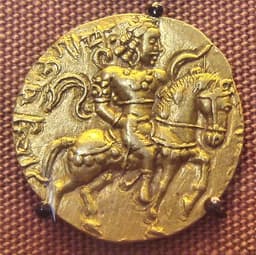
Chandragupta II
Emperor · Ancient
74.7Total

Julius Caesar
General · Ancient
82.8Total
Basic Information
Born
380
-100
Died
415
-44
Era
Ancient
Ancient
Nationality
India
Roman Republic
Occupation
Emperor
General
Civilization
Indian
Western
Score Comparison
Military (10%)
74.0
88.0
Political (20%)
78.0
78.0
Influence (20%)
88.0
85.0
Legacy (20%)
65.0
82.0
Leadership (15%)
72.0
80.0
Strategy (15%)
65.4
85.0
TOTAL
74.7
82.8
Chandragupta II — Complete Timeline
380 AD
Accession to the Gupta ThronePolitical Action
Chandragupta II succeeded his father Samudragupta as emperor of the Gupta Empire. He inherited a vast territory and continued the expansionist policies, further consolidating Gupta power in northern India.
Gupta EmpireSuccessionExpansion
Impact: regional
385 AD
Marriage Alliance with the VakatakasPolitical Action◆ Major
Chandragupta II married his daughter Prabhavatigupta to the Vakataka king Rudrasena II. After Rudrasena's death, Prabhavatigupta ruled as regent, effectively bringing the Vakataka kingdom under Gupta influence and securing the Deccan frontier.
VakatakaAllianceDeccan
Impact: regionalconstructive
395 AD
Conquest of the Western SatrapsWar◆ Major
Chandragupta II defeated the Western Kshatrapas (Saka rulers) in Gujarat and Malwa, annexing their territories. This conquest gave the Gupta Empire access to the Arabian Sea ports and control over lucrative trade routes with the Roman Empire.
Western SatrapsGujaratTrade
Impact: regional
400 AD
Patronage of the Golden Age of Gupta CultureCultural◆ Major
Chandragupta II's court included the poet Kalidasa, the astronomer Varahamihira, and other scholars. This period saw the flourishing of Sanskrit literature, art, and science, often considered the peak of classical Indian culture.
Golden AgeKalidasaSanskrit Literature
Impact: regionalconstructive
405 AD
Visit of the Chinese Pilgrim FaxianCultural
The Chinese Buddhist monk Faxian visited the Gupta Empire during Chandragupta II's reign. Faxian recorded the prosperity, religious tolerance, and efficient administration of the empire, providing valuable historical documentation.
FaxianChinese PilgrimBuddhism
Impact: regionalconstructive
Julius Caesar — Complete Timeline
58 BC
Gallic WarsWar◆ Major
Caesar, as proconsul of Gaul, launched a series of campaigns that conquered all of Gaul (modern France, Belgium, and parts of Switzerland). He fought numerous battles, including against the Helvetii, the Belgae, and the Gallic chieftain Vercingetorix. The wars brought immense wealth and a loyal army to Caesar.
Gallic WarsConquestRoman Expansion
Impact: regional
49 BC
Crossing the RubiconPolitical Action◆ Major
Caesar led Legio XIII across the Rubicon River into Italy, defying the Roman Senate's order to disband his army. This act triggered a civil war against Pompey and the Optimates, ultimately leading to Caesar's dictatorship and the end of the Roman Republic.
Roman Civil WarEnd of RepublicPower Struggle
Impact: global
48 BC
Battle of PharsalusWar◆ Major
Caesar's outnumbered army defeated the larger forces of Pompey the Great at Pharsalus in Greece. Caesar's tactical use of a reserve line to counter Pompey's cavalry charge proved decisive. Pompey fled to Egypt, where he was assassinated, leaving Caesar as the undisputed master of the Roman world.
Roman Civil WarBattleDecisive Victory
Impact: regional
44 BC
Appointment as Dictator for LifePolitical Action◆ Major
The Roman Senate appointed Caesar dictator perpetuo (dictator for life), granting him unprecedented personal power. This move concentrated military, legislative, and judicial authority in one person, effectively ending the Roman Republic's traditional system of checks and balances and alarming many senators.
DictatorshipEnd of RepublicPower Consolidation
Impact: regionaldestructive
Assassination on the Ides of MarchPolitical Action◆ Major
A group of Roman senators, led by Marcus Junius Brutus and Gaius Cassius Longinus, stabbed Caesar to death at a meeting of the Senate in the Theatre of Pompey. The assassination was intended to restore the Republic, but instead triggered another civil war that led to the rise of the Roman Empire.
AssassinationRoman PoliticsEnd of Republic
Impact: globaldestructive
Expert Analysis
chandragupta-ii-vs-julius-caesar
# The Conqueror and the Sage: Two Visions of Power in the Ancient World
On a cold March morning in 44 BCE, Julius Caesar walked into the Senate chamber in Rome, ignoring a soothsayer’s warning that danger would come before the Ides of March. Within minutes, sixty senators had surrounded him, their daggers flashing. He fell at the base of Pompey’s statue, bleeding from twenty-three wounds. Across the world, in the Indian subcontinent, a very different scene unfolded some four centuries later. In the court of Pataliputra, Chandragupta II presided over a kingdom so prosperous that a visiting Chinese monk, Faxian, would write of a land where “the people are rich and happy,” where no one was taxed too heavily, and where criminals were punished only with fines. One ruler died violently, his ambition having shattered a republic. The other died in peace, his reign remembered as a golden age. What drove such different outcomes?
Origins
Julius Caesar was born into a patrician family that had lost much of its political influence. Rome in the first century BCE was a cauldron of civil wars, class conflict, and a crumbling republican system. Caesar grew up watching generals like Marius and Sulla march on Rome itself, proving that military loyalty now trumped constitutional law. The young aristocrat learned early that in such a world, only personal power and glory mattered. He was educated in rhetoric and philosophy, but the real lessons came from observing how ruthlessly Roman politics devoured the weak.
Chandragupta II, by contrast, inherited a stable empire. His father, Samudragupta, had expanded the Gupta realm through military campaigns, but he also left behind a well-oiled administrative machine. The Gupta Empire in 380 CE was not a republic in crisis but a monarchy at peace. Chandragupta II grew up in a world where power was inherited, not seized, and where the ideal ruler was not a conqueror but a patron of arts and dharma. The contrast in their formative environments could not be starker: one man was forged in a furnace of competition, the other in a garden of tradition.
Rise to Power
Caesar’s path was a masterclass in political ambition. He borrowed enormous sums to stage lavish games, bought his way into the priesthood, and allied himself with the wealthy Crassus and the popular general Pompey. His appointment as governor of Gaul at age forty gave him what he truly needed: an army. Over eight years, from 58 to 50 BCE, he conquered all of Gaul, reportedly killing a million people and enslaving another million. The conquest made him a legend and his soldiers fanatically loyal. When the Senate ordered him to disband his army, he crossed the Rubicon River in 49 BCE, igniting a civil war that would end the Republic.
Chandragupta II’s rise was quieter but no less strategic. He succeeded his father in 380 CE without any recorded struggle. His first major move was a marriage alliance in 385 CE: he wed his daughter Prabhavatigupta to the Vakataka king Rudrasena II. When Rudrasena died young, Prabhavatigupta ruled as regent, effectively bringing the Vakataka kingdom under Gupta influence. This was not a conquest of swords but of family ties—a subtle, patient approach utterly foreign to Caesar’s world of legions and battlefields.
Leadership & Governance
Caesar governed as a revolutionary. As dictator, he reformed the calendar, granted citizenship to provincials, initiated public works, and centralized power in his own hands. His military genius was undeniable—he wrote commentaries that are still studied in war colleges—but his political wisdom was compromised by his contempt for the old aristocracy. He pardoned his enemies, only to have them assassinate him. He tried to rule as a king without the title, a contradiction that proved fatal.
Chandragupta II governed as a caretaker of civilization. His conquest of the Western Satraps in 395 CE was a significant military achievement, but it was the exception, not the rule. His real genius lay in administration and culture. Under his patronage, the poet Kalidasa wrote works like *Shakuntala*, the astronomer Varahamihira advanced mathematics, and the Chinese pilgrim Faxian marveled at the empire’s justice system and prosperity. Chandragupta II did not need to be a brilliant general because his empire was not under existential threat. He could afford to be a philosopher-king.
Triumph & Tragedy
Caesar’s greatest moment was his triumph over Gaul, a conquest that doubled Rome’s territory and made him the most famous man in the known world. His greatest tragedy was his assassination, which came just as he was planning a campaign against Parthia. He died not in battle, but at the hands of men he had spared, a bitter irony that speaks to his failure to understand that in Rome, mercy was often seen as weakness.
Chandragupta II’s triumph was not a single battle but an era. His reign from 380 to 415 CE is considered the apex of the Gupta Golden Age, a time of peace, artistic flowering, and religious tolerance. His tragedy, if it can be called one, is that his achievements were cultural rather than dramatic. He left no epic conquests, no stirring last words, no dramatic fall. He simply ruled well, and then he died.
Character & Destiny
Caesar was driven by an insatiable hunger for glory. He once said, “It is better to be the first man in a village than the second man in Rome.” His personality—bold, charismatic, and utterly ruthless—shaped every decision. He took risks that would have destroyed a lesser man, and they paid off until they didn’t. His destiny was to be the bridge between Republic and Empire, a role that required him to be both builder and destroyer.
Chandragupta II was driven not by personal ambition but by a sense of duty to his dynasty and dharma. His personality is harder to discern from the historical record, but the evidence suggests he was patient, diplomatic, and culturally sophisticated. His destiny was to be a steward of civilization, not its transformer. He did not need to change the world; he only needed to keep it running well.
Legacy
Caesar’s legacy is the Roman Empire itself. His name became a title—*Kaiser* in German, *Tsar* in Russian. He changed the course of Western history, but at a terrible cost: the end of the Republic and centuries of autocracy. He is remembered as both a hero and a tyrant, a man whose brilliance was matched only by his ambition.
Chandragupta II’s legacy is the idea of a golden age. In India, his reign is remembered as a time when art, science, and philosophy flourished under a just ruler. He did not create an empire that would last for millennia, but he created a moment of such cultural brilliance that it still shines through the centuries. He is remembered not as a conqueror, but as a patron.
Conclusion
Standing at the edge of the Mediterranean and the heart of the Ganges, these two rulers embody two different answers to the same question: what makes a great leader? Caesar believed greatness meant changing the world through force of will. Chandragupta believed it meant preserving and enriching what was already good. One died with a dagger in his chest, the other with a legacy of peace. Perhaps the final irony is that both were right. The world needs conquerors to break the old and patrons to build the new. The tragedy is that they rarely come in the same person.
Rankings
🥇
Julius CaesarLeader
Mil: 88.0Pol: 78.0Inf: 85.0
82.8
🥈
Chandragupta II
Mil: 74.0Pol: 78.0Inf: 88.0
74.7
+8.1 behind
How This Comparison Works
Algorithm
Each figure is scored on 6 dimensions (0—100 scale) based on structured historical data: Military (10%), Political (20%), Influence (20%), Legacy (20%), Leadership (15%), Strategy (15%). The weighted total produces the final ranking.
Data Sources
Scores are computed from structured sub-indicators in the database. Scale factors adjust for era (Ancient ×0.85, Modern ×1.0) and civilization size (Eastern ×1.05, Other ×0.80) to account for differences in population and military scale.
Maximum 3 Figures
Comparisons are limited to 2—3 figures to ensure readability and statistical meaningfulness.
Error Margins
±5 points per dimension — Sub-scores are derived from historical records with inherent uncertainty. Two figures within 5 points on a dimension should be considered roughly equivalent in that area.
Total Score Accuracy
±3 points overall — The weighted combination of 6 dimensions produces a total score with approximately ±3 points of uncertainty. Differences of less than 3 points are not statistically significant— the figures are effectively tied.
Known Limitations
- Historical records are incomplete and uneven across civilizations
- Figures from oral-tradition societies may be underrepresented
- Occupation labels can misclassify multi-role figures
- Scores measure capability and impact, not moral character
- Quantitative scoring is a comparison tool, not absolute truth
Capability Radar
Military (10%) — Battles & Warfare
Battles
75
95
Win Rate
80
92
Expansion
80
97
Political (20%) — Governance & Reform
Reform
80
90
Diplomacy
75
85
Economy
90
82
Influence (20%) — Cultural & Global Reach
Cultural
95
88
Global
70
94
Legacy (20%) — Historical Impact
Historical
90
95
Longevity
85
96
Leadership (15%) — Power & Stability
Tenure
85
75
Stability
85
60
Strategy (15%) — Tactics & Innovation
Strategy
75
94
Tactics
70
96
Reform
65
88
Similar Comparisons
Comments & Discussion
TheShadowOfPompey6/17/2026
Caesar was a tactical genius, no question—but his political arrogance undid him. He centralized power, crushed the Senate’s authority, and left enemies alive to plot his end. Chandragupta II, by contrast, maintained a decentralized Gupta bureaucracy that kept nobles loyal without fear. Caesar died because he made himself the target; Chandragupta died old and respected because he built systems, not just a personality cult. One man fought for legacy; the other built a lasting state.
罗马的铁锈6/17/2026
说凯撒是伟人?他根本不懂治理,只会打仗和搞宣传。他把平民当工具,对高卢人搞种族清洗,死时连个稳定的继承人都没留。反观笈多王朝的超日王,用贸易和宗教宽容巩固帝国,连法显都夸老百姓“富足安乐”。凯撒的罗马最后烂在暴君手里,笈多却滋养了五百年文化——这叫“伟大”?这叫早该淘汰的军阀思维。
SkepticalScroll6/17/2026
Comparing GDP or “golden ages” across millennia is historiography at its laziest. We have no reliable economic data for Chandragupta II’s India—Faxian’s glowing travelogue is propaganda, not a ledger. Caesar’s Rome had debt crises, bread riots, and murder rates that would shock a modern city. We’re comparing a single Chinese monk’s cherry-picked observations with Cicero’s bitter letters. Both men presided over violent, unequal societies; one just had better PR.
橘中虎6/17/2026
超日王被过誉了,他的“黄金时代”建立在笈多对萨陀罗·罗多王朝的屠杀上。他灭了西萨特拉普王国,把对手贵族吊死在城墙上——这和凯撒在高卢的屠杀有什么区别?只不过印度没留下那么多历史记载,让后人能美化他。凯撒至少写了《高卢战记》自己背锅,超日王全靠佛教僧侣吹捧。暴力在两边都一样,只是书写历史的笔不同。