Loading...
This comparison has not been analyzed yet.
One-time AI generation (~1 minute). Scores and timeline are already available below.
Chandragupta II vs King Huiwen of Qin
Chandragupta II leads by 10.4 pts · 2 figures compared
…
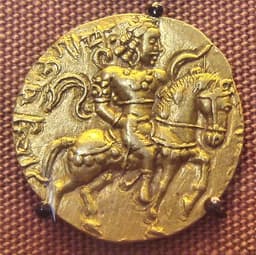
Chandragupta II
Emperor · Ancient
74.7Total

King Huiwen of Qin
Emperor · Ancient
64.3Total
Basic Information
Born
380
-356
Died
415
-311
Era
Ancient
Ancient
Nationality
India
Qin
Occupation
Emperor
Emperor
Civilization
Indian
Eastern
Score Comparison
Military (10%)
74.0
74.7
Political (20%)
78.0
72.0
Influence (20%)
88.0
60.0
Legacy (20%)
65.0
58.0
Leadership (15%)
72.0
66.0
Strategy (15%)
65.4
66.3
TOTAL
74.7
64.3
Chandragupta II — Complete Timeline
380 AD
Accession to the Gupta ThronePolitical Action
Chandragupta II succeeded his father Samudragupta as emperor of the Gupta Empire. He inherited a vast territory and continued the expansionist policies, further consolidating Gupta power in northern India.
Gupta EmpireSuccessionExpansion
Impact: regional
385 AD
Marriage Alliance with the VakatakasPolitical Action◆ Major
Chandragupta II married his daughter Prabhavatigupta to the Vakataka king Rudrasena II. After Rudrasena's death, Prabhavatigupta ruled as regent, effectively bringing the Vakataka kingdom under Gupta influence and securing the Deccan frontier.
VakatakaAllianceDeccan
Impact: regionalconstructive
395 AD
Conquest of the Western SatrapsWar◆ Major
Chandragupta II defeated the Western Kshatrapas (Saka rulers) in Gujarat and Malwa, annexing their territories. This conquest gave the Gupta Empire access to the Arabian Sea ports and control over lucrative trade routes with the Roman Empire.
Western SatrapsGujaratTrade
Impact: regional
400 AD
Patronage of the Golden Age of Gupta CultureCultural◆ Major
Chandragupta II's court included the poet Kalidasa, the astronomer Varahamihira, and other scholars. This period saw the flourishing of Sanskrit literature, art, and science, often considered the peak of classical Indian culture.
Golden AgeKalidasaSanskrit Literature
Impact: regionalconstructive
405 AD
Visit of the Chinese Pilgrim FaxianCultural
The Chinese Buddhist monk Faxian visited the Gupta Empire during Chandragupta II's reign. Faxian recorded the prosperity, religious tolerance, and efficient administration of the empire, providing valuable historical documentation.
FaxianChinese PilgrimBuddhism
Impact: regionalconstructive
King Huiwen of Qin — Complete Timeline
325 BC
Adoption of the title of kingPolitical Action◆ Major
Duke Huiwen of Qin formally adopted the title of king (wang), breaking the Zhou monopoly on royal titles. This act asserted Qin's independence and ambition, setting a precedent for other states to claim kingship during the Warring States period.
QinTitleWarring States
Impact: national
316 BC
Conquest of ShuWar◆ Major
King Huiwen of Qin sent general Sima Cuo to conquer the Shu state in the Sichuan Basin. The acquisition of Shu's fertile lands and resources provided Qin with a strategic base for expansion and a major economic advantage over rival states.
QinConquestShu
Impact: regional
This comparison has not been analyzed yet.
One-time AI generation (~1 minute). Scores and timeline are already available below.
Rankings
🥇
Chandragupta IILeader
Mil: 74.0Pol: 78.0Inf: 88.0
74.7
🥈
King Huiwen of Qin
Mil: 74.7Pol: 72.0Inf: 60.0
64.3
+10.4 behind
How This Comparison Works
Algorithm
Each figure is scored on 6 dimensions (0—100 scale) based on structured historical data: Military (10%), Political (20%), Influence (20%), Legacy (20%), Leadership (15%), Strategy (15%). The weighted total produces the final ranking.
Data Sources
Scores are computed from structured sub-indicators in the database. Scale factors adjust for era (Ancient ×0.85, Modern ×1.0) and civilization size (Eastern ×1.05, Other ×0.80) to account for differences in population and military scale.
Maximum 3 Figures
Comparisons are limited to 2—3 figures to ensure readability and statistical meaningfulness.
Error Margins
±5 points per dimension — Sub-scores are derived from historical records with inherent uncertainty. Two figures within 5 points on a dimension should be considered roughly equivalent in that area.
Total Score Accuracy
±3 points overall — The weighted combination of 6 dimensions produces a total score with approximately ±3 points of uncertainty. Differences of less than 3 points are not statistically significant— the figures are effectively tied.
Known Limitations
- Historical records are incomplete and uneven across civilizations
- Figures from oral-tradition societies may be underrepresented
- Occupation labels can misclassify multi-role figures
- Scores measure capability and impact, not moral character
- Quantitative scoring is a comparison tool, not absolute truth
Capability Radar
Military (10%) — Battles & Warfare
Battles
75
65
Win Rate
80
70
Expansion
80
75
Political (20%) — Governance & Reform
Reform
80
85
Diplomacy
75
80
Economy
90
75
Influence (20%) — Cultural & Global Reach
Cultural
95
60
Global
70
60
Legacy (20%) — Historical Impact
Historical
90
75
Longevity
85
70
Leadership (15%) — Power & Stability
Tenure
85
70
Stability
85
65
Strategy (15%) — Tactics & Innovation
Strategy
75
75
Tactics
70
60
Reform
65
80
Similar Comparisons
Comments & Discussion
No comments yet. Be the first to share your thoughts!