Loading...
Catherine the Great vs Winston Churchill
Winston Churchill leads by 5.0 pts · 2 figures compared
…
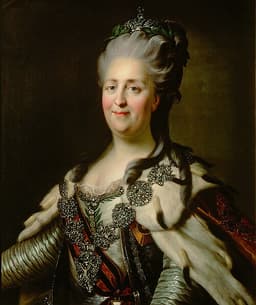
Catherine the Great
Emperor · Modern
66.8Total
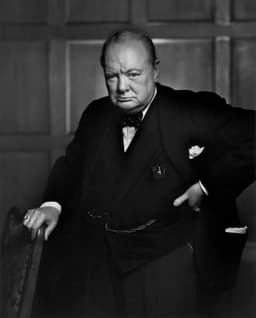
Winston Churchill
Politician · Modern
71.8Total
Basic Information
Born
1729
1874
Died
1796
1965
Era
Modern
Modern
Nationality
Russia
United Kingdom
Occupation
Emperor
Politician
Civilization
Western
Western
Score Comparison
Military (10%)
78.5
55.0
Political (20%)
90.0
78.0
Influence (20%)
65.0
75.0
Legacy (20%)
40.0
68.0
Leadership (15%)
80.0
82.0
Strategy (15%)
72.0
65.0
TOTAL
66.8
71.8
Catherine the Great — Complete Timeline
1762 AD
Coup d'État of 1762Political Action
Catherine II led a coup d'
CoupAccessionPower
Impact: national
1764 AD
Hermitage Museum FoundedCultural◆ Major
Catherine the Great founded the Hermitage Museum in St. Petersburg by purchasing a large collection of paintings from Berlin. The museum grew into one of the world's largest art collections, reflecting her patronage of Enlightenment culture.
ArtMuseumEnlightenment
Impact: globalconstructive
1768 AD
Russo-Turkish War (1768-1774)War◆ Major
Catherine the Great initiated a war against the Ottoman Empire, resulting in Russian victory. The Treaty of K
WarOttoman EmpireExpansion
Impact: regional
1783 AD
Annexation of CrimeaPolitical Action◆ Major
Catherine the Great formally annexed the Crimean Peninsula from the Ottoman Empire. This strategic acquisition gave Russia a dominant position in the Black Sea and a warm-water port, fulfilling a long-standing imperial ambition.
AnnexationCrimeaBlack Sea
Impact: regional
1785 AD
Charter to the Gentry GrantedReform◆ Major
Catherine the Great issued the Charter to the Gentry, which codified the rights and privileges of the Russian nobility. It exempted nobles from taxation and military service, solidifying their social status and support for her rule.
NobilityReformSocial Structure
Impact: nationalconstructive
Winston Churchill — Complete Timeline
1940 AD
Appointed Prime Minister of the United KingdomPolitical Action◆ Major
On May 10, 1940, Winston Churchill became Prime Minister of the United Kingdom, replacing Neville Chamberlain. His appointment came as Nazi Germany invaded France and the Low Countries, and Churchill formed a coalition government to lead Britain through World War II.
World War IILeadershipCoalition Government
Impact: globalconstructive
Delivered the 'We Shall Fight on the Beaches' SpeechOther◆ Major
On June 4, 1940, Churchill delivered a speech to the House of Commons following the evacuation of British forces from Dunkirk. He declared that Britain would fight on the beaches, landing grounds, fields, streets, and hills, and never surrender, rallying British morale during the darkest days of World War II.
World War IIOratoryMorale
Impact: nationalconstructive
1941 AD
Signed the Atlantic CharterOther◆ Major
On August 14, 1941, Churchill and U.S. President Franklin D. Roosevelt signed the Atlantic Charter aboard HMS Prince of Wales. This joint declaration outlined post-war goals including self-determination, disarmament, and free trade, and became a foundational document for the Allied war aims and the United Nations.
World War IIAllied CooperationPost-war Planning
Impact: globalconstructive
1945 AD
Attended the Yalta ConferenceOther◆ Major
In February 1945, Churchill attended the Yalta Conference with Roosevelt and Stalin to discuss the post-war reorganization of Europe. The conference agreed on the division of Germany, the establishment of the United Nations, and the fate of Eastern Europe, though Churchill later expressed regret over concessions to Stalin.
World War IIPost-war SettlementBig Three
Impact: global
1946 AD
Delivered the 'Iron Curtain' SpeechOther◆ Major
On March 5, 1946, Churchill delivered a speech at Westminster College in Fulton, Missouri, where he stated that an 'iron curtain' had descended across Europe from Stettin to Trieste. This speech is widely regarded as marking the beginning of the Cold War, as it highlighted the division between Soviet-controlled Eastern Europe and the West.
Cold WarSoviet UnionDivision of Europe
Impact: globaldestructive
1953 AD
Awarded the Nobel Prize in LiteratureOther◆ Major
In 1953, Churchill was awarded the Nobel Prize in Literature for his historical writings, particularly 'The Second World War' and 'A History of the English-Speaking Peoples'. The Nobel committee cited his mastery of historical and biographical description as well as his brilliant oratory in defending human values.
LiteratureNobel PrizeHistorical Writing
Impact: nationalconstructive
Expert Analysis
Winston Churchill vs Catherine the Great
### The Iron and the Velvet: Churchill and Catherine the Great
In the winter of 1941, as German bombs rained on London, a stout man in a siren suit growled into a microphone, promising blood, toil, tears, and sweat. One hundred and seventy-nine years earlier, in the summer of 1762, a German princess in a Russian uniform led her guards to the Winter Palace, bloodless but decisive, to claim an empire. One fought for survival; the other seized destiny. What separates a wartime icon from an Enlightenment empress? The answer lies not just in their deeds, but in the very fabric of their ages, their ambitions, and the shadows they cast.
### Origins
Winston Churchill was born into the British aristocracy in 1874, the son of a brilliant but erratic politician and an American heiress. His world was one of empire, privilege, and expectation—yet he was a poor student, deemed slow by his teachers, and haunted by a father who dismissed him as a failure. Catherine, born Sophie of Anhalt-Zerbst in 1729, was a minor German princess in a patchwork of petty states. Her world was one of courts, marriages, and survival. Where Churchill’s England was a stable, global power, Catherine’s Russia was a raw, sprawling empire still shaking off the shadow of Peter the Great. Churchill’s era was one of industrialized war; Catherine’s was one of enlightened absolutism, where a ruler could correspond with Voltaire while crushing a peasant revolt.
### Rise to Power
Churchill’s path was a long, winding climb. He rode in cavalry charges in Sudan, escaped from a Boer prison camp, and crossed the floor of Parliament twice—a man of restless ambition who often seemed his own worst enemy. By 1940, at age sixty-five, he was seen as a washed-up adventurer, a Cassandra warning of Hitler while his colleagues appeased. Then came the hour of supreme crisis, and a nation turned to the man who had been preparing for it all his life.
Catherine’s rise was a palace coup, swift and surgical. She arrived in Russia at fifteen to marry the neurotic, German-loving Grand Duke Peter. For eighteen years, she endured a miserable marriage, learned Russian, converted to Orthodoxy, and cultivated allies among the guards and nobility. When her husband became Tsar Peter III and began alienating every power base—from the army to the Church—she struck. On July 9, 1762, with the help of her lover Grigory Orlov and the Imperial Guard, she rode to the Winter Palace and was proclaimed Empress. Peter abdicated and died days later, likely murdered. Churchill rose through crisis; Catherine created it.
### Leadership & Governance
As Prime Minister, Churchill was a war leader, not a peacetime administrator. His genius was in oratory—the defiant speeches that became the soundtrack of British resistance—and in strategy, forging the Grand Alliance with Roosevelt and Stalin. He micromanaged the war effort, but his domestic record was weak; he lost the 1945 election while still at the Potsdam Conference. His political wisdom was instinctive, not systematic.
Catherine, by contrast, governed for thirty-four years of peace and expansion. She corresponded with the philosophes, founded the Hermitage Museum in 1764, and issued the Charter to the Gentry in 1785, codifying noble privileges. She expanded Russia’s borders dramatically, winning the Russo-Turkish War of 1768–1774 and annexing Crimea in 1783. But her reforms were selective: she championed education and law while tightening serfdom, and her Pugachev Rebellion (1773–1775) exposed the brutal limits of her Enlightenment. She was a pragmatist who used ideas as ornaments, not engines.
### Triumph & Tragedy
Churchill’s triumph is singular: he saved Britain from Nazi conquest and helped shape the post-war world. His tragedy is that he won the war but lost the peace—his empire dissolved, his nation bankrupt, and his warnings about Stalin’s Soviet Union largely ignored until too late. He died in 1965, a national hero, but haunted by the decline he could not stop.
Catherine’s triumphs were territorial and cultural: she made Russia a European power, and her court dazzled the continent. Her tragedy was that her reforms were a veneer. She spoke of liberty while expanding serfdom, and her legacy of absolutism, combined with territorial overreach, sowed seeds for future revolutions. She died in 1796, still on the throne, but her son Paul reversed many of her policies.
### Character & Destiny
Churchill was a man of immense ego and melancholy, prone to depression (his “black dog”) and driven by a romantic vision of British greatness. His decisions were shaped by a belief in destiny—that he was born for this hour. Catherine was colder, more calculating. She was a master of appearances, a woman who ruled a patriarchal empire through charm, intellect, and ruthlessness. Where Churchill roared, Catherine seduced. Both were gamblers, but Churchill gambled on survival, Catherine on expansion.
### Legacy
Churchill is remembered as the bulldog of democracy, his speeches carved into stone. Yet his legacy is contested: his views on empire, race, and India are increasingly scrutinized. Catherine is the “Great” of Russian history, a symbol of imperial grandeur, but also of the gap between Enlightenment ideals and autocratic reality. Her Hermitage endures; her serfs do not.
### Conclusion
Churchill and Catherine never met, but they share a strange symmetry. Both were outsiders who became insiders, both wielded power in eras of transition, and both left behind contradictions that still haunt their nations. Churchill’s Britain was fighting for its life; Catherine’s Russia was fighting for its place. One gave voice to a people under siege; the other gave shape to an empire that would outlast her. In the end, what separates them is not their scores—nearly identical on paper—but the nature of their worlds. Churchill’s was a stage of fire; Catherine’s, a stage of mirrors. Both played their parts masterfully, but the play itself was different. And the audience is still debating who truly triumphed.
Rankings
🥇
Winston ChurchillLeader
Mil: 55.0Pol: 78.0Inf: 75.0
71.8
🥈
Catherine the Great
Mil: 78.5Pol: 90.0Inf: 65.0
66.8
+5.0 behind
How This Comparison Works
Algorithm
Each figure is scored on 6 dimensions (0—100 scale) based on structured historical data: Military (10%), Political (20%), Influence (20%), Legacy (20%), Leadership (15%), Strategy (15%). The weighted total produces the final ranking.
Data Sources
Scores are computed from structured sub-indicators in the database. Scale factors adjust for era (Ancient ×0.85, Modern ×1.0) and civilization size (Eastern ×1.05, Other ×0.80) to account for differences in population and military scale.
Maximum 3 Figures
Comparisons are limited to 2—3 figures to ensure readability and statistical meaningfulness.
Error Margins
±5 points per dimension — Sub-scores are derived from historical records with inherent uncertainty. Two figures within 5 points on a dimension should be considered roughly equivalent in that area.
Total Score Accuracy
±3 points overall — The weighted combination of 6 dimensions produces a total score with approximately ±3 points of uncertainty. Differences of less than 3 points are not statistically significant— the figures are effectively tied.
Known Limitations
- Historical records are incomplete and uneven across civilizations
- Figures from oral-tradition societies may be underrepresented
- Occupation labels can misclassify multi-role figures
- Scores measure capability and impact, not moral character
- Quantitative scoring is a comparison tool, not absolute truth
Capability Radar
Military (10%) — Battles & Warfare
Battles
85
55
Win Rate
80
60
Expansion
90
40
Political (20%) — Governance & Reform
Reform
90
70
Diplomacy
85
85
Economy
85
60
Influence (20%) — Cultural & Global Reach
Cultural
85
85
Global
80
85
Legacy (20%) — Historical Impact
Historical
85
90
Longevity
80
80
Leadership (15%) — Power & Stability
Tenure
95
75
Stability
80
70
Strategy (15%) — Tactics & Innovation
Strategy
85
85
Tactics
75
65
Reform
90
70
Similar Comparisons
Comments & Discussion
No comments yet. Be the first to share your thoughts!