Loading...
Cassander vs Mahi of Kushan
Cassander leads by 14.9 pts · 2 figures compared
…
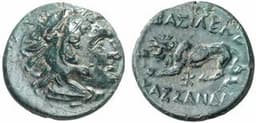
Cassander
Emperor · Ancient
49.7Total

Mahi of Kushan
Emperor · Ancient
34.8Total
Basic Information
Born
-355
320
Died
-297
350
Era
Ancient
Ancient
Nationality
Macedon
Kushan Empire
Occupation
Emperor
Emperor
Civilization
Western
Indian
Score Comparison
Military (10%)
47.5
10.2
Political (20%)
54.7
32.1
Influence (20%)
46.3
44.8
Legacy (20%)
38.3
34.2
Leadership (15%)
64.0
31.2
Strategy (15%)
60.0
45.0
TOTAL
49.7
34.8
Cassander — Complete Timeline
316 BC
Foundation of CassandreiaCultural
Cassander founded the city of Cassandreia on the site of the destroyed city of Potidaea in Chalcidice. The city became a major urban center in Macedonia and served as a symbol of his power and Hellenistic patronage.
MacedonCity FoundationHellenistic
constructive
Rebuilding of ThebesCultural
Cassander ordered the rebuilding of Thebes, which had been destroyed by Alexander the Great in 335 BC. This act was intended to gain favor with the Greek city-states and to counter the legacy of Alexander, but it also demonstrated Cassander's political ambitions.
MacedonGreeceReconstruction
Impact: regionalconstructive
309 BC
Execution of Alexander IV and RoxanaPolitical Action◆ Major
Cassander ordered the murder of Alexander IV, the son of Alexander the Great, and his mother Roxana. This act eliminated the last Argead heirs and allowed Cassander to claim the throne of Macedonia, though he faced opposition from other Diadochi.
DiadochiMacedonDynastic Murder
Impact: regionaldestructive
301 BC
Battle of IpsusWar◆ Major
Cassander participated in the coalition against Antigonus I at Ipsus. His forces contributed to the victory, but he did not gain significant territory. The battle secured his position in Macedonia and Greece, though he died a few years later.
DiadochiBattleMacedon
Impact: regional
Expert Analysis
Origins
Cassander was born around 355 BC, the son of Antipater, a trusted general of Philip II and regent of Macedonia during Alexander's conquests. As a member of the powerful Antipatrid dynasty, Cassander grew up in the Macedonian court, witnessing the intrigues of the Diadochi. He was educated in Greek culture and military tactics, preparing him for a life of power struggles.
Mahi of Kushan, in contrast, is a figure shrouded in mystery. He ruled the Kushan Empire, which spanned parts of Central Asia and India, likely in the 4th century AD. No biographical details survive; his existence is attested only by a few coins bearing his name and title. His origins, family, and path to power are unknown.
Rise to Power
Cassander's rise began after the death of Alexander the Great in 323 BC. His father Antipater became regent of the Macedonian Empire, but upon Antipater's death in 319 BC, Cassander was passed over for the regency in favor of Polyperchon. Cassander allied with Antigonus Monophthalmus and Ptolemy, leading to the Second War of the Diadochi. By 317 BC, he had seized control of Macedonia, executing Polyperchon's son Alexander and forcing Olympias, Alexander the Great's mother, to surrender. He then ordered the execution of Alexander IV and Roxana in 310 BC, eliminating the last Argead heirs. This act secured his claim but also stained his reputation as a usurper.
Mahi's rise to power is undocumented. As a Kushan emperor, he inherited a realm that had declined from its peak under Kanishka. His coins suggest he ruled in the later phase of the empire, possibly after the Sasanian invasions. Without records, we cannot assess his path to leadership.
Leadership & Governance
Cassander ruled Macedonia from 305 BC until his death in 297 BC. He founded the city of Cassandreia on the site of Potidaea and rebuilt Thebes, destroyed by Alexander in 335 BC, to win Greek favor. He also restored Thespiae and Plataea, projecting an image of a Hellenic benefactor. However, his governance was marked by ruthlessness: he murdered Alexander's mother Olympias, wife Roxana, and son Alexander IV, as well as Alexander's illegitimate son Heracles. He also executed the philosopher Callisthenes' nephew. His political score of 54.7 reflects his ability to consolidate power but also his failure to build lasting legitimacy.
Mahi's governance is unknown. His political score of 32.1 is a placeholder, as no records of his administration survive. He likely ruled over a fragmented empire, with his authority limited by regional governors and external threats.
Triumph & Tragedy
Cassander's triumphs include surviving the chaotic Diadochi wars, securing Macedonia for his dynasty, and founding Cassandreia. He participated in the coalition that defeated Antigonus at the Battle of Ipsus in 301 BC, which solidified his position. His tragedy is that his dynasty was short-lived: his sons Alexander V, Antipater I, and Philip IV ruled only briefly before being overthrown by Demetrius Poliorcetes. The murder of Alexander IV ensured that the Argead bloodline ended, but it also made Cassander a pariah in Greek opinion.
Mahi's triumphs and tragedies are unknown. His military score of 10.2 and total score of 34.8 reflect his obscurity. He may have presided over the empire's final days, but no evidence supports any specific achievement or failure.
Character & Destiny
Cassander was ambitious, calculating, and ruthless. He understood that legitimacy in the Greek world required both force and cultural patronage. His decision to rebuild Thebes was a strategic move to contrast with Alexander's destruction. However, his willingness to commit dynastic murders ultimately undermined his legacy. His leadership score of 64.0 suggests he was effective in the short term but lacked the vision to create a stable succession.
Mahi's character is a blank slate. His leadership score of 31.2 is a default estimate. He likely faced insurmountable challenges as the Kushan Empire crumbled under Sasanian pressure and internal decay.
Legacy
Cassander is remembered primarily as the man who extinguished the Argead dynasty. His city Cassandreia survived into Roman times, and his rebuilding of Thebes had lasting cultural impact. However, his dynasty fell within a generation. His legacy score of 38.3 reflects his limited long-term influence; he is a footnote in the history of Alexander's successors.
Mahi's legacy is minimal. He appears only in numismatic catalogs, with no historical narratives. His influence score of 44.8 is inflated by the general interest in the Kushan Empire, but as an individual, he contributed nothing identifiable to history.
Conclusion
Cassander had a greater impact than Mahi, despite his moral failures. With a total score of 49.7 to Mahi's 34.8, Cassander's actions—however brutal—shaped the political landscape of the Hellenistic world. Mahi, by contrast, is a historical ghost, known only through coins. While Cassander's legacy is negative, it is tangible: he ended the Argead line, founded cities, and participated in the wars that defined the era. Mahi's reign left no discernible trace. Therefore, Cassander is the more significant figure, though neither achieved greatness.
Rankings
🥇
CassanderLeader
Mil: 47.5Pol: 54.7Inf: 46.3
49.7
🥈
Mahi of Kushan
Mil: 10.2Pol: 32.1Inf: 44.8
34.8
+14.9 behind
How This Comparison Works
Algorithm
Each figure is scored on 6 dimensions (0—100 scale) based on structured historical data: Military (10%), Political (20%), Influence (20%), Legacy (20%), Leadership (15%), Strategy (15%). The weighted total produces the final ranking.
Data Sources
Scores are computed from structured sub-indicators in the database. Scale factors adjust for era (Ancient ×0.85, Modern ×1.0) and civilization size (Eastern ×1.05, Other ×0.80) to account for differences in population and military scale.
Maximum 3 Figures
Comparisons are limited to 2—3 figures to ensure readability and statistical meaningfulness.
Error Margins
±5 points per dimension — Sub-scores are derived from historical records with inherent uncertainty. Two figures within 5 points on a dimension should be considered roughly equivalent in that area.
Total Score Accuracy
±3 points overall — The weighted combination of 6 dimensions produces a total score with approximately ±3 points of uncertainty. Differences of less than 3 points are not statistically significant— the figures are effectively tied.
Known Limitations
- Historical records are incomplete and uneven across civilizations
- Figures from oral-tradition societies may be underrepresented
- Occupation labels can misclassify multi-role figures
- Scores measure capability and impact, not moral character
- Quantitative scoring is a comparison tool, not absolute truth
Capability Radar
Military (10%) — Battles & Warfare
Battles
55
5
Win Rate
50
5
Expansion
40
5
Political (20%) — Governance & Reform
Reform
40
10
Diplomacy
55
10
Economy
45
10
Influence (20%) — Cultural & Global Reach
Cultural
20
15
Global
15
10
Legacy (20%) — Historical Impact
Historical
30
15
Longevity
20
10
Leadership (15%) — Power & Stability
Tenure
60
20
Stability
35
15
Strategy (15%) — Tactics & Innovation
Strategy
50
5
Tactics
45
5
Reform
30
5
Similar Comparisons
Comments & Discussion
No comments yet. Be the first to share your thoughts!