Loading...
Antiochus IV Epiphanes vs Cassander
Antiochus IV Epiphanes leads by 3.7 pts · 2 figures compared
…

Antiochus IV Epiphanes
Emperor · Ancient
53.4Total
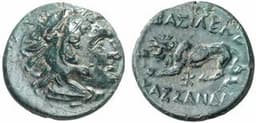
Cassander
Emperor · Ancient
49.7Total
Basic Information
Born
-215
-355
Died
-164
-297
Era
Ancient
Ancient
Nationality
Seleucid Empire
Macedon
Occupation
Emperor
Emperor
Civilization
Middle Eastern
Western
Score Comparison
Military (10%)
72.5
47.5
Political (20%)
39.4
54.7
Influence (20%)
58.0
46.3
Legacy (20%)
52.0
38.3
Leadership (15%)
51.9
64.0
Strategy (15%)
50.0
60.0
TOTAL
53.4
49.7
Antiochus IV Epiphanes — Complete Timeline
175 BC
Accession as King of the Seleucid EmpirePolitical Action◆ Major
Antiochus IV Epiphanes became king of the Seleucid Empire after the death of his brother Seleucus IV Philopator. He seized power while the rightful heir, Demetrius I, was a hostage in Rome. His reign was marked by ambitious expansion and Hellenization policies.
AccessionSeleucid DynastyHellenization
Impact: regional
169 BC
Invasion of EgyptWar◆ Major
Antiochus IV invaded Ptolemaic Egypt, capturing much of the country and besieging Alexandria. He was forced to withdraw after the Roman envoy Gaius Popillius Laenas delivered an ultimatum, famously drawing a circle in the sand around Antiochus and demanding an answer before he left it.
InvasionEgyptRoman Ultimatum
Impact: regional
167 BC
Persecution of the Jews and Desecration of the TemplePolitical Action
Antiochus IV issued decrees forbidding Jewish religious practices, including Sabbath observance and circumcision. He ordered the erection of an altar to Zeus in the Second Temple in Jerusalem and sacrificed pigs, an act known as the 'Abomination of Desolation'. This sparked the Maccabean Revolt.
PersecutionTemple DesecrationMaccabean Revolt
Impact: regionaldestructive
164 BC
Death in PersiaWar◆ Major
Antiochus IV died during a military campaign in Persia, possibly from disease or in battle. His death left the Seleucid Empire weakened and facing internal revolts, including the ongoing Maccabean Revolt in Judea.
DeathCampaignSeleucid Decline
Impact: regional
Cassander — Complete Timeline
316 BC
Foundation of CassandreiaCultural
Cassander founded the city of Cassandreia on the site of the destroyed city of Potidaea in Chalcidice. The city became a major urban center in Macedonia and served as a symbol of his power and Hellenistic patronage.
MacedonCity FoundationHellenistic
constructive
Rebuilding of ThebesCultural
Cassander ordered the rebuilding of Thebes, which had been destroyed by Alexander the Great in 335 BC. This act was intended to gain favor with the Greek city-states and to counter the legacy of Alexander, but it also demonstrated Cassander's political ambitions.
MacedonGreeceReconstruction
Impact: regionalconstructive
309 BC
Execution of Alexander IV and RoxanaPolitical Action◆ Major
Cassander ordered the murder of Alexander IV, the son of Alexander the Great, and his mother Roxana. This act eliminated the last Argead heirs and allowed Cassander to claim the throne of Macedonia, though he faced opposition from other Diadochi.
DiadochiMacedonDynastic Murder
Impact: regionaldestructive
301 BC
Battle of IpsusWar◆ Major
Cassander participated in the coalition against Antigonus I at Ipsus. His forces contributed to the victory, but he did not gain significant territory. The battle secured his position in Macedonia and Greece, though he died a few years later.
DiadochiBattleMacedon
Impact: regional
Expert Analysis
Origins
Antiochus IV Epiphanes was born around 215 BC as a son of King Antiochus III the Great of the Seleucid Empire. He spent his early years as a hostage in Rome (189-175 BC) after his father's defeat at Magnesia. This experience exposed him to Roman power and diplomacy. In contrast, Cassander (c. 355-297 BC) was the son of Antipater, a trusted general of Philip II and regent of Macedonia. Cassander grew up in the court of Philip and Alexander, learning the intricacies of Macedonian politics. His father's position as regent after Alexander's death gave him a privileged but contentious start.
Rise to Power
Antiochus IV came to power in 175 BC after his brother Seleucus IV was assassinated. He seized the throne by posing as the protector of his nephew Demetrius, but soon sidelined the child. His early reign focused on stabilizing the empire and projecting strength, including a successful campaign in Armenia. Cassander's rise was more brutal. After his father Antipater died in 319 BC, Cassander had to fight for control against Polyperchon, the new regent. He allied with Antigonus, Ptolemy, and Lysimachus, and by 316 BC he had secured Macedonia. His key move was ordering the execution of Alexander IV and Roxana in 309 BC, eliminating the last Argead heirs.
Leadership & Governance
Antiochus IV ruled with a blend of Hellenization and centralization. He founded cities like Antioch on the Orontes and promoted Greek culture. However, his heavy-handed policies in Judea—banning Jewish practices and desecrating the Temple in 167 BC—sparked the Maccabean Revolt. His leadership score of 51.9 reflects his mixed effectiveness. Cassander, with a leadership score of 64.0, was more pragmatic. He rebuilt Thebes to gain Greek favor, founded Cassandreia, and strengthened Macedonia's economy. Yet his rule was marked by ruthlessness: he murdered Alexander's mother and son, and also killed Alexander's other wife, Stateira.
Triumph & Tragedy
Antiochus IV's greatest triumph was his invasion of Egypt in 169-168 BC, where he nearly conquered the Ptolemaic kingdom. However, his tragedy came when the Roman envoy Popillius Laenas drew a circle in the sand and ordered him to withdraw—he complied, humiliated. His military score of 72.5 is undermined by this political failure (39.4). Cassander's triumph was his victory at the Battle of Ipsus in 301 BC, where he helped defeat Antigonus. His tragedy was the legacy of dynastic murder: by eliminating Alexander's line, he ensured his own dynasty's illegitimacy. His political score of 54.7 is higher than Antiochus's, but his military score of 47.5 is lower.
Character & Destiny
Antiochus IV was energetic, ambitious, but erratic. His epithet "Epiphanes" (God Manifest) suggests megalomania. He often acted impulsively, as in his Egyptian campaign, leading to Roman confrontation. Cassander was calculating and ruthless. He methodically eliminated rivals, but his cruelty alienated many. Ancient sources describe him as clever but treacherous. Antiochus died in 164 BC during a campaign in Persia, possibly from disease. Cassander died of natural causes in 297 BC, but his dynasty collapsed within a decade.
Legacy
Antiochus IV's legacy is dominated by the Maccabean Revolt, which led to the Hasmonean kingdom and influenced Jewish history. His desecration of the Temple is commemorated in Hanukkah. His influence score of 58.0 reflects this enduring religious impact. Cassander's legacy is more negative: he is remembered as the destroyer of Alexander's dynasty. His rebuilding of Thebes and founding of Cassandreia are overshadowed by his murders. His legacy score of 38.3 is the lowest of the two.
Conclusion
Antiochus IV Epiphanes had a greater historical impact than Cassander. Despite a lower leadership score (51.9 vs 64.0), his military score (72.5 vs 47.5) and influence (58.0 vs 46.3) are higher. His actions sparked a revolt that shaped Jewish identity and religious tradition, while Cassander's murders, though significant, led to his own dynasty's obscurity. The total score of 53.4 vs 49.7 reflects this: Antiochus's legacy, though mixed, resonates more broadly.
Rankings
🥇
Antiochus IV EpiphanesLeader
Mil: 72.5Pol: 39.4Inf: 58.0
53.4
🥈
Cassander
Mil: 47.5Pol: 54.7Inf: 46.3
49.7
+3.7 behind
How This Comparison Works
Algorithm
Each figure is scored on 6 dimensions (0—100 scale) based on structured historical data: Military (10%), Political (20%), Influence (20%), Legacy (20%), Leadership (15%), Strategy (15%). The weighted total produces the final ranking.
Data Sources
Scores are computed from structured sub-indicators in the database. Scale factors adjust for era (Ancient ×0.85, Modern ×1.0) and civilization size (Eastern ×1.05, Other ×0.80) to account for differences in population and military scale.
Maximum 3 Figures
Comparisons are limited to 2—3 figures to ensure readability and statistical meaningfulness.
Error Margins
±5 points per dimension — Sub-scores are derived from historical records with inherent uncertainty. Two figures within 5 points on a dimension should be considered roughly equivalent in that area.
Total Score Accuracy
±3 points overall — The weighted combination of 6 dimensions produces a total score with approximately ±3 points of uncertainty. Differences of less than 3 points are not statistically significant— the figures are effectively tied.
Known Limitations
- Historical records are incomplete and uneven across civilizations
- Figures from oral-tradition societies may be underrepresented
- Occupation labels can misclassify multi-role figures
- Scores measure capability and impact, not moral character
- Quantitative scoring is a comparison tool, not absolute truth
Capability Radar
Military (10%) — Battles & Warfare
Battles
65
55
Win Rate
55
50
Expansion
50
40
Political (20%) — Governance & Reform
Reform
30
40
Diplomacy
40
55
Economy
35
45
Influence (20%) — Cultural & Global Reach
Cultural
55
20
Global
55
15
Legacy (20%) — Historical Impact
Historical
70
30
Longevity
60
20
Leadership (15%) — Power & Stability
Tenure
45
60
Stability
20
35
Strategy (15%) — Tactics & Innovation
Strategy
60
50
Tactics
70
45
Reform
40
30
Similar Comparisons
Comments & Discussion
No comments yet. Be the first to share your thoughts!