Loading...
Cardinal Richelieu vs Napoleon Bonaparte
Napoleon Bonaparte leads by 4.3 pts · 2 figures compared
…
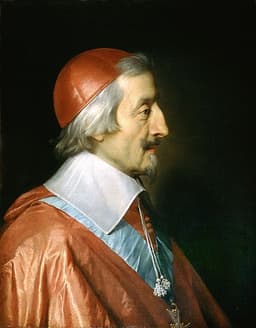
Cardinal Richelieu
Politician · Modern
66.6Total

Napoleon Bonaparte
General · Modern
70.9Total
Basic Information
Born
1585
1769
Died
1642
1821
Era
Modern
Modern
Nationality
France
France
Occupation
Politician
General
Civilization
Western
Western
Score Comparison
Military (10%)
50.0
94.0
Political (20%)
75.0
72.0
Influence (20%)
65.0
40.0
Legacy (20%)
65.0
80.0
Leadership (15%)
75.0
78.0
Strategy (15%)
66.3
90.0
TOTAL
66.6
70.9
Cardinal Richelieu — Complete Timeline
1627 AD
Siege of La RochelleWar◆ Major
Richelieu personally commanded the siege of La Rochelle, a Huguenot stronghold, which lasted 14 months. The city's surrender ended Huguenot political and military power in France, centralizing royal authority and enforcing Catholic uniformity.
SiegeHuguenotsCentralization
Impact: nationaldestructive
1635 AD
Entry of France into the Thirty Years' WarWar
Richelieu declared war on Spain, bringing France directly into the Thirty Years' War on the side of the Protestant powers. This decision prioritized French state interests over Catholic solidarity, aiming to weaken Habsburg dominance in Europe.
War DeclarationThirty Years' WarHabsburg
Impact: global
Establishment of the Académie FrançaiseCultural◆ Major
Richelieu founded the Acad
Cultural InstitutionLanguageRoyal Patronage
Impact: nationalconstructive
Napoleon Bonaparte — Complete Timeline
1799 AD
Coup of 18 BrumaireOther◆ Major
Napoleon Bonaparte, with support from his brother Lucien and key political figures, overthrew the Directory in a bloodless coup. He established the Consulate with himself as First Consul, effectively becoming the ruler of France. This event ended the French Revolution's most unstable period.
French RevolutionCoupRise to Power
Impact: regional
1804 AD
Promulgation of the Napoleonic CodeOther◆ Major
Napoleon enacted the Civil Code of the French, known as the Napoleonic Code, a comprehensive set of laws that replaced the fragmented feudal legal systems. The code established legal equality, protected property rights, and secularized law. It became the basis for legal systems in many European and world countries.
Legal ReformNapoleonic CodeCivil Law
Impact: globalconstructive
1805 AD
Battle of AusterlitzWar◆ Major
Napoleon's Grande Arm
Napoleonic WarsBattleDecisive Victory
Impact: global
1812 AD
Invasion of RussiaWar◆ Major
Napoleon led the Grande Arm
Napoleonic WarsInvasionDisaster
Impact: globaldestructive
1815 AD
Battle of WaterlooWar◆ Major
Napoleon's French army was defeated by the combined forces of the Duke of Wellington's Anglo-Allied army and Gebhard Leberecht von Bl
Napoleonic WarsBattleFinal Defeat
Impact: globaldestructive
Expert Analysis
cardinal-richelieu-vs-napoleon-bonaparte
# The Architect and the Emperor
On a winter morning in 1642, an old man lay dying in his Paris palace, his body ravaged by illness, his mind still sharp as a blade. Across the Channel, English nobles were sharpening their axes for a civil war. In Vienna, Habsburg emperors dreamed of revenge. And in the chambers of the Louvre, a boy king waited to learn if his master had finally released his grip. Cardinal Richelieu did not die in battle. He never held a sword in anger. Yet when he breathed his last, he had reshaped France more profoundly than any general who ever marched across Europe. A century and a half later, another Frenchman would march across that same continent, carrying Richelieu's vision in his saddlebags—but with a sword in his hand.
Origins
Napoleon Bonaparte was born in 1769 on the island of Corsica, a place that had only become French the year before. His family was minor nobility, poor enough to feel hunger, proud enough to resent their new masters. Young Napoleon spoke Italian before French, and his schoolmates mocked his accent. That outsider's fury never left him. He studied artillery at military academies, devoured history and philosophy, and watched the French Revolution tear apart the world he was about to enter.
Armand Jean du Plessis, Cardinal Richelieu, was born in 1585 to a noble family that had served the crown for generations. His father died when he was five, leaving the family in debt, but young Armand was destined for the Church. He became a bishop at twenty-two—the minimum age, and only after a special dispensation from the Pope. Where Napoleon was forged in the fire of revolution, Richelieu was carved in the cold stone of court intrigue. One learned to conquer; the other learned to manipulate.
Rise to Power
Napoleon's ascent was a cannon shot. At twenty-four, he drove the British from Toulon. At twenty-six, he crushed a royalist uprising in Paris with a "whiff of grapeshot." At twenty-seven, he took command of the Italian campaign and astonished Europe by turning a ragged army into a conquering force. By 1799, at thirty, he staged a coup and made himself First Consul. In 1804, he crowned himself Emperor. His path was straight, violent, and upward.
Richelieu's rise was a spider's web. He entered Louis XIII's council in 1616, was exiled in 1617, and spent years patiently rebuilding his position. He became chief minister in 1624, but his power was never secure. The queen mother conspired against him. The king's brother plotted with Spain. The nobility mocked him as a priest playing at politics. Richelieu survived by being indispensable—and terrifying. He crushed the Huguenot stronghold of La Rochelle in a fourteen-month siege that ended in 1628, personally commanding the operation not as a general but as a strategist. He broke the backs of rebellious nobles with executions and exiles. He created the first modern intelligence network, reading his enemies' letters before they wrote them.
Leadership & Governance
Napoleon governed through energy and genius. He reformed French law into the Napoleonic Code, a system that still shapes legal thinking across Europe and the Americas. He centralized education, created the Bank of France, and built roads and canals that connected his empire. He promoted men by merit, not birth—his marshals included a former soldier, a draper's son, and a man who had been a common laborer. But he could not stop conquering. Every victory demanded another, and his political wisdom was always subordinated to his military ambition.
Richelieu governed through patience and calculation. He never sought glory; he sought results. He broke the power of the Habsburgs by dragging France into the Thirty Years' War in 1635, fighting on the side of Protestant powers against Catholic Spain and Austria. He justified this as *raison d'état*—reason of state—a concept he practically invented. He founded the Académie Française in 1635 to standardize and control the French language, understanding that culture was a weapon. He centralized royal power so completely that when Louis XIV later declared "L'État, c'est moi," he was merely stating what Richelieu had already built.
Triumph & Tragedy
Napoleon's greatest moment was Austerlitz in 1805, where he destroyed the combined armies of Russia and Austria with a masterpiece of deception and speed. His worst came at Waterloo in 1815, when his old magic failed, his generals faltered, and the Prussians arrived at dusk. He died in 1821 on Saint Helena, a prisoner of the British, dictating memoirs and dreaming of glory.
Richelieu's triumph was France itself. He died in 1642, having broken the Habsburg ring, tamed the nobility, and handed his king a nation that would dominate Europe for a century. His tragedy was that he was hated by nearly everyone he served. The people cursed him for taxes. The nobles plotted his assassination. The Church distrusted his politics. He died alone, with only his cat for company, knowing that his king—who wept at his deathbed—had often wished him dead.
Character & Destiny
Napoleon was a creature of will. "Impossible is a word to be found only in the dictionary of fools," he said. He believed that destiny was something to be seized, and he seized it with both hands. But his ambition had no limits, and limits eventually find every man. His character—restless, brilliant, arrogant—drove him to conquer Europe and then to lose it.
Richelieu was a creature of discipline. "Secrecy is the first essential in affairs of state," he wrote. He never married, never had children, never sought personal glory. His only passion was France. His character—cold, calculating, patient—allowed him to build something that outlasted him. He did not want to be loved. He wanted to be effective.
Legacy
Napoleon left a legend. His name is synonymous with military genius, with the little corporal who conquered an empire. His legal reforms survive. His code civil remains. But his empire crumbled within a decade of his death, and France never again dominated Europe as it did under him.
Richelieu left a system. The absolutist state he built survived until the French Revolution, and the centralized French government he created persists to this day. The Académie Française still polices the language. The *raison d'état* he championed became the foundation of modern diplomacy. He is remembered not as a hero but as an architect—the man who designed the French state.
Conclusion
Two Frenchmen, two centuries apart, each remade their nation. Napoleon Bonaparte conquered with a sword and changed the world through sheer force of will. Cardinal Richelieu conquered with a quill and changed the world through sheer force of intellect. One burned bright and died young, leaving a trail of glory and ruin. One burned steady and died old, leaving a structure that still stands. The question is not which was greater—it is which we need more. In times of crisis, we call for Napoleons. In times of construction, we need Richelieus. History, mercifully, gives us both.
Rankings
🥇
Napoleon BonaparteLeader
Mil: 94.0Pol: 72.0Inf: 40.0
70.9
🥈
Cardinal Richelieu
Mil: 50.0Pol: 75.0Inf: 65.0
66.6
+4.3 behind
How This Comparison Works
Algorithm
Each figure is scored on 6 dimensions (0—100 scale) based on structured historical data: Military (10%), Political (20%), Influence (20%), Legacy (20%), Leadership (15%), Strategy (15%). The weighted total produces the final ranking.
Data Sources
Scores are computed from structured sub-indicators in the database. Scale factors adjust for era (Ancient ×0.85, Modern ×1.0) and civilization size (Eastern ×1.05, Other ×0.80) to account for differences in population and military scale.
Maximum 3 Figures
Comparisons are limited to 2—3 figures to ensure readability and statistical meaningfulness.
Error Margins
±5 points per dimension — Sub-scores are derived from historical records with inherent uncertainty. Two figures within 5 points on a dimension should be considered roughly equivalent in that area.
Total Score Accuracy
±3 points overall — The weighted combination of 6 dimensions produces a total score with approximately ±3 points of uncertainty. Differences of less than 3 points are not statistically significant— the figures are effectively tied.
Known Limitations
- Historical records are incomplete and uneven across civilizations
- Figures from oral-tradition societies may be underrepresented
- Occupation labels can misclassify multi-role figures
- Scores measure capability and impact, not moral character
- Quantitative scoring is a comparison tool, not absolute truth
Capability Radar
Military (10%) — Battles & Warfare
Battles
55
95
Win Rate
60
90
Expansion
75
95
Political (20%) — Governance & Reform
Reform
95
95
Diplomacy
90
80
Economy
70
85
Influence (20%) — Cultural & Global Reach
Cultural
75
85
Global
75
90
Legacy (20%) — Historical Impact
Historical
85
95
Longevity
80
90
Leadership (15%) — Power & Stability
Tenure
85
85
Stability
80
70
Strategy (15%) — Tactics & Innovation
Strategy
85
95
Tactics
65
98
Reform
70
92
Similar Comparisons
Comments & Discussion
NapoleonWreckingBall6/17/2026
Comparing Richelieu to Napoleon is like comparing the architect to the wrecking ball. Richelieu *built* the French state - centralized power, crushed the Huguenots militarily at La Rochelle, and established the intendant system that actually ran the country. Napoleon just took that machine, put on a fancy uniform, and drove it off a cliff chasing Moscow. Without Richelieu's institutional foundation, Napoleon would have just been a loud Italian with good artillery. The Cardinal won without ever l
老兵不死6/17/2026
拿皇粉丝总吹军功,却不懂治国。黎塞留搞垮了哈布斯堡包围网,把法国从欧洲二流捧成霸主;拿破仑十三年就把这份家底败光——滑铁卢战役仅一天内法军就伤亡25000人,比黎塞留一生所有战争的总和还多。关键不在谁更"伟大",在谁更持久。柯尔贝尔曾说:"红衣主教创造了现代法国,皇帝只是透支了它。"|zh|Napoleon fans always shout about military glory but ignore governance. Richelieu dismantled the Habsburg encirclement, elevating France from second-tier to hegemon; Napoleon squandered that legacy in just thirteen years—Waterloo alone saw 25,000 French casualties in one day, more than all of Richelieu's wars combined. The question isn't who was greater
古典学人6/17/2026
若论治国之道,黎塞留堪比奥古斯都——以"国家理性"为圭臬,用《政治遗书》立下现代集权国家的蓝图;拿破仑则更像亚历山大大帝,靠个人魅力与战争机器维系帝国,身死而国裂。你我皆知,奥古斯都的罗马持续了四百年,亚历山大的帝国不过十年。黎塞留死前说:"法国就是我的遗作。"拿破仑的遗作呢?一部《民法典》和一场未遂的欧洲统一梦。|zh|Richelieu was like Augustus—building a state
GrandQuill706/17/2026
Let's do math. Napoleon's campaigns cost France roughly 1.2 million military dead and billions in economic damage. Richelieu's Thirty Years' War interventions? About 100,000 French soldiers over 13 years, and France *ended* the war richer and with new territory. Napoleon bankrupted the country, got exiled twice, and left France smaller than he found it. Richelieu left France as the dominant European power. The scorecard isn't close. Stop romanticizing the little corporal's body count.|en|Napoleo