Loading...
Cardinal Richelieu vs Count von Beust
Cardinal Richelieu leads by 8.1 pts · 2 figures compared
…
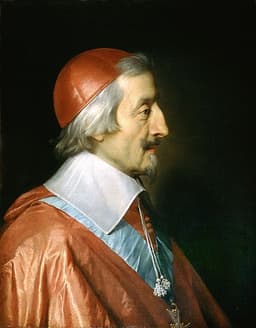
Cardinal Richelieu
Politician · Modern
66.6Total

Count von Beust
Politician · Modern
58.5Total
Basic Information
Born
1585
1809
Died
1642
1886
Era
Modern
Modern
Nationality
France
Austria
Occupation
Politician
Politician
Civilization
Western
Western
Score Comparison
Military (10%)
50.0
50.0
Political (20%)
75.0
70.0
Influence (20%)
65.0
57.2
Legacy (20%)
65.0
50.0
Leadership (15%)
75.0
80.0
Strategy (15%)
66.3
41.9
TOTAL
66.6
58.5
Cardinal Richelieu — Complete Timeline
1627 AD
Siege of La RochelleWar◆ Major
Richelieu personally commanded the siege of La Rochelle, a Huguenot stronghold, which lasted 14 months. The city's surrender ended Huguenot political and military power in France, centralizing royal authority and enforcing Catholic uniformity.
SiegeHuguenotsCentralization
Impact: nationaldestructive
1635 AD
Entry of France into the Thirty Years' WarWar
Richelieu declared war on Spain, bringing France directly into the Thirty Years' War on the side of the Protestant powers. This decision prioritized French state interests over Catholic solidarity, aiming to weaken Habsburg dominance in Europe.
War DeclarationThirty Years' WarHabsburg
Impact: global
Establishment of the Académie FrançaiseCultural◆ Major
Richelieu founded the Acad
Cultural InstitutionLanguageRoyal Patronage
Impact: nationalconstructive
Count von Beust — Complete Timeline
1866 AD
Appointment as Foreign Minister of AustriaPolitical Action◆ Major
Beust was appointed Foreign Minister of Austria after the Austro-Prussian War. He was tasked with rebuilding Austrian influence and finding a new political structure for the empire after its exclusion from Germany.
AppointmentPost-WarDiplomacy
Impact: national
1867 AD
Negotiation of the Austro-Hungarian Compromise (Ausgleich)Political Action
Beust led the negotiations with Hungarian leaders, resulting in the Ausgleich. This agreement transformed the Austrian Empire into the dual monarchy of Austria-Hungary, granting Hungary equal status and internal autonomy.
CompromiseDual MonarchyHungary
Impact: regionalconstructive
Appointment as Chancellor of Austria-HungaryPolitical Action◆ Major
Beust was appointed the first Chancellor of Austria-Hungary after the Ausgleich. He served as the empire's chief minister, focusing on foreign policy and attempting to restore Austrian influence in Germany.
ChancellorshipGovernmentDual Monarchy
Impact: national
1871 AD
Resignation as ChancellorPolitical Action◆ Major
Beust resigned as Chancellor after the Franco-Prussian War, in which Austria-Hungary remained neutral. His policy of seeking revenge against Prussia had failed, and he was replaced by Count Andrassy.
ResignationFranco-Prussian WarPolicy Failure
Impact: national
Expert Analysis
Origins
Cardinal Richelieu, born Armand Jean du Plessis on September 9, 1585, in Paris, came from a minor noble family. His father, François du Plessis, was a courtier under Henry III, but the family's fortunes declined after his death. Richelieu initially trained for a military career but was forced into the clergy to retain the family's bishopric of Luçon. He studied theology at the Collège de Navarre and was consecrated bishop at age 22. His early ecclesiastical career was marked by administrative competence and loyalty to the crown.
Count Friedrich Ferdinand von Beust, born on January 13, 1809, in Dresden, Saxony, was the son of a Saxon diplomat. He studied law and political science at the University of Leipzig and entered the Saxon civil service. His early career was shaped by the conservative Restoration era, and he rose through diplomatic posts, serving as Saxon envoy to Berlin, Paris, and Munich. His formative experiences were in the fragmented German Confederation, where he advocated for Saxon independence against Prussian and Austrian dominance.
Rise to Power
Richelieu's rise began in 1614 when he was elected as a deputy of the clergy to the Estates-General. There, he impressed the regent Marie de' Medici, who appointed him Secretary of State for Foreign Affairs in 1616. However, after the assassination of her favorite Concino Concini, Richelieu fell from favor and was exiled to Avignon in 1617. He returned in 1619 through the mediation of the Pope and reconciled with Marie de' Medici. In 1622, he was made a cardinal, and in 1624, he entered the royal council as chief minister to Louis XIII. By 1629, he had outmaneuvered his rivals, including the Queen Mother, and established himself as the de facto ruler of France.
Beust rose to prominence in Saxony, becoming foreign minister in 1849. He pursued a policy of German dualism, seeking to balance Prussian and Austrian influence. During the Austro-Prussian War of 1866, Saxony fought on Austria's side. After Austria's defeat, Emperor Franz Joseph appointed Beust as Austrian foreign minister in 1866, tasking him with rebuilding the empire's position. Beust's key achievement came in 1867 when he negotiated the Austro-Hungarian Compromise (Ausgleich), transforming the Austrian Empire into the dual monarchy of Austria-Hungary. He then became the first chancellor of the new entity.
Leadership & Governance
Richelieu's governance focused on centralizing royal authority. He systematically dismantled the political power of the Huguenots, exemplified by the 14-month Siege of La Rochelle (1627-1628), which ended their military independence. He suppressed noble conspiracies, executing or imprisoning aristocrats who challenged the king. He reformed the administration by creating intendants—royal agents in the provinces—who bypassed local nobles. He also founded the Académie Française in 1635 to standardize the French language and promote royal patronage of culture. His foreign policy aimed at weakening the Habsburgs, leading to France's entry into the Thirty Years' War in 1635 on the Protestant side, a realpolitik move that prioritized state interests over religion.
Beust's leadership was defined by diplomatic negotiation. The Ausgleich was a pragmatic compromise: Hungary gained internal autonomy and a separate parliament, while common affairs (foreign policy, defense, finance) were managed jointly. Beust's governance style was conciliatory, seeking to stabilize the empire after military defeat. He pursued a revisionist foreign policy, hoping to avenge the 1866 defeat by Prussia, but his plans were thwarted by the Franco-Prussian War (1870-1871), in which Austria-Hungary remained neutral. After the war, his influence waned, and he resigned in 1871.
Triumph & Tragedy
Richelieu's triumphs include the successful centralization of France, the suppression of Huguenot political power, and the expansion of French influence in Europe. His policies laid the groundwork for the absolute monarchy of Louis XIV. However, his heavy taxation to fund wars caused widespread suffering, and his suppression of religious dissent alienated many. The Thirty Years' War, while weakening the Habsburgs, devastated much of Europe and drained French resources. His death in 1642 left a powerful but exhausted state.
Beust's greatest triumph was the Ausgleich, which preserved the Habsburg Empire for another 50 years. It stabilized the monarchy after the 1866 defeat and granted Hungary a stake in the empire. However, the compromise also sowed seeds of future ethnic tensions, as other nationalities (Czechs, Poles, etc.) were not granted similar autonomy. His tragedy was his failure to reverse Prussian dominance in Germany. His policy of revanche against Prussia led nowhere, and his resignation after the Franco-Prussian War marked the end of his influence.
Character & Destiny
Richelieu was ruthless, calculating, and pragmatic. He subordinated personal loyalty to state interests, famously saying, "The reason of state is my guide." He was a master of intrigue, able to manipulate factions and eliminate threats quietly. His character drove him to centralize power at all costs, and his destiny was to become the architect of French absolutism. Historians like William F. Church have noted his ability to combine clerical office with political ambition.
Beust was a skilled diplomat with a conciliatory temperament. He believed in compromise and federalism, which suited the multi-ethnic Habsburg Empire. However, his optimism about reversing Prussian hegemony proved unrealistic. His character led him to seek consensus, but his destiny was to be a transitional figure, bridging the old Austrian Empire and the dual monarchy. He is often seen as a pragmatic conservative.
Legacy
Richelieu's legacy is profound. He established the model of a strong central state, which influenced French governance for centuries. The Académie Française continues to regulate the French language. His foreign policy orientation against the Habsburgs shaped European alliances. His total score of 66.6 reflects his high political (75.0) and leadership (75.0) scores. In contrast, Beust's legacy is more limited. The Ausgleich endured until 1918, but its failure to address nationalism contributed to the empire's collapse. Beust's total score of 58.5 is lower, with his political (70.0) and leadership (80.0) scores showing strengths in diplomacy but lower influence (57.2) and legacy (50.0).
Conclusion
Cardinal Richelieu had a greater impact than Count von Beust. Richelieu's centralization of France created the modern nation-state and set the stage for France's dominance under Louis XIV. His political and strategic innovations (scoring 75.0 and 66.3 respectively) were foundational for European absolutism. Beust's Ausgleich was a significant diplomatic achievement, but it was a compromise that merely postponed the empire's dissolution. Richelieu's reforms endured for centuries, while Beust's work was undone within 50 years. The score gap of 8.1 points reflects this: Richelieu's total of 66.6 versus Beust's 58.5. Richelieu's influence on state-building and international relations remains far more consequential.
Rankings
🥇
Cardinal RichelieuLeader
Mil: 50.0Pol: 75.0Inf: 65.0
66.6
🥈
Count von Beust
Mil: 50.0Pol: 70.0Inf: 57.2
58.5
+8.1 behind
How This Comparison Works
Algorithm
Each figure is scored on 6 dimensions (0—100 scale) based on structured historical data: Military (10%), Political (20%), Influence (20%), Legacy (20%), Leadership (15%), Strategy (15%). The weighted total produces the final ranking.
Data Sources
Scores are computed from structured sub-indicators in the database. Scale factors adjust for era (Ancient ×0.85, Modern ×1.0) and civilization size (Eastern ×1.05, Other ×0.80) to account for differences in population and military scale.
Maximum 3 Figures
Comparisons are limited to 2—3 figures to ensure readability and statistical meaningfulness.
Error Margins
±5 points per dimension — Sub-scores are derived from historical records with inherent uncertainty. Two figures within 5 points on a dimension should be considered roughly equivalent in that area.
Total Score Accuracy
±3 points overall — The weighted combination of 6 dimensions produces a total score with approximately ±3 points of uncertainty. Differences of less than 3 points are not statistically significant— the figures are effectively tied.
Known Limitations
- Historical records are incomplete and uneven across civilizations
- Figures from oral-tradition societies may be underrepresented
- Occupation labels can misclassify multi-role figures
- Scores measure capability and impact, not moral character
- Quantitative scoring is a comparison tool, not absolute truth
Capability Radar
Military (10%) — Battles & Warfare
Battles
55
28
Win Rate
60
31
Expansion
75
33
Political (20%) — Governance & Reform
Reform
95
75
Diplomacy
90
80
Economy
70
60
Influence (20%) — Cultural & Global Reach
Cultural
75
30
Global
75
45
Legacy (20%) — Historical Impact
Historical
85
55
Longevity
80
50
Leadership (15%) — Power & Stability
Tenure
85
65
Stability
80
70
Strategy (15%) — Tactics & Innovation
Strategy
85
39
Tactics
65
39
Reform
70
43
Similar Comparisons
Comments & Discussion
No comments yet. Be the first to share your thoughts!