Loading...
Cardinal Richelieu vs Robert Peel
Cardinal Richelieu leads by 0.6 pts · 2 figures compared
…
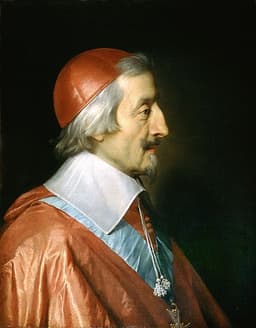
Cardinal Richelieu
Politician · Modern
66.6Total

Robert Peel
Politician · Modern
66.0Total
Basic Information
Born
1585
1788
Died
1642
1850
Era
Modern
Modern
Nationality
France
United Kingdom
Occupation
Politician
Politician
Civilization
Western
Western
Score Comparison
Military (10%)
50.0
50.0
Political (20%)
75.0
85.0
Influence (20%)
65.0
72.0
Legacy (20%)
65.0
55.0
Leadership (15%)
75.0
82.0
Strategy (15%)
66.3
42.4
TOTAL
66.6
66.0
Cardinal Richelieu — Complete Timeline
1627 AD
Siege of La RochelleWar◆ Major
Richelieu personally commanded the siege of La Rochelle, a Huguenot stronghold, which lasted 14 months. The city's surrender ended Huguenot political and military power in France, centralizing royal authority and enforcing Catholic uniformity.
SiegeHuguenotsCentralization
Impact: nationaldestructive
1635 AD
Entry of France into the Thirty Years' WarWar
Richelieu declared war on Spain, bringing France directly into the Thirty Years' War on the side of the Protestant powers. This decision prioritized French state interests over Catholic solidarity, aiming to weaken Habsburg dominance in Europe.
War DeclarationThirty Years' WarHabsburg
Impact: global
Establishment of the Académie FrançaiseCultural◆ Major
Richelieu founded the Acad
Cultural InstitutionLanguageRoyal Patronage
Impact: nationalconstructive
Robert Peel — Complete Timeline
1829 AD
Founded Metropolitan PoliceReform
As Home Secretary, Peel established the Metropolitan Police Act in 1829, creating the first modern professional police force in London. Officers became known as 'bobbies' or 'peelers' after him. This model was later adopted across Britain and influenced policing worldwide.
PoliceLaw EnforcementReform
Impact: globalconstructive
Catholic Emancipation ActReform◆ Major
Peel, despite earlier opposition, supported the Catholic Relief Act 1829, which removed most restrictions on Catholics in the UK. This allowed Catholics to sit in Parliament and hold public office. The act was passed to avoid civil war in Ireland.
Catholic RightsReligious FreedomIreland
Impact: nationalprogressive
1834 AD
Tamworth ManifestoPolitical Action
Peel issued the Tamworth Manifesto in December 1834, outlining the principles of the new Conservative Party. It accepted the Reform Act of 1832 and advocated for moderate reform, establishing the modern Conservative Party's platform and defining 'One Nation' conservatism.
Conservative PartyPolitical ManifestoReform
Impact: nationalconstructive
1842 AD
Mines Act 1842Reform
Peel's government passed the Mines Act 1842, which prohibited women and girls from working underground in coal mines and set a minimum age of 10 for boys. This was a significant labor reform, improving working conditions in the mining industry.
Labor ReformMiningChild Labor
Impact: nationalprogressive
1846 AD
Repeal of the Corn LawsReform
Peel, as Prime Minister, repealed the Corn Laws in June 1846, ending tariffs on imported grain. This split the Conservative Party, as many protectionists opposed free trade. Peel's government fell immediately after, but the repeal lowered food prices and shaped British economic policy.
Free TradeCorn LawsEconomic Policy
Impact: nationalconstructive
Expert Analysis
Origins
**Cardinal Richelieu** (1585–1642) was born Armand Jean du Plessis in Paris to a minor noble family. His father, François du Plessis, served as a grand provost under Henry III, but the family was not wealthy. Richelieu was initially destined for a military career, but after his brother's resignation, he entered the clergy. He studied theology at the Collège de Navarre and was consecrated Bishop of Luçon in 1607 at age 22. His early ecclesiastical career was marked by administrative efficiency and political ambition, which caught the attention of Queen Marie de' Medici.
**Robert Peel** (1788–1850) was born in Bury, Lancashire, to a wealthy cotton manufacturer, Sir Robert Peel, 1st Baronet. His father was a Member of Parliament and a prominent industrialist. Peel was educated at Harrow and Christ Church, Oxford, where he excelled in classics and mathematics. He entered Parliament in 1809 at age 21, representing the family borough of Cashel. His early political career was shaped by his father's influence and his own intellect, quickly rising as a Tory reformer.
Rise to Power
Richelieu rose through the Catholic Church, becoming a cardinal in 1622. His political ascent came when he served as secretary of state to Marie de' Medici, but his real power began in 1624 when he became chief minister to King Louis XIII. He consolidated power by outmaneuvering rivals like the Queen Mother and the nobility, culminating in the Day of the Dupes (1630) when he secured the king's confidence and eliminated opposition. He then pursued a policy of centralization and anti-Habsburg foreign policy.
Peel rose by mastering parliamentary politics. He served as Chief Secretary for Ireland (1812–1818), where he opposed Catholic Emancipation, but later reversed his position in 1829, supporting the Catholic Relief Act. This earned him the enmity of hardline Tories. As Home Secretary (1822–1827, 1828–1830), he reformed criminal law and founded the Metropolitan Police in 1829. He became Prime Minister briefly in 1834–1835 and again in 1841–1846, leading the Conservative Party after issuing the Tamworth Manifesto (1834), which accepted the Reform Act of 1832.
Leadership & Governance
Richelieu governed as an absolutist, centralizing royal authority at the expense of the nobility and Huguenots. He crushed the Huguenot political and military power with the Siege of La Rochelle (1627–1628), ending their right to fortified cities. He also curbed the power of the high nobility, executing or exiling conspirators. His domestic reforms included strengthening the intendant system, improving tax collection, and founding the Académie Française (1635) to standardize French language and culture. In foreign policy, he entered the Thirty Years' War on the side of Protestant powers to weaken the Habsburgs, a strategic move that expanded French influence.
Peel governed as a pragmatic conservative, adapting Tory principles to changing times. As Home Secretary, he reformed the penal code, reducing the number of capital offenses and establishing the Metropolitan Police, which became a model for modern policing. As Prime Minister, his government passed the Mines Act 1842, prohibiting women and girls from working underground, and the Factory Act 1844, limiting child labor. His most significant act was the Repeal of the Corn Laws in 1846, which ended agricultural tariffs and promoted free trade. This split the Conservative Party but demonstrated Peel's willingness to prioritize national interest over party unity.
Triumph & Tragedy
Richelieu's triumphs include the successful centralization of French state power, the reduction of Habsburg dominance, and the establishment of the Académie Française. His military score of 50.0 reflects his indirect role in warfare, but his political score of 75.0 underscores his mastery of statecraft. His tragedy was the harsh suppression of dissent, including the destruction of La Rochelle, which caused immense suffering. His legacy is stained by the authoritarian methods he employed, though they strengthened France.
Peel's triumphs include founding the Metropolitan Police (political score 85.0), which revolutionized law enforcement, and repealing the Corn Laws, which shifted Britain toward free trade. His leadership score of 82.0 reflects his ability to enact major reforms. His tragedy was the split of the Conservative Party over the Corn Laws, ending his political career. He died in 1850 from a riding accident, leaving his party in disarray.
Character & Destiny
Richelieu was calculating, patient, and ruthless. He used spies and propaganda to maintain control, and his ability to retain Louis XIII's trust was key to his longevity. His character shaped his destiny: he died in power in 1642, having achieved his goals but leaving a legacy of centralized absolutism that would culminate in the French Revolution.
Peel was pragmatic, principled, and stubborn. He was known for his integrity and willingness to change his mind, as with Catholic Emancipation and the Corn Laws. His character led to his political downfall because he alienated his party, but his principles earned him historical respect. He died shortly after retiring from politics.
Legacy
Richelieu's legacy is the modern French state: centralized administration, standardized language, and a powerful monarchy. The Académie Française still regulates French language. His foreign policy weakened the Habsburgs and set France on a path to European dominance. His influence score of 65.0 reflects his role in shaping early modern Europe.
Peel's legacy is the modern Conservative Party and the Metropolitan Police, which became a model for police forces worldwide. The repeal of the Corn Laws established free trade as a British policy for decades. His legacy score of 55.0 is lower due to the temporary collapse of his party, but his reforms had lasting impact.
Conclusion
While both were transformative figures, Cardinal Richelieu had greater impact on the structure of European governance. His centralization of French power and his role in the Thirty Years' War reshaped the continent, laying the groundwork for the nation-state system. Peel's reforms were significant but more contained to Britain. Richelieu's political score of 75.0 and influence score of 65.0 edge out Peel's 85.0 and 72.0 respectively when considering the scale of their effects. Richelieu's total score of 66.6 surpasses Peel's 66.0, but more importantly, his actions altered the course of European history for centuries. Therefore, Richelieu had greater historical impact.
Rankings
🥇
Cardinal RichelieuLeader
Mil: 50.0Pol: 75.0Inf: 65.0
66.6
🥈
Robert Peel
Mil: 50.0Pol: 85.0Inf: 72.0
66.0
+0.6 behind
How This Comparison Works
Algorithm
Each figure is scored on 6 dimensions (0—100 scale) based on structured historical data: Military (10%), Political (20%), Influence (20%), Legacy (20%), Leadership (15%), Strategy (15%). The weighted total produces the final ranking.
Data Sources
Scores are computed from structured sub-indicators in the database. Scale factors adjust for era (Ancient ×0.85, Modern ×1.0) and civilization size (Eastern ×1.05, Other ×0.80) to account for differences in population and military scale.
Maximum 3 Figures
Comparisons are limited to 2—3 figures to ensure readability and statistical meaningfulness.
Error Margins
±5 points per dimension — Sub-scores are derived from historical records with inherent uncertainty. Two figures within 5 points on a dimension should be considered roughly equivalent in that area.
Total Score Accuracy
±3 points overall — The weighted combination of 6 dimensions produces a total score with approximately ±3 points of uncertainty. Differences of less than 3 points are not statistically significant— the figures are effectively tied.
Known Limitations
- Historical records are incomplete and uneven across civilizations
- Figures from oral-tradition societies may be underrepresented
- Occupation labels can misclassify multi-role figures
- Scores measure capability and impact, not moral character
- Quantitative scoring is a comparison tool, not absolute truth
Capability Radar
Military (10%) — Battles & Warfare
Battles
55
26
Win Rate
60
32
Expansion
75
33
Political (20%) — Governance & Reform
Reform
95
85
Diplomacy
90
70
Economy
70
80
Influence (20%) — Cultural & Global Reach
Cultural
75
60
Global
75
65
Legacy (20%) — Historical Impact
Historical
85
75
Longevity
80
70
Leadership (15%) — Power & Stability
Tenure
85
75
Stability
80
70
Strategy (15%) — Tactics & Innovation
Strategy
85
41
Tactics
65
40
Reform
70
41
Similar Comparisons
Comments & Discussion
No comments yet. Be the first to share your thoughts!