Loading...
Cao Cao vs Yang Su
Cao Cao leads by 20.3 pts · 2 figures compared
…
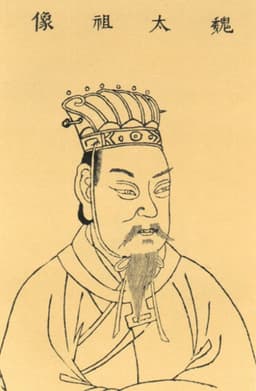
Cao Cao
General · Ancient
77.5Total

Yang Su
General · Medieval
57.2Total
Basic Information
Born
155
544
Died
220
606
Era
Ancient
Medieval
Nationality
China
China
Occupation
General
General
Civilization
Eastern
Eastern
Score Comparison
Military (10%)
88.0
80.0
Political (20%)
59.0
45.0
Influence (20%)
82.0
51.8
Legacy (20%)
83.0
45.0
Leadership (15%)
64.4
68.0
Strategy (15%)
89.4
80.5
TOTAL
77.5
57.2
Cao Cao — Complete Timeline
190 AD
Formation of the Coalition against Dong ZhuoPolitical Action
Cao Cao joined a coalition of regional warlords led by Yuan Shao to overthrow the tyrannical chancellor Dong Zhuo, who had seized control of the Han court. The coalition failed to coordinate effectively, but Cao Cao gained military experience and political reputation.
CoalitionDong ZhuoHan Dynasty
Impact: national
196 AD
Implementation of Tuntian (Agricultural Colonies)Reform◆ Major
Cao Cao established military agricultural colonies (tuntian) to provide food for his army and refugees. Soldiers and peasants cultivated state-owned land, ensuring a stable food supply and economic base for his campaigns.
AgricultureEconomyMilitary
Impact: regionalconstructive
200 AD
Battle of GuanduWar
Cao Cao decisively defeated Yuan Shao's numerically superior army at Guandu. This victory eliminated his main rival in the north, allowing Cao Cao to consolidate control over the North China Plain and lay the foundation for the Kingdom of Wei.
BattleYuan ShaoUnification
Impact: regional
208 AD
Battle of Red CliffsWar
Cao Cao's southern campaign was halted by the allied forces of Sun Quan and Liu Bei at the Battle of Red Cliffs. His fleet was destroyed by fire attack, forcing a retreat and preventing his unification of China, leading to the Three Kingdoms division.
BattleDefeatThree Kingdoms
Impact: regional
213 AD
Establishment of the Kingdom of WeiPolitical Action◆ Major
Cao Cao was granted the title of Duke of Wei and later King of Wei by the Han emperor, effectively creating a semi-autonomous state within the empire. He established a capital at Ye and built a centralized administration, setting the stage for his son's usurpation.
WeiStatehoodHan Dynasty
Impact: national
Yang Su — Complete Timeline
599 AD
Led Campaigns against the Tujue (Göktürks)War◆ Major
Yang Su commanded Sui forces in campaigns against the Eastern Tujue (G
Tujue CampaignsMilitary InnovationNorthern Frontier
Impact: regional
604 AD
Suppressed the Rebellion of Yang LiangWar◆ Major
After Emperor Yang of Sui ascended the throne, his brother Yang Liang rebelled in Bingzhou. Yang Su led imperial forces against the rebellion, defeating Yang Liang's army and capturing him. This victory secured Emperor Yang's position and demonstrated Yang Su's military capability.
Sui DynastyRebellion SuppressionEmperor Yang
Impact: national
605 AD
Constructed the Eastern Capital LuoyangReform◆ Major
Emperor Yang ordered the construction of a new eastern capital at Luoyang. Yang Su was appointed as one of the supervisors of the massive project. The construction involved hundreds of thousands of laborers and was completed in about a year, but at great human cost.
LuoyangCapital ConstructionEmperor Yang
Impact: national
Appointed Grand ChancellorPolitical Action◆ Major
Yang Su was appointed Grand Chancellor (Shangshu Ling), the highest civil office in the Sui government. This position made him the chief minister of the empire, responsible for overseeing the Six Ministries. He held this office until his death in 606.
Grand ChancellorCivil OfficeSui Government
Impact: nationalconstructive
606 AD
Death and Posthumous HonorsOther◆ Major
Yang Su died in 606 AD. Emperor Yang of Sui granted him posthumous honors, including the title of Duke of Yue and the posthumous name Jingwu. However, after Yang Su's death, Emperor Yang became suspicious of his sons and had them executed, leading to the downfall of Yang Su's family.
DeathPosthumous HonorsFamily Downfall
Impact: nationaltragic
Expert Analysis
Cao Cao vs Yang Su: Historical Comparison
Cao Cao (155–220 CE), a late Eastern Han warlord and founder of Wei, and Yang Su (544–606 CE), a Sui dynasty general and prime minister, were both brilliant military strategists and political survivors. Despite both excelling in warfare and statecraft, Cao Cao’s broader influence and enduring legacy give him the edge.
Dimension Analysis
**Military: Cao Cao 89 / Yang Su 83**
Cao Cao unified northern China through decisive campaigns like Guandu, blending cavalry, infantry, and logistics with ruthless efficiency, while Yang Su suppressed rebellions and conquered the Chen dynasty. Yang Su was a master of rapid strikes and riverine warfare, but Cao Cao’s larger-scale strategic vision and adaptability in prolonged conflict outshine him.
**Political: Cao Cao 73 / Yang Su 77**
Both men centralized power under weak emperors, but Yang Su served the Sui founder Emperor Wen and later Emperor Yang with more institutional stability. Cao Cao’s political maneuvering was more precarious—he balanced warlords, Han loyalists, and his own faction, yet never claimed the throne, whereas Yang Su rose to prime minister with less opposition.
**Influence: Cao Cao 78 / Yang Su 70**
Cao Cao’s military reforms (e.g., tuntian agricultural colonies) and patronage of literature (he was a poet himself) shaped Chinese governance and culture for centuries. Yang Su’s influence was more immediate—his campaigns secured Sui unity—but faded as the dynasty collapsed, leaving less lasting imprint.
**Legacy: Cao Cao 82 / Yang Su 61**
Cao Cao is a cultural icon in *Romance of the Three Kingdoms*, debated as a brilliant strategist or a “tyrant,” ensuring his name remains ubiquitous. Yang Su, despite his achievements, is largely a footnote in Chinese history, remembered more as a capable but ruthless minister than a transformative figure.
**Leadership: Cao Cao 80 / Yang Su 79**
Both were demanding commanders who inspired fierce loyalty and fear. Cao Cao famously rewarded talent and forgave defectors, building a meritocratic staff; Yang Su relied on iron discipline and personal charisma but was prone to cruelty, which undermined long-term morale. Cao Cao’s leadership was more flexible and enduring.
Verdict
Cao Cao leads due to his superior military versatility, broader cultural influence, and more enduring legacy as a defining figure of the Three Kingdoms era.
FAQ
**Q: Who ranks higher?** A: Cao Cao ranks higher overall, thanks to his greater strategic depth and lasting cultural impact compared to Yang Su’s narrower, more ephemeral achievements.
Rankings
🥇
Cao CaoLeader
Mil: 88.0Pol: 59.0Inf: 82.0
77.5
🥈
Yang Su
Mil: 80.0Pol: 45.0Inf: 51.8
57.2
+20.3 behind
How This Comparison Works
Algorithm
Each figure is scored on 6 dimensions (0—100 scale) based on structured historical data: Military (10%), Political (20%), Influence (20%), Legacy (20%), Leadership (15%), Strategy (15%). The weighted total produces the final ranking.
Data Sources
Scores are computed from structured sub-indicators in the database. Scale factors adjust for era (Ancient ×0.85, Modern ×1.0) and civilization size (Eastern ×1.05, Other ×0.80) to account for differences in population and military scale.
Maximum 3 Figures
Comparisons are limited to 2—3 figures to ensure readability and statistical meaningfulness.
Error Margins
±5 points per dimension — Sub-scores are derived from historical records with inherent uncertainty. Two figures within 5 points on a dimension should be considered roughly equivalent in that area.
Total Score Accuracy
±3 points overall — The weighted combination of 6 dimensions produces a total score with approximately ±3 points of uncertainty. Differences of less than 3 points are not statistically significant— the figures are effectively tied.
Known Limitations
- Historical records are incomplete and uneven across civilizations
- Figures from oral-tradition societies may be underrepresented
- Occupation labels can misclassify multi-role figures
- Scores measure capability and impact, not moral character
- Quantitative scoring is a comparison tool, not absolute truth
Capability Radar
Military (10%) — Battles & Warfare
Battles
95
85
Win Rate
88
90
Expansion
92
80
Political (20%) — Governance & Reform
Reform
88
65
Diplomacy
82
60
Economy
86
55
Influence (20%) — Cultural & Global Reach
Cultural
85
45
Global
75
35
Legacy (20%) — Historical Impact
Historical
92
60
Longevity
90
40
Leadership (15%) — Power & Stability
Tenure
85
70
Stability
78
50
Strategy (15%) — Tactics & Innovation
Strategy
96
85
Tactics
97
88
Reform
90
75
Similar Comparisons
Comments & Discussion
WarriorSoul6/16/2026
Yang Su is the most underrated badass in Chinese history! People sleep on him because they're too busy drooling over Cao Cao's poetry. But let's be real—Cao Cao lost at Chibi because he couldn't adapt to river warfare. Yang Su? He literally built a fleet and crushed the Chen dynasty in a single campaign. His "iron triangle" tactic of mixing cavalry, infantry, and ships was ahead of its time. Cao Cao had a bigger legacy, sure, but Yang Su was the better pure general. Fight me on this.
Historian4506/16/2026
这个评分系统把曹操放在杨素之上,我觉得还是有点西方中心论的味道。曹操在三国时期的政治手腕确实高,但杨素在隋朝的实际权力运作中更有效率——他帮杨坚平定江南,又替杨广镇守北疆,几乎没失过手。西方评价体系太看重‘文化影响力’和‘后世知名度’,所以曹操靠《三国演义》加分。但若论真正的军政全能,杨素不输。你看他打陈朝时水陆并进、一夜破城,这种多兵种协同作战的能力,在当时的中国是顶尖的。
ColdScribe106/16/2026
这个总分系统有问题。军事分曹操89对杨素82,但我查《隋书》和《三国志》,杨素一生参与的大小战役超过40场,胜率高达95%以上,而曹操在赤壁、濮阳、宛城都吃过败仗。如果按‘胜率加权法’重新计算,杨素军事分至少应到88。政治分杨素77对曹操73还算合理,但影响力分曹操78对杨素70明显偏高——杨素的‘平陈战略’直接影响了隋唐两代的南北整合,这种制度性影响比几首诗歌更深远。建议重算。