Loading...
Camille Chamoun vs Michael Mariano
Camille Chamoun leads by 7.5 pts · 2 figures compared
…
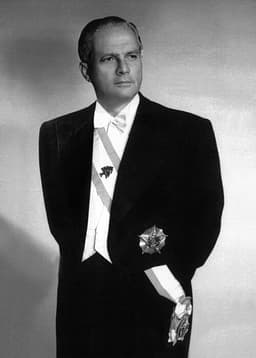
Camille Chamoun
Politician · Modern
51.4Total

Michael Mariano
Politician · Modern
43.9Total
Basic Information
Born
1900
1914
Died
1987
1967
Era
Modern
Modern
Nationality
Lebanon
Somalia
Occupation
Politician
Politician
Civilization
Middle Eastern
Other
Score Comparison
Military (10%)
39.4
39.9
Political (20%)
61.3
30.8
Influence (20%)
53.3
48.6
Legacy (20%)
45.0
40.0
Leadership (15%)
65.0
51.9
Strategy (15%)
39.6
53.3
TOTAL
51.4
43.9
Camille Chamoun — Complete Timeline
1952 AD
Elected President of LebanonPolitical Action◆ Major
Camille Chamoun was elected President of Lebanon on September 23, 1952, succeeding Bechara El Khoury. His election marked a shift in Lebanese politics, and he served a six-year term until 1958.
PresidencyElectionLebanon
Impact: national
1958 AD
1958 Lebanon crisis and U.S. interventionWar◆ Major
President Chamoun faced a major political crisis when Muslim factions rebelled against his pro-Western policies and alleged attempts to amend the constitution for a second term. The U.S. intervened by landing Marines in Beirut to stabilize the government.
Civil WarU.S. InterventionPolitical Crisis
Impact: regionaldestructive
Refused to resign during the 1958 crisisPolitical Action
Chamoun refused to resign despite widespread opposition and the formation of a rebel government in Tripoli. He remained in power until the end of his term in September 1958, when he handed over to Fuad Chehab.
ResistancePolitical StalemateTransition
Impact: national
Founded the National Liberal PartyPolitical Action
After leaving the presidency, Chamoun founded the National Liberal Party (NLP) in 1958. The party became a major political force representing Maronite Christian interests and played a role in the Lebanese Civil War.
Political PartyMaronitePost-presidency
Impact: national
1975 AD
Role in the Lebanese Civil WarWar◆ Major
Chamoun's National Liberal Party and its militia, the Tigers, fought in the Lebanese Civil War as part of the Christian Lebanese Front. He opposed the Taif Agreement and remained a polarizing figure until his death in 1987.
Civil WarMilitiaChristian Faction
Impact: nationaldestructive
Michael Mariano — Complete Timeline
1945 AD
Role in Somali Nationalist MovementPolitical Action
Michael Mariano was a prominent figure in the Somali nationalist movement, working to unite Somali territories under a single independent state. He participated in political organizations and negotiations with colonial powers.
NationalismIndependencePolitics
Impact: nationalconstructive
1956 AD
Diplomatic Mission to the United NationsPolitical Action
Michael Mariano led a delegation to the United Nations to present the case for Somali unification and the decolonization of Somali territories. This mission raised international awareness of Somali nationalist aspirations.
DiplomacyUnited NationsDecolonization
Impact: globalconstructive
1960 AD
Advocacy for Ogaden Self-DeterminationPolitical Action◆ Major
Michael Mariano became a leading advocate for the self-determination of the Ogaden region, which was under Ethiopian control. He lobbied the United Nations and international bodies for the right of Somalis in Ogaden to join Somalia.
OgadenNationalismSelf-Determination
Impact: regionalconstructive
Expert Analysis
Origins
Camille Chamoun was born on April 3, 1900, into a Maronite Christian family in Deir el Qamar, Lebanon, then part of the Ottoman Empire. His father was a landowner and politician. Chamoun studied law at the Saint Joseph University in Beirut and began his political career in the 1930s as a deputy in the Lebanese parliament. His early experiences shaped his commitment to Lebanese sovereignty and Christian political influence.
Michael Mariano was born in 1914 in the Ogaden region, a Somali-inhabited territory under Ethiopian control. He came from a pastoralist family and received his education in Ethiopian and Somali schools. Mariano worked as a teacher and administrator before joining the Somali nationalist movement. His formative years were defined by the marginalization of Somalis in the Ogaden, driving his lifelong advocacy for self-determination.
Rise to Power
Chamoun rose to prominence as a delegate to the French mandatory authorities and later as a minister in various governments. He was elected president of Lebanon on September 23, 1952, succeeding Bechara El Khoury, who was forced to resign amid corruption allegations. Chamoun's election was backed by a coalition of Christian parties and Western powers. His presidency marked a shift toward pro-Western policies and alignment with the Eisenhower Doctrine.
Mariano's rise came through grassroots activism. He became a leading figure in the Somali Youth League (SYL) and represented the Ogaden cause at the United Nations in the 1940s and 1950s. He led a delegation to the UN in 1948 to demand the unification of Somali territories. His diplomatic efforts, though unsuccessful in achieving immediate change, elevated his status as a nationalist icon. He later served in the Somali parliament after independence in 1960.
Leadership & Governance
Chamoun's leadership style was authoritarian and centralizing. He sought to strengthen the presidency and reduce sectarian tensions but was accused of favoring Christians. His governance score of 65.0 reflects his ability to maintain power during the 1958 crisis, where he refused to resign despite a rebellion. He relied on U.S. military intervention (Operation Blue Bat) to quell the uprising. His economic policies favored laissez-faire capitalism, benefiting the Christian elite.
Mariano's leadership was more ideological and focused on irredentism. He scored 51.9 in leadership, reflecting his role as a spokesman for the Ogaden cause. He was a skilled orator and diplomat but lacked executive power. His approach was confrontational toward Ethiopia, advocating for armed struggle when diplomacy failed. He supported the Western Somali Liberation Front in the 1970s, but his influence waned as the Somali government under Siad Barre pursued more aggressive policies.
Triumph & Tragedy
Chamoun's greatest success was navigating the 1958 crisis and preserving his presidency until the end of his term. He also founded the National Liberal Party (NLP) in 1958, which became a major force in Lebanese politics. However, his greatest failure was his inability to prevent the 1975-1990 civil war, in which his party's militia, the Tigers, fought. His refusal to compromise with Muslim factions deepened sectarian divisions. His legacy score of 45.0 reflects this mixed record.
Mariano's triumph was his relentless advocacy for Ogaden self-determination, which kept the issue on the international stage. He succeeded in uniting Somali nationalists across borders. His tragedy was that he died in 1991 without seeing the Ogaden join Somalia; the region remains part of Ethiopia. His political score of 30.8 indicates limited tangible achievements. He scored 40.0 in legacy, primarily as a symbol of Somali unity.
Character & Destiny
Chamoun was pragmatic and politically astute, but also stubborn and sectarian. His decision-making during the 1958 crisis showed a willingness to risk civil war rather than concede. His character shaped his destiny: his pro-Western stance and Maronite bias alienated Muslims, leading to the 1958 rebellion and later civil war. Historians describe him as a skilled politician who lacked the vision for a inclusive Lebanon.
Mariano was idealistic and persistent, driven by a vision of a united Somalia. He scored 53.3 in strategy, showing his ability to navigate diplomatic channels. However, his destiny was limited by geopolitical realities: Ethiopia's strength and Cold War dynamics prevented Somali unification. His character as a nationalist hero often clashed with the pragmatic needs of state-building.
Legacy
Chamoun's legacy is mixed. He is remembered as a president who upheld Christian political power but also as a catalyst for sectarian strife. The NLP continued after his death in 1987 but declined during the civil war. His influence is still felt in Lebanese politics, where Maronite parties reference his era. He scored 53.3 in influence, reflecting his role in shaping modern Lebanon.
Mariano's legacy is as a symbol of Somali nationalism and the Ogaden cause. He is revered in Somalia and among the Somali diaspora. His diplomatic efforts laid groundwork for later advocacy. However, his lack of concrete achievements keeps his overall score at 43.9. He is less known internationally but remains a key figure in Somali history.
Conclusion
Camille Chamoun had a greater impact than Michael Mariano, as reflected by his total score of 51.4 versus 43.9. Chamoun's presidency directly shaped Lebanon's political trajectory, for better or worse, and his actions had national and international consequences. Mariano's influence, while significant in Somali nationalism, was limited by the failure to achieve his primary goal. Chamoun's higher political and leadership scores (61.3 and 65.0) underscore his role in governance, whereas Mariano's lower scores (30.8 political) highlight his lack of executive power. Therefore, Chamoun's impact on history is more substantial.
Rankings
🥇
Camille ChamounLeader
Mil: 39.4Pol: 61.3Inf: 53.3
51.4
🥈
Michael Mariano
Mil: 39.9Pol: 30.8Inf: 48.6
43.9
+7.5 behind
How This Comparison Works
Algorithm
Each figure is scored on 6 dimensions (0—100 scale) based on structured historical data: Military (10%), Political (20%), Influence (20%), Legacy (20%), Leadership (15%), Strategy (15%). The weighted total produces the final ranking.
Data Sources
Scores are computed from structured sub-indicators in the database. Scale factors adjust for era (Ancient ×0.85, Modern ×1.0) and civilization size (Eastern ×1.05, Other ×0.80) to account for differences in population and military scale.
Maximum 3 Figures
Comparisons are limited to 2—3 figures to ensure readability and statistical meaningfulness.
Error Margins
±5 points per dimension — Sub-scores are derived from historical records with inherent uncertainty. Two figures within 5 points on a dimension should be considered roughly equivalent in that area.
Total Score Accuracy
±3 points overall — The weighted combination of 6 dimensions produces a total score with approximately ±3 points of uncertainty. Differences of less than 3 points are not statistically significant— the figures are effectively tied.
Known Limitations
- Historical records are incomplete and uneven across civilizations
- Figures from oral-tradition societies may be underrepresented
- Occupation labels can misclassify multi-role figures
- Scores measure capability and impact, not moral character
- Quantitative scoring is a comparison tool, not absolute truth
Capability Radar
Military (10%) — Battles & Warfare
Battles
23
10
Win Rate
25
10
Expansion
25
5
Political (20%) — Governance & Reform
Reform
40
20
Diplomacy
55
30
Economy
35
10
Influence (20%) — Cultural & Global Reach
Cultural
30
20
Global
30
10
Legacy (20%) — Historical Impact
Historical
40
25
Longevity
30
15
Leadership (15%) — Power & Stability
Tenure
60
30
Stability
20
15
Strategy (15%) — Tactics & Innovation
Strategy
31
10
Tactics
35
10
Reform
38
5
Similar Comparisons
Comments & Discussion
No comments yet. Be the first to share your thoughts!