Loading...
Camille Chamoun vs Gamal Abdel Nasser
Gamal Abdel Nasser leads by 14.7 pts · 2 figures compared
…
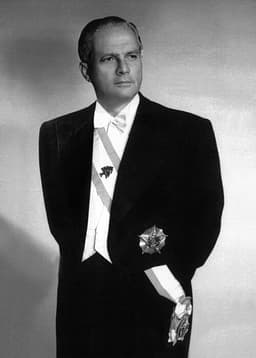
Camille Chamoun
Politician · Modern
51.4Total
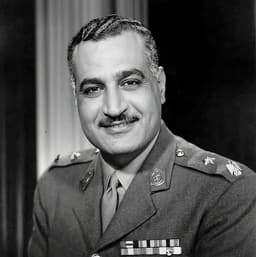
Gamal Abdel Nasser
Politician · Modern
66.1Total
Basic Information
Born
1900
1918
Died
1987
1970
Era
Modern
Modern
Nationality
Lebanon
Egypt
Occupation
Politician
Politician
Civilization
Middle Eastern
Middle Eastern
Score Comparison
Military (10%)
39.4
50.0
Political (20%)
61.3
72.0
Influence (20%)
53.3
88.0
Legacy (20%)
45.0
52.0
Leadership (15%)
65.0
72.0
Strategy (15%)
39.6
45.0
TOTAL
51.4
66.1
Camille Chamoun — Complete Timeline
1952 AD
Elected President of LebanonPolitical Action◆ Major
Camille Chamoun was elected President of Lebanon on September 23, 1952, succeeding Bechara El Khoury. His election marked a shift in Lebanese politics, and he served a six-year term until 1958.
PresidencyElectionLebanon
Impact: national
1958 AD
1958 Lebanon crisis and U.S. interventionWar◆ Major
President Chamoun faced a major political crisis when Muslim factions rebelled against his pro-Western policies and alleged attempts to amend the constitution for a second term. The U.S. intervened by landing Marines in Beirut to stabilize the government.
Civil WarU.S. InterventionPolitical Crisis
Impact: regionaldestructive
Refused to resign during the 1958 crisisPolitical Action
Chamoun refused to resign despite widespread opposition and the formation of a rebel government in Tripoli. He remained in power until the end of his term in September 1958, when he handed over to Fuad Chehab.
ResistancePolitical StalemateTransition
Impact: national
Founded the National Liberal PartyPolitical Action
After leaving the presidency, Chamoun founded the National Liberal Party (NLP) in 1958. The party became a major political force representing Maronite Christian interests and played a role in the Lebanese Civil War.
Political PartyMaronitePost-presidency
Impact: national
1975 AD
Role in the Lebanese Civil WarWar◆ Major
Chamoun's National Liberal Party and its militia, the Tigers, fought in the Lebanese Civil War as part of the Christian Lebanese Front. He opposed the Taif Agreement and remained a polarizing figure until his death in 1987.
Civil WarMilitiaChristian Faction
Impact: nationaldestructive
Gamal Abdel Nasser — Complete Timeline
1952 AD
Led the 1952 Egyptian RevolutionPolitical Action◆ Major
Nasser was a key leader of the Free Officers Movement that overthrew King Farouk in the 1952 Egyptian Revolution. The coup ended the monarchy and British influence, establishing a republic. Nasser emerged as the dominant figure in the new government by 1954.
RevolutionRepublicEgypt
Impact: national
1956 AD
Nationalized the Suez CanalPolitical Action◆ Major
Nasser nationalized the Suez Canal Company, taking control of the vital waterway from British and French interests. This act triggered the Suez Crisis, where Israel, Britain, and France invaded Egypt. Nasser emerged politically strengthened after international pressure forced their withdrawal.
Suez CrisisNationalizationDecolonization
Impact: global
1958 AD
Formed the United Arab RepublicOther◆ Major
Nasser formed the United Arab Republic (UAR), a political union between Egypt and Syria. The union aimed to advance Arab nationalism and counter Western influence. It collapsed in 1961 when Syria seceded following a military coup, but Egypt retained the name until 1971.
Arab NationalismPolitical UnionMiddle East
Impact: regional
1961 AD
Implemented Land Reform and Arab SocialismPolitical Action◆ Major
Nasser implemented sweeping land reform laws and nationalized major industries, banks, and businesses. These socialist policies redistributed land from large landowners to peasants and expanded state control over the economy, fundamentally transforming Egyptian society.
Land ReformSocialismEconomic Policy
Impact: national
1967 AD
Suffered Defeat in the Six-Day WarWar◆ Major
Egypt under Nasser suffered a devastating military defeat in the Six-Day War against Israel. Israel captured the Sinai Peninsula, Gaza Strip, and other territories. Nasser offered to resign but remained in power after mass protests demanded he stay. The defeat severely damaged his prestige.
Six-Day WarMilitary DefeatArab-Israeli Conflict
Impact: globaldestructive
1969 AD
Launched the War of AttritionOther◆ Major
Nasser launched the War of Attrition against Israel along the Suez Canal. The conflict involved artillery exchanges, commando raids, and Soviet military support for Egypt. The war ended with a ceasefire in 1970, shortly before Nasser's death, without achieving Egyptian objectives.
War of AttritionArab-Israeli ConflictMilitary Strategy
Impact: regional
1970 AD
Accepted the Rogers Plan CeasefireOther◆ Major
Nasser accepted the US-sponsored Rogers Plan ceasefire to end the War of Attrition. This decision marked a shift toward diplomatic engagement with the United States and acceptance of UN Resolution 242, though it was controversial among hardliners in the Arab world.
CeasefireDiplomacyUS-Egypt Relations
Impact: national
Expert Analysis
Origins
Camille Chamoun was born on April 3, 1900, in Deir el Qamar, Lebanon, into a prominent Maronite Christian family. He studied law at the Saint Joseph University in Beirut and later at the University of Paris. His early career included working as a lawyer and entering politics, where he was elected to the Lebanese parliament in 1934. Chamoun's background was deeply rooted in the French Mandate system and Lebanese sectarian politics.
Gamal Abdel Nasser was born on January 15, 1918, in Alexandria, Egypt, to a postal clerk's family. He attended the Royal Military Academy in Cairo and graduated in 1938. Nasser's early military career included service in Sudan and involvement in the 1948 Arab-Israeli War, where he was wounded. The defeat in Palestine radicalized him, leading to his leadership in the Free Officers Movement.
Rise to Power
Chamoun rose to prominence as a key figure in the Lebanese independence movement. He served as Minister of Finance and later as Minister of the Interior. In 1952, he was elected President of Lebanon, succeeding Bechara El Khoury. His election was supported by a coalition of Christian and Muslim leaders, but his pro-Western stance soon alienated many.
Nasser's rise began with the 1952 Egyptian Revolution. As a key leader of the Free Officers, he orchestrated the overthrow of King Farouk. Initially, General Muhammad Naguib became president, but Nasser outmaneuvered him, becoming prime minister in 1954 and president in 1956. His nationalization of the Suez Canal in July 1956 cemented his status as a champion of Arab nationalism.
Leadership & Governance
Chamoun's leadership style was marked by a commitment to Lebanese sovereignty and alignment with the West. He pursued economic development and maintained close ties with the United States and Britain. However, his refusal to amend the constitution to allow Muslim representation and his alleged attempt to secure a second term sparked the 1958 crisis. He relied on the Lebanese army and requested U.S. military intervention (Operation Blue Bat) to quell the rebellion.
Nasser governed through a mix of authoritarianism and populism. He implemented land reforms, nationalized major industries, and promoted Arab socialism. His leadership was charismatic, using radio broadcasts to mobilize the masses. He formed the United Arab Republic with Syria in 1958, though it collapsed in 1961. His governance style centralized power in the presidency and suppressed political opposition.
Triumph & Tragedy
Chamoun's greatest success was preserving Lebanese independence during the 1958 crisis, albeit with foreign intervention. He successfully navigated the crisis without a full-scale civil war, and his term ended peacefully in 1958. However, his failure to address sectarian imbalances and his pro-Western policies deepened divisions. In the later Lebanese Civil War (1975-1990), his militia, the Tigers, fought but ultimately lost influence.
Nasser's triumphs include the Suez Canal nationalization, which boosted Egyptian sovereignty and inspired anti-colonial movements. His land reforms reduced rural poverty. However, his greatest tragedy was the 1967 Six-Day War, where Egypt lost the Sinai Peninsula and Gaza. Nasser's military scored 50.0, reflecting his inability to achieve strategic victories. He died in 1970, leaving a legacy of unfulfilled pan-Arab dreams.
Character & Destiny
Chamoun was pragmatic, legalistic, and stubborn. He believed in strong presidential authority and resisted compromise. His refusal to resign during the 1958 crisis showed determination but also inflexibility. Historians note his political score of 61.3 reflects his skill in maneuvering within Lebanon's sectarian system, but his leadership score of 65.0 indicates he was effective within constraints.
Nasser was charismatic, ambitious, and emotionally driven. His personality inspired millions but also led to overreach. His strategy score of 45.0 highlights poor long-term planning, especially in military affairs. The 1967 defeat was partly due to his miscalculations. Nasser's influence score of 88.0 underscores his ability to shape regional politics, but his legacy is mixed.
Legacy
Chamoun's legacy is tied to Lebanon's confessional system. He founded the National Liberal Party, which remained influential. His presidency set a precedent for Maronite dominance. However, his role in the 1958 crisis and later civil war is controversial. He is remembered as a defender of Christian rights but also as a divisive figure.
Nasser's legacy is vast: he transformed Egypt into a republic, redistributed land, and challenged Western imperialism. The United Arab Republic and Arab socialism influenced generations. However, the 1967 defeat damaged his reputation. Nasser scored 52.0 in legacy, reflecting his profound but incomplete impact. His ideas of Arab unity remain influential.
Conclusion
Gamal Abdel Nasser had a greater impact globally and regionally. His political score of 72.0 and influence of 88.0 dwarf Chamoun's 61.3 and 53.3. Nasser's actions—Suez nationalization, land reform, and Arab nationalism—reshaped the Middle East. Chamoun's influence was limited to Lebanon's sectarian politics. While Chamoun successfully navigated the 1958 crisis, his reliance on U.S. intervention and failure to address sectarian issues limited his legacy. Nasser's vision, despite failure, altered the course of Arab history. Thus, Nasser is the more consequential figure.
Rankings
🥇
Gamal Abdel NasserLeader
Mil: 50.0Pol: 72.0Inf: 88.0
66.1
🥈
Camille Chamoun
Mil: 39.4Pol: 61.3Inf: 53.3
51.4
+14.7 behind
How This Comparison Works
Algorithm
Each figure is scored on 6 dimensions (0—100 scale) based on structured historical data: Military (10%), Political (20%), Influence (20%), Legacy (20%), Leadership (15%), Strategy (15%). The weighted total produces the final ranking.
Data Sources
Scores are computed from structured sub-indicators in the database. Scale factors adjust for era (Ancient ×0.85, Modern ×1.0) and civilization size (Eastern ×1.05, Other ×0.80) to account for differences in population and military scale.
Maximum 3 Figures
Comparisons are limited to 2—3 figures to ensure readability and statistical meaningfulness.
Error Margins
±5 points per dimension — Sub-scores are derived from historical records with inherent uncertainty. Two figures within 5 points on a dimension should be considered roughly equivalent in that area.
Total Score Accuracy
±3 points overall — The weighted combination of 6 dimensions produces a total score with approximately ±3 points of uncertainty. Differences of less than 3 points are not statistically significant— the figures are effectively tied.
Known Limitations
- Historical records are incomplete and uneven across civilizations
- Figures from oral-tradition societies may be underrepresented
- Occupation labels can misclassify multi-role figures
- Scores measure capability and impact, not moral character
- Quantitative scoring is a comparison tool, not absolute truth
Capability Radar
Military (10%) — Battles & Warfare
Battles
23
30
Win Rate
25
25
Expansion
25
20
Political (20%) — Governance & Reform
Reform
40
75
Diplomacy
55
65
Economy
35
50
Influence (20%) — Cultural & Global Reach
Cultural
30
70
Global
30
65
Legacy (20%) — Historical Impact
Historical
40
70
Longevity
30
55
Leadership (15%) — Power & Stability
Tenure
60
70
Stability
20
40
Strategy (15%) — Tactics & Innovation
Strategy
31
40
Tactics
35
35
Reform
38
60
Similar Comparisons
Comments & Discussion
No comments yet. Be the first to share your thoughts!