Loading...
Camille Chamoun vs Juan Negrin
Camille Chamoun leads by 0.2 pts · 2 figures compared
…
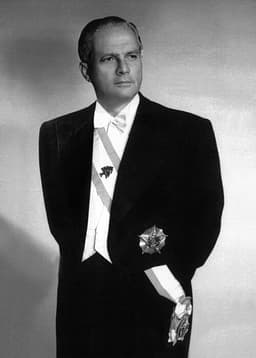
Camille Chamoun
Politician · Modern
51.4Total

Juan Negrin
Politician · Modern
51.2Total
Basic Information
Born
1900
1892
Died
1987
1956
Era
Modern
Modern
Nationality
Lebanon
Spain
Occupation
Politician
Politician
Civilization
Middle Eastern
Western
Score Comparison
Military (10%)
39.4
48.8
Political (20%)
61.3
45.0
Influence (20%)
53.3
54.9
Legacy (20%)
45.0
47.5
Leadership (15%)
65.0
65.0
Strategy (15%)
39.6
42.3
TOTAL
51.4
51.2
Camille Chamoun — Complete Timeline
1952 AD
Elected President of LebanonPolitical Action◆ Major
Camille Chamoun was elected President of Lebanon on September 23, 1952, succeeding Bechara El Khoury. His election marked a shift in Lebanese politics, and he served a six-year term until 1958.
PresidencyElectionLebanon
Impact: national
1958 AD
1958 Lebanon crisis and U.S. interventionWar◆ Major
President Chamoun faced a major political crisis when Muslim factions rebelled against his pro-Western policies and alleged attempts to amend the constitution for a second term. The U.S. intervened by landing Marines in Beirut to stabilize the government.
Civil WarU.S. InterventionPolitical Crisis
Impact: regionaldestructive
Refused to resign during the 1958 crisisPolitical Action
Chamoun refused to resign despite widespread opposition and the formation of a rebel government in Tripoli. He remained in power until the end of his term in September 1958, when he handed over to Fuad Chehab.
ResistancePolitical StalemateTransition
Impact: national
Founded the National Liberal PartyPolitical Action
After leaving the presidency, Chamoun founded the National Liberal Party (NLP) in 1958. The party became a major political force representing Maronite Christian interests and played a role in the Lebanese Civil War.
Political PartyMaronitePost-presidency
Impact: national
1975 AD
Role in the Lebanese Civil WarWar◆ Major
Chamoun's National Liberal Party and its militia, the Tigers, fought in the Lebanese Civil War as part of the Christian Lebanese Front. He opposed the Taif Agreement and remained a polarizing figure until his death in 1987.
Civil WarMilitiaChristian Faction
Impact: nationaldestructive
Juan Negrin — Complete Timeline
1937 AD
Became Prime Minister of the RepublicPolitical Action◆ Major
Negrin succeeded Largo Caballero as prime minister of the Second Spanish Republic on May 17, 1937. He formed a government dominated by the Spanish Communist Party and pursued a policy of centralizing war efforts and seeking Soviet support.
Prime MinisterCivil WarCommunist Influence
Impact: national
1938 AD
Oversaw the Battle of the EbroWar◆ Major
Negrin's government ordered the Battle of the Ebro, the largest Republican offensive of the Civil War, in July 1938. The battle lasted four months and ended in a costly Republican defeat, depleting the Republican army and leading to the final Nationalist advance.
Battle of the EbroMilitary OffensiveDefeat
Impact: nationaltragic
Implemented the Thirteen Points ProgramPolitical Action◆ Major
Negrin announced the Thirteen Points program on April 30, 1938, outlining the Republican war aims. The program called for independence, democracy, social justice, and amnesty, but failed to attract international support or negotiate a peace settlement with the Nationalists.
War AimsDiplomacyPropaganda
Impact: nationalconstructive
1939 AD
Fled into Exile After the Republican DefeatPolitical Action◆ Major
As Nationalist forces captured Barcelona and Madrid, Negrin fled to France in March 1939. He continued to lead the Republican government-in-exile until 1945, but was unable to secure international recognition or support for the restoration of the Republic.
ExileGovernment-in-ExileDefeat
Impact: nationaltragic
Expert Analysis
Origins
Camille Chamoun was born on April 3, 1900, in Deir el Qamar, Lebanon, into a prominent Maronite Christian family. His father was a lawyer and politician, providing Chamoun with early exposure to Lebanese politics. He studied law at Saint Joseph University in Beirut and later at the University of Paris. Chamoun entered politics in 1934, winning a seat in the Lebanese Parliament as a representative of the Maronite community.
Juan Negrín was born on February 3, 1892, in Las Palmas de Gran Canaria, Spain, into a wealthy family. His father was a prosperous businessman, allowing Negrín to pursue higher education. He studied medicine at the University of Leipzig and later specialized in physiology. Negrín became a respected professor at the University of Madrid and entered politics in the 1930s as a member of the Spanish Socialist Workers' Party (PSOE).
Rise to Power
Chamoun's rise was facilitated by his role in the Lebanese independence movement. He served as Minister of Finance and later as Minister of Interior under President Bechara El Khoury. In 1952, Chamoun was elected President of Lebanon on September 23, succeeding El Khoury. His election marked a shift in Lebanese politics, as he was seen as a reformer who would reduce corruption and strengthen the state.
Negrín's ascension came during the Spanish Civil War. He was appointed Minister of Finance in 1936, where he managed the Republic's gold reserves. On May 17, 1937, Negrín succeeded Largo Caballero as Prime Minister of the Second Spanish Republic. His government was dominated by the Spanish Communist Party (PCE) and relied heavily on Soviet support. Negrín's rise was driven by his organizational skills and his willingness to cooperate with the communists.
Leadership & Governance
Chamoun's leadership style was characterized by a pro-Western orientation and a commitment to preserving Lebanon's sectarian balance. He aligned Lebanon with the United States and the Baghdad Pact, alienating Muslim factions who favored pan-Arabism under Gamal Abdel Nasser. Chamoun's governance score of 65.0 reflected his ability to maintain power despite opposition, but his refusal to amend the constitution to allow Muslim representation exacerbated tensions.
Negrín's leadership focused on centralizing the Republican war effort. He implemented the Thirteen Points program on April 30, 1938, which outlined war aims including independence, democracy, and social justice. Negrín's governance score of 65.0 matched Chamoun's, but his reliance on communist support and Soviet aid undermined his legitimacy among anarchists and leftist republicans. His decision to order the Battle of the Ebro in July 1938, while ambitious, resulted in a costly defeat that drained Republican resources.
Triumph & Tragedy
Chamoun's greatest triumph was his successful navigation of the 1958 crisis with U.S. intervention, which preserved his presidency and prevented an immediate civil war. However, his refusal to resign despite widespread opposition led to the formation of a rebel government in Tripoli. The U.S. intervention under the Eisenhower Doctrine stabilized the situation but set a precedent for foreign involvement in Lebanese affairs. Chamoun's legacy score of 45.0 reflects the mixed outcomes of his tenure.
Negrín's triumph was his ability to prolong the Spanish Republic's resistance against Franco's Nationalists. The Battle of the Ebro, though a failure, demonstrated the Republic's capacity to mount a major offensive. However, Negrín's tragic flaw was his over-reliance on the Soviet Union, which alienated Western democracies and weakened internal unity. His failure to negotiate a conditional surrender led to a harsh post-war repression. Negrín's legacy score of 47.5 is slightly higher than Chamoun's, reflecting his symbolic importance as the last Republican leader.
Character & Destiny
Chamoun was pragmatic and stubborn, traits that helped him survive the 1958 crisis but also made him inflexible. His pro-Western stance was a double-edged sword: it secured U.S. support but deepened sectarian divides. Chamoun's political score of 61.3 indicates his skill in maneuvering within Lebanon's complex political landscape.
Negrín was intellectually rigorous and determined, but his willingness to subordinate Republican ideals to communist strategy tarnished his reputation. His military score of 48.8 is slightly higher than Chamoun's 39.4, reflecting his direct involvement in war decisions. Negrín's character shaped his destiny as a tragic figure who fought for a lost cause but could not overcome internal divisions.
Legacy
Chamoun's legacy is intertwined with the 1958 crisis and the expansion of U.S. influence in the Middle East. His National Liberal Party remained a force in Lebanese politics until the Civil War. Chamoun's score of 45.0 in legacy reflects the limited long-term impact of his presidency, as Lebanon's sectarian system persisted and eventually collapsed.
Negrín's legacy is more contested. He is remembered as the last prime minister of the Spanish Republic, a symbol of anti-fascist resistance. The Thirteen Points program influenced later democratic transitions in Spain. Negrín's legacy score of 47.5 is slightly higher, as his ideals outlived his government. However, his association with communist repression during the war has led to criticism from both left and right.
Conclusion
Camille Chamoun and Juan Negrín both scored near 51 overall, but their impacts differ. Chamoun's political maneuvering preserved his presidency in the short term but exacerbated Lebanon's sectarian tensions, which erupted into civil war in 1975. Negrín's leadership, while ultimately unsuccessful, articulated a vision for a democratic Spain that would be realized after Franco's death. Negrín's influence score of 54.9 edges out Chamoun's 53.3, and his legacy score of 47.5 exceeds Chamoun's 45.0. Therefore, Juan Negrín had a greater long-term impact, as his ideas contributed to Spain's democratic transition, whereas Chamoun's actions reinforced a system that led to decades of conflict.
Rankings
🥇
Camille ChamounLeader
Mil: 39.4Pol: 61.3Inf: 53.3
51.4
🥈
Juan Negrin
Mil: 48.8Pol: 45.0Inf: 54.9
51.2
+0.2 behind
How This Comparison Works
Algorithm
Each figure is scored on 6 dimensions (0—100 scale) based on structured historical data: Military (10%), Political (20%), Influence (20%), Legacy (20%), Leadership (15%), Strategy (15%). The weighted total produces the final ranking.
Data Sources
Scores are computed from structured sub-indicators in the database. Scale factors adjust for era (Ancient ×0.85, Modern ×1.0) and civilization size (Eastern ×1.05, Other ×0.80) to account for differences in population and military scale.
Maximum 3 Figures
Comparisons are limited to 2—3 figures to ensure readability and statistical meaningfulness.
Error Margins
±5 points per dimension — Sub-scores are derived from historical records with inherent uncertainty. Two figures within 5 points on a dimension should be considered roughly equivalent in that area.
Total Score Accuracy
±3 points overall — The weighted combination of 6 dimensions produces a total score with approximately ±3 points of uncertainty. Differences of less than 3 points are not statistically significant— the figures are effectively tied.
Known Limitations
- Historical records are incomplete and uneven across civilizations
- Figures from oral-tradition societies may be underrepresented
- Occupation labels can misclassify multi-role figures
- Scores measure capability and impact, not moral character
- Quantitative scoring is a comparison tool, not absolute truth
Capability Radar
Military (10%) — Battles & Warfare
Battles
23
27
Win Rate
25
35
Expansion
25
36
Political (20%) — Governance & Reform
Reform
40
55
Diplomacy
55
50
Economy
35
45
Influence (20%) — Cultural & Global Reach
Cultural
30
25
Global
30
35
Legacy (20%) — Historical Impact
Historical
40
45
Longevity
30
30
Leadership (15%) — Power & Stability
Tenure
60
40
Stability
20
20
Strategy (15%) — Tactics & Innovation
Strategy
31
37
Tactics
35
40
Reform
38
46
Similar Comparisons
Comments & Discussion
No comments yet. Be the first to share your thoughts!