Loading...
This comparison has not been analyzed yet.
One-time AI generation (~1 minute). Scores and timeline are already available below.
Bronislaw Komorowski vs Francis Escudero
Francis Escudero leads by 4.5 pts · 2 figures compared
…
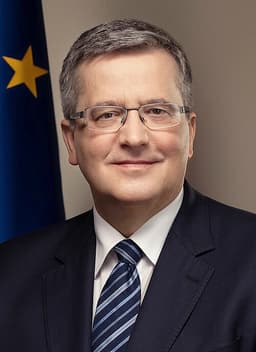
Bronislaw Komorowski
Politician · Modern
49.9Total

Francis Escudero
Politician · Modern
54.4Total
Basic Information
Born
1952
1969
Died
—
—
Era
Modern
Modern
Nationality
Poland
Philippines
Occupation
Politician
Politician
Civilization
Western
Eastern
Score Comparison
Military (10%)
49.4
36.7
Political (20%)
68.0
68.0
Influence (20%)
50.2
51.8
Legacy (20%)
40.0
44.2
Leadership (15%)
53.2
72.0
Strategy (15%)
42.7
57.4
TOTAL
49.9
54.4
Bronislaw Komorowski — Complete Timeline
2009 AD
Signed the Treaty of LisbonPolitical Action◆ Major
As acting president after the Smolensk crash, Komorowski signed the Treaty of Lisbon ratification document on behalf of Poland. This completed Poland's ratification of the EU reform treaty, which had been delayed by the previous president.
European UnionTreaty of LisbonRatification
Impact: regionalconstructive
2010 AD
Elected President of PolandPolitical Action◆ Major
Bronislaw Komorowski was elected President of Poland in a snap election following the death of President Lech Kaczynski in the Smolensk air disaster. He defeated Jaroslaw Kaczynski in the runoff, becoming the second president of the Third Polish Republic.
Presidential ElectionSmolensk AftermathCivic Platform
Impact: national
2015 AD
Lost Re-election to Andrzej DudaPolitical Action◆ Major
Komorowski lost the presidential election to Andrzej Duda of the Law and Justice party. Duda won in the first round with 51.5% of the vote, marking a shift in Polish politics towards the conservative PiS.
Presidential ElectionDefeatPiS Victory
Impact: nationaltragic
2016 AD
Vetoed the Media LawPolitical Action
Komorowski vetoed a law that would have given the government more control over public media appointments. The veto was overridden by the Law and Justice (PiS) majority in parliament, leading to increased political polarization.
Media LawVetoPolitical Conflict
Impact: national
Francis Escudero — Complete Timeline
2007 AD
Elected Senator in 2007 ElectionsPolitical Action◆ Major
Francis Escudero won a Senate seat in the 2007 Philippine general election. He was known for his articulate speeches and advocacy for education and rural development.
ElectionSenateEducation
Impact: national
2016 AD
Presidential Candidacy in 2016 ElectionPolitical Action◆ Major
Escudero ran for vice president in the 2016 Philippine election as the running mate of Grace Poe. He lost to Leni Robredo, receiving 35.7% of the vote.
Vice Presidential ElectionPhilippinesGrace Poe
Impact: national
2019 AD
Appointed Chairman of the Senate Committee on Justice and Human RightsPolitical Action
Escudero was appointed chairman of the Senate Committee on Justice and Human Rights. He presided over hearings on the Anti-Terrorism Act of 2020 and other controversial legislation.
SenateJusticeHuman Rights
Impact: national
This comparison has not been analyzed yet.
One-time AI generation (~1 minute). Scores and timeline are already available below.
Rankings
🥇
Francis EscuderoLeader
Mil: 36.7Pol: 68.0Inf: 51.8
54.4
🥈
Bronislaw Komorowski
Mil: 49.4Pol: 68.0Inf: 50.2
49.9
+4.5 behind
How This Comparison Works
Algorithm
Each figure is scored on 6 dimensions (0—100 scale) based on structured historical data: Military (10%), Political (20%), Influence (20%), Legacy (20%), Leadership (15%), Strategy (15%). The weighted total produces the final ranking.
Data Sources
Scores are computed from structured sub-indicators in the database. Scale factors adjust for era (Ancient ×0.85, Modern ×1.0) and civilization size (Eastern ×1.05, Other ×0.80) to account for differences in population and military scale.
Maximum 3 Figures
Comparisons are limited to 2—3 figures to ensure readability and statistical meaningfulness.
Error Margins
±5 points per dimension — Sub-scores are derived from historical records with inherent uncertainty. Two figures within 5 points on a dimension should be considered roughly equivalent in that area.
Total Score Accuracy
±3 points overall — The weighted combination of 6 dimensions produces a total score with approximately ±3 points of uncertainty. Differences of less than 3 points are not statistically significant— the figures are effectively tied.
Known Limitations
- Historical records are incomplete and uneven across civilizations
- Figures from oral-tradition societies may be underrepresented
- Occupation labels can misclassify multi-role figures
- Scores measure capability and impact, not moral character
- Quantitative scoring is a comparison tool, not absolute truth
Capability Radar
Military (10%) — Battles & Warfare
Battles
30
51
Win Rate
30
55
Expansion
37
56
Political (20%) — Governance & Reform
Reform
40
55
Diplomacy
50
60
Economy
45
50
Influence (20%) — Cultural & Global Reach
Cultural
20
30
Global
20
20
Legacy (20%) — Historical Impact
Historical
25
35
Longevity
15
30
Leadership (15%) — Power & Stability
Tenure
55
65
Stability
45
55
Strategy (15%) — Tactics & Innovation
Strategy
40
58
Tactics
40
66
Reform
43
67
Similar Comparisons
Comments & Discussion
No comments yet. Be the first to share your thoughts!