Loading...
Bohemond I of Antioch vs Mori Motonari
Mori Motonari leads by 10.4 pts · 2 figures compared
…
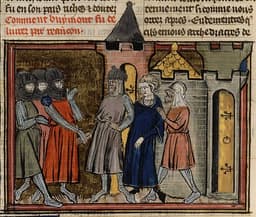
Bohemond I of Antioch
General · Medieval
55.2Total

Mori Motonari
General · Medieval
65.6Total
Basic Information
Born
1054
1497
Died
1111
1571
Era
Medieval
Medieval
Nationality
Italy
Japan
Occupation
General
General
Civilization
Western
Eastern
Score Comparison
Military (10%)
76.0
67.3
Political (20%)
45.1
72.0
Influence (20%)
53.3
62.0
Legacy (20%)
46.7
52.0
Leadership (15%)
61.1
85.0
Strategy (15%)
66.3
68.1
TOTAL
55.2
65.6
Bohemond I of Antioch — Complete Timeline
1098 AD
Capture of AntiochWar
Bohemond led the capture of Antioch during the First Crusade. He negotiated with a traitor inside the city to open a gate, allowing the crusaders to enter. He then claimed the city for himself, becoming Prince of Antioch.
CrusadeSiegeCrusader States
Impact: regional
1104 AD
Battle of HarranWar◆ Major
Bohemond and Baldwin of Edessa were defeated by a combined Seljuk force at the Battle of Harran. Bohemond was captured and held for ransom, weakening the Principality of Antioch.
Crusader StatesBattleDefeat
Impact: regionaltragic
1107 AD
Campaign against the Byzantine EmpireWar◆ Major
After his release, Bohemond launched a campaign against the Byzantine Empire, besieging Dyrrhachium. He was forced to surrender in 1108 and sign the Treaty of Devol, which made Antioch a vassal of Byzantium.
Byzantine EmpireWarTreaty
Impact: regional
1108 AD
Treaty of DevolPolitical Action◆ Major
Bohemond signed the Treaty of Devol with Byzantine Emperor Alexios I Komnenos. The treaty recognized Bohemond as Prince of Antioch but made him a vassal of the Byzantine Empire, a humiliation that ended his ambitions.
TreatyByzantine EmpireCrusader States
Impact: regional
Mori Motonari — Complete Timeline
1554 AD
Battle of OshikibataWar
Mori Motonari defeated the forces of the Ouchi clan at Oshikibata. This victory weakened the Ouchi clan and allowed the Mori to expand their territory in the Chugoku region.
Sengoku PeriodBattleOuchi Clan
Impact: regionalconstructive
1555 AD
Battle of ItsukushimaWar
Mori Motonaga defeated Sue Harukata of the Ouchi clan at Itsukushima. Using a daring amphibious assault and feigned retreat, Motonari secured control of Aki Province and established the Mori clan as a major power in the Chugoku region.
Sengoku PeriodBattleAmphibious Assault
Impact: regionalconstructive
1561 AD
Siege of Moji CastleWar
Mori Motonari besieged Moji Castle, held by the Otomo clan. The siege was unsuccessful, and the Mori forces were repelled, marking a rare defeat for Motonari.
Sengoku PeriodSiegeDefeat
Impact: regionaldestructive
1566 AD
Conquest of Iwami ProvinceWar◆ Major
Mori Motonari conquered Iwami Province, including the important silver mines at Omori. This victory provided the Mori clan with substantial wealth to fund further military campaigns and expand their influence.
Sengoku PeriodConquestEconomic Power
Impact: regionalconstructive
Expert Analysis
Origins
Bohemond I of Antioch (c. 1054–1111) was born into the Hauteville family, Norman conquerors of southern Italy. As the son of Robert Guiscard, he grew up immersed in Norman military culture and the ongoing conflicts with the Byzantine Empire. His early campaigns alongside his father, such as the siege of Dyrrhachium (1081), honed his martial skills. In contrast, Mori Motonari (1497–1571) was born into a minor samurai family in Aki Province, Japan. His father, Mori Hiromoto, died when Motonari was young, forcing him to navigate the Sengoku period's chaos through alliances and strategic marriages. Motonari's early life was marked by the decline of the Ouchi and Amago clans, which he would later exploit.
Rise to Power
Bohemond's rise came during the First Crusade (1096–1099). He joined the crusade seeking personal gain and quickly distinguished himself. His pivotal moment was the capture of Antioch in June 1098. Bohemond negotiated with a traitor, Firouz, who opened a gate, allowing the crusaders to seize the city after an eight-month siege. He then claimed the principality for himself, outmaneuvering other crusader leaders. Mori Motonari's ascent began with the Battle of Itsukushima (1555). He defeated Sue Harukata of the Ouchi clan through a daring amphibious assault and feigned retreat, securing control of the Ouchi domains. This victory elevated Motonari from a local lord to a major power in the Chugoku region. His political acumen (72.0) allowed him to forge alliances and consolidate control over Iwami Province, including the rich silver mines at Omori.
Leadership & Governance
Bohemond's leadership (61.1) was characterized by aggressive ambition and military prowess. As Prince of Antioch, he ruled with a heavy hand, prioritizing expansion and personal glory. He alienated the Byzantine Empire by refusing to return Antioch as promised, leading to conflict. His governance was pragmatic but short-sighted, focused on immediate gains. In contrast, Motonari's leadership (85.0) was more strategic and inclusive. He governed through a system of alliances and family ties, famously instructing his sons to "break off three arrows" (unity is strength). He promoted economic development, especially mining, and maintained stable relations with neighboring clans through marriage and diplomacy. Motonari's political score (72.0) reflects his ability to balance military action with long-term state-building.
Triumph & Tragedy
Bohemond's greatest triumph was the capture of Antioch, which established a crusader state that lasted until 1268. However, his tragedy came at the Battle of Harran (1104), where he was captured by the Seljuks. Ransomed, he later attacked the Byzantine Empire but was forced to sign the Treaty of Devol (1108), making Antioch a Byzantine vassal. This treaty humiliated Bohemond and undermined his legacy. Mori Motonari's triumph was the conquest of the Chugoku region, transforming the Mori clan into a dominant force. His strategic genius at Itsukushima is celebrated. Yet his tragedy was the failure of the Siege of Moji Castle (1561), where he was repelled by the Otomo clan. This defeat checked his expansion and showed the limits of his military power (67.3).
Character & Destiny
Bohemond was charismatic and daring but also greedy and treacherous. His decision to break his oath to the Byzantine emperor led to constant conflict. His character drove him to seek power at all costs, but his lack of political foresight (45.1) ultimately limited his success. Motonari was patient, cunning, and a master of strategy (68.1). Known for his wisdom, he often used deception and psychological warfare. His character allowed him to build a stable domain, but his refusal to centralize power as the Tokugawa later did meant his clan's long-term survival was not assured. Historical assessments often rank Motonari as one of Japan's great strategists, while Bohemond is seen as a skilled but flawed crusader.
Legacy
Bohemond's legacy (46.7) is mixed. He founded the Principality of Antioch, which endured for 170 years, but his submission to Byzantium weakened crusader authority. His exploits were recorded in chronicles like the Gesta Francorum. In contrast, Motonari's legacy (52.0) is more enduring in Japanese culture. He is remembered as a symbol of strategic wisdom and family unity. His teachings influenced later daimyo, and the Mori clan remained powerful until the Edo period. The silver mines he secured fueled Japan's economy for decades.
Conclusion
While Bohemond scored higher in military (76.0 vs 67.3), Motonari's overall total (65.6 vs 55.2) reflects superior leadership and political skill. Motonari's impact on Japanese history was more sustained and constructive. He built a stable domain that lasted centuries, whereas Bohemond's principality was constantly threatened and ultimately fell. Motonari had greater impact due to his strategic governance and lasting cultural influence. Therefore, Mori Motonari is the more significant historical figure.
Rankings
🥇
Mori MotonariLeader
Mil: 67.3Pol: 72.0Inf: 62.0
65.6
🥈
Bohemond I of Antioch
Mil: 76.0Pol: 45.1Inf: 53.3
55.2
+10.4 behind
How This Comparison Works
Algorithm
Each figure is scored on 6 dimensions (0—100 scale) based on structured historical data: Military (10%), Political (20%), Influence (20%), Legacy (20%), Leadership (15%), Strategy (15%). The weighted total produces the final ranking.
Data Sources
Scores are computed from structured sub-indicators in the database. Scale factors adjust for era (Ancient ×0.85, Modern ×1.0) and civilization size (Eastern ×1.05, Other ×0.80) to account for differences in population and military scale.
Maximum 3 Figures
Comparisons are limited to 2—3 figures to ensure readability and statistical meaningfulness.
Error Margins
±5 points per dimension — Sub-scores are derived from historical records with inherent uncertainty. Two figures within 5 points on a dimension should be considered roughly equivalent in that area.
Total Score Accuracy
±3 points overall — The weighted combination of 6 dimensions produces a total score with approximately ±3 points of uncertainty. Differences of less than 3 points are not statistically significant— the figures are effectively tied.
Known Limitations
- Historical records are incomplete and uneven across civilizations
- Figures from oral-tradition societies may be underrepresented
- Occupation labels can misclassify multi-role figures
- Scores measure capability and impact, not moral character
- Quantitative scoring is a comparison tool, not absolute truth
Capability Radar
Military (10%) — Battles & Warfare
Battles
75
65
Win Rate
70
70
Expansion
65
70
Political (20%) — Governance & Reform
Reform
40
55
Diplomacy
65
75
Economy
35
60
Influence (20%) — Cultural & Global Reach
Cultural
45
60
Global
45
40
Legacy (20%) — Historical Impact
Historical
60
65
Longevity
50
55
Leadership (15%) — Power & Stability
Tenure
55
65
Stability
30
65
Strategy (15%) — Tactics & Innovation
Strategy
75
80
Tactics
80
85
Reform
30
60
Similar Comparisons
Comments & Discussion
No comments yet. Be the first to share your thoughts!