Loading...
This comparison has not been analyzed yet.
One-time AI generation (~1 minute). Scores and timeline are already available below.
Bohemond I of Antioch vs Kang Kam-chan
Bohemond I of Antioch leads by 6.8 pts · 2 figures compared
…
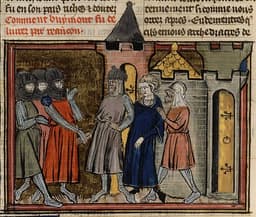
Bohemond I of Antioch
General · Medieval
55.2Total

Kang Kam-chan
General · Medieval
48.4Total
Basic Information
Born
1054
948
Died
1111
1031
Era
Medieval
Medieval
Nationality
Italy
Korea
Occupation
General
General
Civilization
Western
Eastern
Score Comparison
Military (10%)
76.0
60.0
Political (20%)
45.1
25.0
Influence (20%)
53.3
51.8
Legacy (20%)
46.7
45.8
Leadership (15%)
61.1
50.7
Strategy (15%)
66.3
66.9
TOTAL
55.2
48.4
Bohemond I of Antioch — Complete Timeline
1098 AD
Capture of AntiochWar
Bohemond led the capture of Antioch during the First Crusade. He negotiated with a traitor inside the city to open a gate, allowing the crusaders to enter. He then claimed the city for himself, becoming Prince of Antioch.
CrusadeSiegeCrusader States
Impact: regional
1104 AD
Battle of HarranWar◆ Major
Bohemond and Baldwin of Edessa were defeated by a combined Seljuk force at the Battle of Harran. Bohemond was captured and held for ransom, weakening the Principality of Antioch.
Crusader StatesBattleDefeat
Impact: regionaltragic
1107 AD
Campaign against the Byzantine EmpireWar◆ Major
After his release, Bohemond launched a campaign against the Byzantine Empire, besieging Dyrrhachium. He was forced to surrender in 1108 and sign the Treaty of Devol, which made Antioch a vassal of Byzantium.
Byzantine EmpireWarTreaty
Impact: regional
1108 AD
Treaty of DevolPolitical Action◆ Major
Bohemond signed the Treaty of Devol with Byzantine Emperor Alexios I Komnenos. The treaty recognized Bohemond as Prince of Antioch but made him a vassal of the Byzantine Empire, a humiliation that ended his ambitions.
TreatyByzantine EmpireCrusader States
Impact: regional
Kang Kam-chan — Complete Timeline
1010 AD
Siege of HeunghwajinWar◆ Major
During the Second Goryeo-Khitan War, Kang Kam-chan successfully defended the fortress of Heunghwajin against a Khitan siege. His stubborn resistance bought time for Goryeo to regroup and negotiate a truce.
SiegeDefenseKhitan War
Impact: nationalconstructive
1018 AD
Appointment as Supreme CommanderPolitical Action
King Hyeonjong appointed Kang Kam-chan as supreme commander of Goryeo's forces during the Third Khitan War. This appointment gave him authority over all military operations and reflected the king's trust in his strategic abilities.
Military CommandRoyal AppointmentLeadership
Impact: nationalconstructive
1019 AD
Battle of GwijuWar
General Kang Kam-chan led Goryeo forces to a decisive victory over the Khitan Liao dynasty at Gwiju. The battle ended the Third Goryeo-Khitan War, with Goryeo inflicting heavy casualties and forcing the Khitan to withdraw permanently.
Khitan WarDecisive VictoryNational Defense
Impact: regionalconstructive
This comparison has not been analyzed yet.
One-time AI generation (~1 minute). Scores and timeline are already available below.
Rankings
🥇
Bohemond I of AntiochLeader
Mil: 76.0Pol: 45.1Inf: 53.3
55.2
🥈
Kang Kam-chan
Mil: 60.0Pol: 25.0Inf: 51.8
48.4
+6.8 behind
How This Comparison Works
Algorithm
Each figure is scored on 6 dimensions (0—100 scale) based on structured historical data: Military (10%), Political (20%), Influence (20%), Legacy (20%), Leadership (15%), Strategy (15%). The weighted total produces the final ranking.
Data Sources
Scores are computed from structured sub-indicators in the database. Scale factors adjust for era (Ancient ×0.85, Modern ×1.0) and civilization size (Eastern ×1.05, Other ×0.80) to account for differences in population and military scale.
Maximum 3 Figures
Comparisons are limited to 2—3 figures to ensure readability and statistical meaningfulness.
Error Margins
±5 points per dimension — Sub-scores are derived from historical records with inherent uncertainty. Two figures within 5 points on a dimension should be considered roughly equivalent in that area.
Total Score Accuracy
±3 points overall — The weighted combination of 6 dimensions produces a total score with approximately ±3 points of uncertainty. Differences of less than 3 points are not statistically significant— the figures are effectively tied.
Known Limitations
- Historical records are incomplete and uneven across civilizations
- Figures from oral-tradition societies may be underrepresented
- Occupation labels can misclassify multi-role figures
- Scores measure capability and impact, not moral character
- Quantitative scoring is a comparison tool, not absolute truth
Capability Radar
Military (10%) — Battles & Warfare
Battles
75
75
Win Rate
70
85
Expansion
65
20
Political (20%) — Governance & Reform
Reform
40
20
Diplomacy
65
35
Economy
35
15
Influence (20%) — Cultural & Global Reach
Cultural
45
45
Global
45
35
Legacy (20%) — Historical Impact
Historical
60
55
Longevity
50
50
Leadership (15%) — Power & Stability
Tenure
55
40
Stability
30
30
Strategy (15%) — Tactics & Innovation
Strategy
75
78
Tactics
80
80
Reform
30
30
Similar Comparisons
Comments & Discussion
No comments yet. Be the first to share your thoughts!