Loading...
This comparison has not been analyzed yet.
One-time AI generation (~1 minute). Scores and timeline are already available below.
Bogu Qaghan vs Tomislav of Croatia
Bogu Qaghan leads by 5.4 pts · 2 figures compared
…
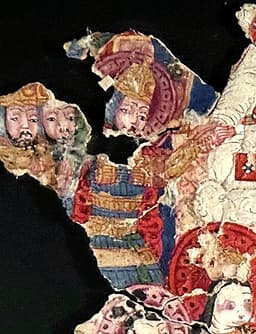
Bogu Qaghan
Emperor · Medieval
52.6Total

Tomislav of Croatia
Emperor · Medieval
47.2Total
Basic Information
Born
724
753
Died
780
928
Era
Medieval
Medieval
Nationality
Uyghur Khaganate
Croatia
Occupation
Emperor
Emperor
Civilization
Eastern
Western
Score Comparison
Military (10%)
40.0
10.0
Political (20%)
61.3
45.1
Influence (20%)
56.4
54.9
Legacy (20%)
45.0
45.8
Leadership (15%)
64.0
65.0
Strategy (15%)
45.0
45.0
TOTAL
52.6
47.2
Bogu Qaghan — Complete Timeline
759 AD
Accession as Bogu QaghanPolitical Action◆ Major
Bogu Qaghan ascended to the throne of the Uyghur Khaganate after the death of his father. His reign saw the khaganate reach its peak in power and influence.
SuccessionKhaganateLeadership
Impact: regionalconstructive
762 AD
Suppression of the An Lushan RebellionWar◆ Major
Bogu Qaghan sent Uyghur cavalry to aid the Tang dynasty in suppressing the An Lushan Rebellion. The Uyghur forces helped recapture the Tang capital Chang'an, strengthening the alliance with Tang.
Military AidTang DynastyRebellion
Impact: regionalconstructive
763 AD
Conversion to ManichaeismCultural
Bogu Qaghan converted to Manichaeism after meeting Manichaean missionaries from Sogdiana. He declared Manichaeism the state religion of the Uyghur Khaganate, a unique development among steppe empires.
ReligionManichaeismConversion
Impact: regionalconstructive
779 AD
Assassination by Tun Bagha TarkhanPolitical Action
Bogu Qaghan was assassinated by his minister Tun Bagha Tarkhan, who opposed his pro-Sogdian policies and Manichaean conversion. This coup ended Bogu's reign and led to a shift in Uyghur policy.
AssassinationCoupPolicy Change
Impact: regionaltragic
Tomislav of Croatia — Complete Timeline
925 AD
Coronation as King of CroatiaPolitical Action
Tomislav was crowned the first king of Croatia by Pope John X. His coronation established the Kingdom of Croatia and recognized his authority over both Pannonian and Dalmatian Croatia.
CoronationKingdomUnification
Impact: regionalconstructive
Unification of Pannonian and Dalmatian CroatiaPolitical Action◆ Major
Tomislav united the duchies of Pannonian Croatia and Dalmatian Croatia under his rule. This unification created a single Croatian state for the first time, laying the foundation for the medieval Kingdom of Croatia.
UnificationState FormationMedieval
Impact: regionalconstructive
926 AD
Battle of the Bosnian HighlandsWar◆ Major
Tomislav defeated the Bulgarian Empire under Tsar Simeon I in the Battle of the Bosnian Highlands. This victory prevented Bulgarian expansion into Croatia and secured Croatian independence.
BattleBulgarian EmpireIndependence
Impact: regionalconstructive
This comparison has not been analyzed yet.
One-time AI generation (~1 minute). Scores and timeline are already available below.
Rankings
🥇
Bogu QaghanLeader
Mil: 40.0Pol: 61.3Inf: 56.4
52.6
🥈
Tomislav of Croatia
Mil: 10.0Pol: 45.1Inf: 54.9
47.2
+5.4 behind
How This Comparison Works
Algorithm
Each figure is scored on 6 dimensions (0—100 scale) based on structured historical data: Military (10%), Political (20%), Influence (20%), Legacy (20%), Leadership (15%), Strategy (15%). The weighted total produces the final ranking.
Data Sources
Scores are computed from structured sub-indicators in the database. Scale factors adjust for era (Ancient ×0.85, Modern ×1.0) and civilization size (Eastern ×1.05, Other ×0.80) to account for differences in population and military scale.
Maximum 3 Figures
Comparisons are limited to 2—3 figures to ensure readability and statistical meaningfulness.
Error Margins
±5 points per dimension — Sub-scores are derived from historical records with inherent uncertainty. Two figures within 5 points on a dimension should be considered roughly equivalent in that area.
Total Score Accuracy
±3 points overall — The weighted combination of 6 dimensions produces a total score with approximately ±3 points of uncertainty. Differences of less than 3 points are not statistically significant— the figures are effectively tied.
Known Limitations
- Historical records are incomplete and uneven across civilizations
- Figures from oral-tradition societies may be underrepresented
- Occupation labels can misclassify multi-role figures
- Scores measure capability and impact, not moral character
- Quantitative scoring is a comparison tool, not absolute truth
Capability Radar
Military (10%) — Battles & Warfare
Battles
45
35
Win Rate
40
40
Expansion
25
45
Political (20%) — Governance & Reform
Reform
55
40
Diplomacy
50
50
Economy
40
35
Influence (20%) — Cultural & Global Reach
Cultural
45
40
Global
25
20
Legacy (20%) — Historical Impact
Historical
40
45
Longevity
30
30
Leadership (15%) — Power & Stability
Tenure
60
55
Stability
35
45
Strategy (15%) — Tactics & Innovation
Strategy
30
35
Tactics
35
30
Reform
20
25
Similar Comparisons
Comments & Discussion
No comments yet. Be the first to share your thoughts!