Loading...
Moctezuma II vs Tomislav of Croatia
Moctezuma II leads by 23.5 pts · 2 figures compared
…

Moctezuma II
Emperor · Medieval
70.7Total
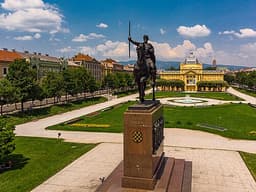
Tomislav of Croatia
Emperor · Medieval
47.2Total
Basic Information
Born
1466
753
Died
1520
928
Era
Medieval
Medieval
Nationality
Aztec Empire
Croatia
Occupation
Emperor
Emperor
Civilization
Other
Western
Score Comparison
Military (10%)
65.0
10.0
Political (20%)
68.0
45.1
Influence (20%)
82.0
54.9
Legacy (20%)
72.0
45.8
Leadership (15%)
65.0
65.0
Strategy (15%)
57.5
45.0
TOTAL
70.7
47.2
Moctezuma II — Complete Timeline
1502 AD
Expansion of the Aztec Empire under Moctezuma IIWar◆ Major
Moctezuma II launched military campaigns that expanded the Aztec Empire to its greatest territorial extent, extending control over regions from the Gulf of Mexico to the Pacific. He also centralized power by reducing the autonomy of conquered provinces and increasing tribute demands.
ConquestTerritorial ExpansionAztec Empire
Impact: regional
1519 AD
First Meeting with Hernán CortésPolitical Action
Moctezuma II received Hern
EncounterSpanish ConquestAztec Empire
Impact: global
1520 AD
Capture and Death of Moctezuma IIPolitical Action◆ Major
Moctezuma was taken hostage by Cort
HostageDeathSpanish Conquest
Impact: globaltragic
Tomislav of Croatia — Complete Timeline
925 AD
Coronation as King of CroatiaPolitical Action
Tomislav was crowned the first king of Croatia by Pope John X. His coronation established the Kingdom of Croatia and recognized his authority over both Pannonian and Dalmatian Croatia.
CoronationKingdomUnification
Impact: regionalconstructive
Unification of Pannonian and Dalmatian CroatiaPolitical Action◆ Major
Tomislav united the duchies of Pannonian Croatia and Dalmatian Croatia under his rule. This unification created a single Croatian state for the first time, laying the foundation for the medieval Kingdom of Croatia.
UnificationState FormationMedieval
Impact: regionalconstructive
926 AD
Battle of the Bosnian HighlandsWar◆ Major
Tomislav defeated the Bulgarian Empire under Tsar Simeon I in the Battle of the Bosnian Highlands. This victory prevented Bulgarian expansion into Croatia and secured Croatian independence.
BattleBulgarian EmpireIndependence
Impact: regionalconstructive
Expert Analysis
Origins
Moctezuma II (1466–1520) was born into the Aztec royal family, the son of Axayacatl. He received a rigorous education in religion, military tactics, and governance at the calmecac school. His upbringing prepared him for leadership, steeped in the ritual and expansionist ethos of the Aztec Empire. Tomislav of Croatia (died c. 928) emerged from the Trpimirović dynasty, likely the son of Duke Muncimir. He inherited the Duchy of Pannonian Croatia and later claimed Dalmatian Croatia, unifying them through military and diplomatic skill. His early life is less documented, but his rise indicates a strong martial and political background.
Rise to Power
Moctezuma II ascended the throne in 1502 after the death of his uncle Ahuitzotl. He consolidated power by purging potential rivals and restructuring the nobility. His coronation was marked by a grand ceremony, and he immediately launched military campaigns to assert dominance. By 1519, his empire stretched from the Gulf of Mexico to the Pacific. Tomislav became duke of Pannonian Croatia around 910 and, by 925, had united both Croatian duchies. His coronation as king by Pope John X in 925 legitimized his rule and established the Kingdom of Croatia. The Battle of the Bosnian Highlands in 926, where he defeated Tsar Simeon I of Bulgaria, cemented his reputation and secured his realm.
Leadership & Governance
Moctezuma II centralized authority in Tenochtitlan, expanding the tribute system and enforcing strict social hierarchies. He built temples, improved infrastructure, and maintained a vast army. However, his governance relied heavily on fear and ritual sacrifice. In contrast, Tomislav created a unified Croatian state by merging two distinct territories with different traditions. He established a legal code and fostered ties with the Papacy, aligning Croatia with Western Christendom. While Moctezuma ruled through coercion, Tomislav built alliances and institutional foundations. Moctezuma's leadership score is 65.0; Tomislav's is also 65.0, reflecting similar effectiveness in their contexts.
Triumph & Tragedy
Moctezuma's greatest triumph was expanding the Aztec Empire to its largest extent, controlling trade routes and extracting tribute from dozens of provinces. His tragedy was his encounter with Hernán Cortés in 1519. Believing Cortés might be the god Quetzalcoatl, he hesitated and allowed the Spanish into Tenochtitlan. He was taken hostage, used as a puppet, and killed in 1520 during a revolt, either stoned by his own people or stabbed by Spaniards. Tomislav's triumph was unifying Croatia and defeating Bulgaria, ensuring Croatian independence. His tragedy is the lack of detailed records; his kingdom fragmented after his death, and later kings struggled to maintain unity. Tomislav's legacy score is 45.8, while Moctezuma's is 72.0, reflecting the latter's greater historical footprint.
Character & Destiny
Moctezuma was cautious, religious, and indecisive. He relied on omens and prophecies, which led to his fatal miscalculation with Cortés. His political score of 68.0 and strategy of 57.5 indicate a ruler better at administration than crisis management. Tomislav was pragmatic and martial, as shown by his decisive victory over Bulgaria. His political score of 45.1 reflects the limited scope of his state. Moctezuma's character led to his downfall; Tomislav's character enabled his success but his realm lacked enduring institutions.
Legacy
Moctezuma's legacy is defined by his role in the Spanish conquest. His empire collapsed, but his name symbolizes the clash of civilizations. The Aztec capital Tenochtitlan became Mexico City. Tomislav is celebrated as the first king of Croatia, a national unifier. His coronation is a key date in Croatian history. Moctezuma's influence score of 82.0 and legacy of 72.0 far exceed Tomislav's 54.9 and 45.8, due to the global impact of the conquest.
Conclusion
Moctezuma II had greater historical impact, with a total score of 70.7 versus Tomislav's 47.2. His rule marked the peak of the Aztec Empire and its catastrophic fall, reshaping the Americas. Tomislav's unification of Croatia was significant regionally but did not alter global history. Moctezuma's decisions directly led to the end of a civilization, while Tomislav's achievements were built upon by later rulers. Therefore, Moctezuma II is the more consequential figure.
Rankings
🥇
Moctezuma IILeader
Mil: 65.0Pol: 68.0Inf: 82.0
70.7
🥈
Tomislav of Croatia
Mil: 10.0Pol: 45.1Inf: 54.9
47.2
+23.5 behind
How This Comparison Works
Algorithm
Each figure is scored on 6 dimensions (0—100 scale) based on structured historical data: Military (10%), Political (20%), Influence (20%), Legacy (20%), Leadership (15%), Strategy (15%). The weighted total produces the final ranking.
Data Sources
Scores are computed from structured sub-indicators in the database. Scale factors adjust for era (Ancient ×0.85, Modern ×1.0) and civilization size (Eastern ×1.05, Other ×0.80) to account for differences in population and military scale.
Maximum 3 Figures
Comparisons are limited to 2—3 figures to ensure readability and statistical meaningfulness.
Error Margins
±5 points per dimension — Sub-scores are derived from historical records with inherent uncertainty. Two figures within 5 points on a dimension should be considered roughly equivalent in that area.
Total Score Accuracy
±3 points overall — The weighted combination of 6 dimensions produces a total score with approximately ±3 points of uncertainty. Differences of less than 3 points are not statistically significant— the figures are effectively tied.
Known Limitations
- Historical records are incomplete and uneven across civilizations
- Figures from oral-tradition societies may be underrepresented
- Occupation labels can misclassify multi-role figures
- Scores measure capability and impact, not moral character
- Quantitative scoring is a comparison tool, not absolute truth
Capability Radar
Military (10%) — Battles & Warfare
Battles
65
35
Win Rate
60
40
Expansion
70
45
Political (20%) — Governance & Reform
Reform
55
40
Diplomacy
30
50
Economy
65
35
Influence (20%) — Cultural & Global Reach
Cultural
75
40
Global
65
20
Legacy (20%) — Historical Impact
Historical
80
45
Longevity
70
30
Leadership (15%) — Power & Stability
Tenure
60
55
Stability
40
45
Strategy (15%) — Tactics & Innovation
Strategy
50
35
Tactics
55
30
Reform
40
25
Similar Comparisons
Comments & Discussion
No comments yet. Be the first to share your thoughts!