Loading...
Bhutto Zulfikar Ali vs Ngo Dinh Diem
Bhutto Zulfikar Ali leads by 6.0 pts · 2 figures compared
…
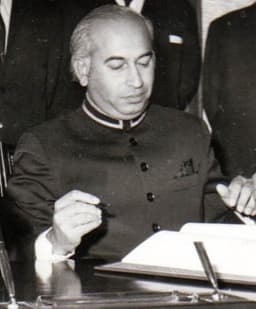
Bhutto Zulfikar Ali
Politician · Modern
52.4Total

Ngo Dinh Diem
Politician · Modern
46.4Total
Basic Information
Born
1928
1901
Died
—
1963
Era
Modern
Modern
Nationality
Pakistan
Vietnam
Occupation
Politician
Politician
Civilization
Indian
Eastern
Score Comparison
Military (10%)
45.7
29.8
Political (20%)
55.0
33.6
Influence (20%)
58.3
51.8
Legacy (20%)
52.0
43.3
Leadership (15%)
40.0
62.2
Strategy (15%)
60.0
53.0
TOTAL
52.4
46.4
Bhutto Zulfikar Ali — Complete Timeline
1967 AD
Founding of the Pakistan People's PartyPolitical Action◆ Major
Bhutto founded the Pakistan People's Party (PPP) with a socialist and populist platform. The party quickly gained mass support, especially in West Pakistan, challenging the military regime of Ayub Khan.
PPPSocialismPolitical party
Impact: nationalconstructive
1970 AD
1970 general election victoryPolitical Action
Bhutto's PPP won a majority of seats in West Pakistan in the 1970 general election, while the Awami League won in East Pakistan. The refusal to transfer power to the Awami League led to the Bangladesh Liberation War.
ElectionBangladesh Liberation WarPolitical crisis
Impact: nationaldestructive
1972 AD
Nationalization of industriesReform◆ Major
Bhutto's government nationalized major industries, including steel, banking, and oil. This policy aimed to reduce economic inequality but led to inefficiencies, reduced foreign investment, and long-term economic challenges.
NationalizationEconomic reformSocialism
Impact: national
Simla AgreementPolitical Action◆ Major
Bhutto signed the Simla Agreement with Indian Prime Minister Indira Gandhi, normalizing relations after the 1971 war. The agreement established the Line of Control in Kashmir and committed both countries to bilateral resolution of disputes.
India-Pakistan relationsKashmirPeace treaty
Impact: regionalconstructive
1979 AD
Execution by Zia-ul-HaqPolitical Action
Bhutto was executed by hanging after a controversial murder trial under General Zia-ul-Haq's military regime. His death sparked international outrage and made him a martyr for the PPP, shaping Pakistani politics for decades.
ExecutionMartyrdomMilitary regime
Impact: nationaltragic
Ngo Dinh Diem — Complete Timeline
1955 AD
Establishment of the Republic of VietnamPolitical Action
Ngo Dinh Diem became the first president of the Republic of Vietnam (South Vietnam) after a referendum that abolished the monarchy. He consolidated power, refused to hold reunification elections with the North, and established a Catholic-dominated regime in a Buddhist-majority country.
South VietnamFoundingDivision
Impact: regionalconstructive
1962 AD
Strategic Hamlet ProgramReform◆ Major
Diem launched the Strategic Hamlet Program, relocating rural villagers into fortified hamlets to isolate them from Viet Cong insurgents. The program was poorly implemented, caused widespread resentment, and failed to stem the insurgency, contributing to the regime's unpopularity.
CounterinsurgencyVietnam WarStrategic Hamlets
Impact: nationaldestructive
1963 AD
Buddhist CrisisPolitical Action◆ Major
Diem's regime banned the Buddhist flag and suppressed Buddhist protests, leading to self-immolations by monks like Thich Quang Duc. The crisis sparked international outrage, eroded US support, and exposed the regime's religious discrimination and authoritarianism.
Buddhist CrisisReligious PersecutionVietnam
Impact: globaltragic
Assassination of Ngo Dinh DiemPolitical Action
Diem and his brother Ngo Dinh Nhu were captured and executed by ARVN officers during a US-backed coup. The assassination destabilized South Vietnam, leading to a series of short-lived governments and deepening US involvement in the Vietnam War.
CoupAssassinationVietnam War
Impact: regionaltragic
Expert Analysis
Origins
Zulfikar Ali Bhutto was born on January 5, 1928, in Larkana, Sindh, into a wealthy landowning family. His father, Sir Shah Nawaz Bhutto, was a prominent politician. Bhutto studied at the University of California, Berkeley (B.A. in political science, 1950) and Christ Church, Oxford (LL.B., 1953; M.A., 1953). He was called to the bar at Lincoln's Inn. His early career included teaching law and joining the Pakistani delegation to the UN in 1957.
Ngo Dinh Diem was born on January 3, 1901, in Quang Binh, central Vietnam, into a Catholic noble family. His father, Ngo Dinh Kha, was a mandarin. Diem was educated at the Hue National Academy and later at the School of Administration in Hanoi. He entered the civil service under the French colonial administration, becoming a provincial governor in 1929. He resigned in 1933 due to French interference.
Rise to Power
Bhutto rose to prominence as a close ally of President Ayub Khan, serving as Foreign Minister from 1963 to 1966. He gained fame for his assertive foreign policy, including the 1965 war with India and the Tashkent Agreement. After falling out with Ayub, Bhutto founded the Pakistan People's Party (PPP) in 1967 on a socialist platform. The 1970 general election saw the PPP win a majority in West Pakistan, while the Awami League won in East Pakistan. The refusal to transfer power to the Awami League led to the Bangladesh Liberation War and Pakistan's defeat in 1971. Bhutto then became President (1971-1973) and later Prime Minister (1973-1977).
Diem's rise began when he returned to Vietnam in 1954 after years of exile in the US and Europe. Emperor Bao Dai appointed him Prime Minister in 1954. Diem consolidated power by suppressing rival sects (Cao Dai, Hoa Hao) and the Binh Xuyen crime syndicate. In 1955, he held a referendum that abolished the monarchy, making him President of the Republic of Vietnam. He was backed by the US, which saw him as a bulwark against communism.
Leadership & Governance
Bhutto's leadership style was charismatic and populist. He introduced sweeping reforms: nationalizing major industries (steel, banking, oil), land reforms, and expanding education and healthcare. He also promulgated a new constitution in 1973, transitioning Pakistan from a presidential to a parliamentary system. However, his governance was increasingly authoritarian, suppressing political opposition and curtailing press freedom. His political score of 55.0 reflects both his popular appeal and his autocratic turn.
Diem ruled as a Catholic autocrat in a predominantly Buddhist country. He centralized power, relying on his family, especially his brother Ngo Dinh Nhu. His Strategic Hamlet Program (1961-1963) aimed to isolate rural populations from Viet Cong guerrillas but was poorly implemented, alienating peasants. The Buddhist Crisis of 1963 saw violent repression of Buddhist protests, leading to self-immolations. Diem's leadership score of 62.2 indicates his firm control, but his political score of 33.6 reflects his inability to build broad support.
Triumph & Tragedy
Bhutto's greatest triumph was the Simla Agreement (1972) with Indian Prime Minister Indira Gandhi, which normalized relations after the 1971 war and established the Line of Control in Kashmir. He also successfully managed the 1974 Islamic summit in Lahore. His tragedy was his execution in 1979 by General Zia-ul-Haq after a controversial murder trial. The trial was widely seen as politically motivated, and his death sparked international condemnation. His nationalization policies also led to economic inefficiency and slowed growth.
Diem's triumph was his initial consolidation of South Vietnam, defeating the armed sects and establishing a stable government. He also implemented land reforms and built infrastructure. His tragedy was his assassination in 1963 during a US-backed coup, which plunged South Vietnam into political chaos and accelerated the Vietnam War. The Strategic Hamlet Program failed to defeat the Viet Cong and alienated the rural population. His suppression of Buddhists eroded his legitimacy and led to his downfall.
Character & Destiny
Bhutto was ambitious, charismatic, and shrewd. He was a skilled orator who connected with the masses. However, his ambition and authoritarian tendencies alienated many, including the military. His decision to rig the 1977 elections triggered protests, leading to a military coup. His character shaped his destiny: he rose through populism but fell due to overreach. Historical assessments vary; some see him as a visionary, others as a demagogue.
Diem was austere, devout, and stubborn. He was a nationalist who resisted French and American influence, but his rigid Catholicism and reliance on his family made him inflexible. He refused to compromise with Buddhists or reform his government. His fate was sealed by the Buddhist Crisis and US disillusionment. His assassination was a direct result of his inability to adapt. Historians often view him as a well-intentioned but flawed leader who failed to build a viable state.
Legacy
Bhutto's legacy is complex. He founded the PPP, which remains a major political force in Pakistan. His socialist rhetoric and reforms shaped Pakistani politics for decades. However, his authoritarianism and execution set a precedent for military intervention. His influence score of 58.3 reflects his lasting impact on Pakistan's political culture. The PPP continues to invoke his name.
Diem's legacy is largely negative. He is remembered for his autocratic rule and the Buddhist Crisis. The Strategic Hamlet Program is seen as a failed counterinsurgency tactic. His assassination led to greater US involvement in Vietnam. His legacy score of 43.3 is low, but some Vietnamese nationalists credit him for standing up to both the French and the communists. He remains a controversial figure.
Conclusion
Zulfikar Ali Bhutto had a greater impact than Ngo Dinh Diem, as reflected in his higher total score of 52.4 versus Diem's 46.4. Bhutto's influence on Pakistan's political system and his role in founding a major party endure, while Diem's regime collapsed under its own weight and his legacy is largely cautionary. Bhutto's scores in political (55.0 vs 33.6), influence (58.3 vs 51.8), and legacy (52.0 vs 43.3) are all higher. Although Diem had a higher leadership score (62.2 vs 40.0), Bhutto's broader impact on his country's trajectory is undeniable. Bhutto's story is one of a populist who rose from privilege to power, only to be executed by the military he once led. Diem's story is of a rigid autocrat who failed to adapt and was discarded by his backers. In the balance of history, Bhutto's achievements and failures weigh more heavily.
Rankings
🥇
Bhutto Zulfikar AliLeader
Mil: 45.7Pol: 55.0Inf: 58.3
52.4
🥈
Ngo Dinh Diem
Mil: 29.8Pol: 33.6Inf: 51.8
46.4
+6.0 behind
How This Comparison Works
Algorithm
Each figure is scored on 6 dimensions (0—100 scale) based on structured historical data: Military (10%), Political (20%), Influence (20%), Legacy (20%), Leadership (15%), Strategy (15%). The weighted total produces the final ranking.
Data Sources
Scores are computed from structured sub-indicators in the database. Scale factors adjust for era (Ancient ×0.85, Modern ×1.0) and civilization size (Eastern ×1.05, Other ×0.80) to account for differences in population and military scale.
Maximum 3 Figures
Comparisons are limited to 2—3 figures to ensure readability and statistical meaningfulness.
Error Margins
±5 points per dimension — Sub-scores are derived from historical records with inherent uncertainty. Two figures within 5 points on a dimension should be considered roughly equivalent in that area.
Total Score Accuracy
±3 points overall — The weighted combination of 6 dimensions produces a total score with approximately ±3 points of uncertainty. Differences of less than 3 points are not statistically significant— the figures are effectively tied.
Known Limitations
- Historical records are incomplete and uneven across civilizations
- Figures from oral-tradition societies may be underrepresented
- Occupation labels can misclassify multi-role figures
- Scores measure capability and impact, not moral character
- Quantitative scoring is a comparison tool, not absolute truth
Capability Radar
Military (10%) — Battles & Warfare
Battles
42
5
Win Rate
45
5
Expansion
51
5
Political (20%) — Governance & Reform
Reform
70
30
Diplomacy
60
20
Economy
55
20
Influence (20%) — Cultural & Global Reach
Cultural
55
20
Global
55
30
Legacy (20%) — Historical Impact
Historical
60
40
Longevity
50
20
Leadership (15%) — Power & Stability
Tenure
65
50
Stability
30
10
Strategy (15%) — Tactics & Innovation
Strategy
52
5
Tactics
57
5
Reform
60
10
Similar Comparisons
Comments & Discussion
No comments yet. Be the first to share your thoughts!