Loading...
Basarab I vs Simeon I of Bulgaria
Simeon I of Bulgaria leads by 15.7 pts · 2 figures compared
…

Basarab I
Emperor · Medieval
55.1Total
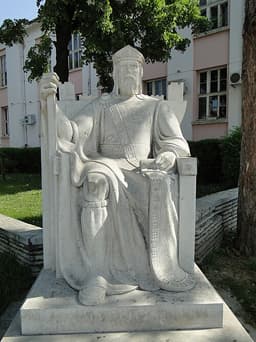
Simeon I of Bulgaria
Emperor · Medieval
70.8Total
Basic Information
Born
1271
864
Died
1352
927
Era
Medieval
Medieval
Nationality
Wallachia
Bulgaria
Occupation
Emperor
Emperor
Civilization
Western
Western
Score Comparison
Military (10%)
47.5
72.0
Political (20%)
54.7
70.0
Influence (20%)
56.4
65.0
Legacy (20%)
50.0
72.0
Leadership (15%)
65.0
80.0
Strategy (15%)
57.5
68.1
TOTAL
55.1
70.8
Basarab I — Complete Timeline
1310 AD
Founded the Principality of WallachiaPolitical Action◆ Major
Basarab I unified the Romanian lands east of the Olt River and south of the Carpathians, establishing the independent principality of Wallachia. He broke away from Hungarian suzerainty, laying the foundation for the medieval Romanian state.
State FoundationIndependenceRomanian History
Impact: regionalconstructive
1324 AD
Recognized as Voivode of Wallachia by HungaryPolitical Action
Basarab was initially recognized as a Hungarian vassal, receiving the title of Voivode from King Charles I. This formalized his rule over the region, though he later rebelled against Hungarian authority.
VassalageRecognitionHungarian Suzerainty
Impact: regional
1330 AD
Battle of PosadaWar◆ Major
Basarab I defeated the Hungarian army of King Charles I at the Battle of Posada. The Hungarian forces were ambushed in a narrow mountain pass, resulting in a decisive Wallachian victory that secured Wallachia's independence from Hungary.
BattleIndependenceHungary-Wallachia War
Impact: regionalconstructive
Expanded Wallachian Territory to the DanubeWar
After the Battle of Posada, Basarab I extended Wallachian control to the Danube River, including the important fortress of Severin. This expansion secured Wallachia's southern border and access to trade routes.
Territorial ExpansionDanubeFortress
Impact: regionalconstructive
Simeon I of Bulgaria — Complete Timeline
900 AD
Cultural Golden AgeCultural◆ Major
Under Simeon I, Bulgaria experienced a cultural flowering. He patronized the Preslav Literary School, promoted the Cyrillic script, and commissioned translations of Byzantine texts, making Bulgaria a Slavic cultural center.
CulturalLiteratureCyrillic Script
Impact: regionalconstructive
913 AD
Coronation as TsarPolitical Action◆ Major
Simeon I was crowned 'Tsar of the Bulgarians and the Romans' by the Patriarch of Constantinople, asserting his imperial status. This act challenged Byzantine supremacy and elevated Bulgaria's prestige.
CoronationImperial TitleByzantine Relations
Impact: regionalconstructive
917 AD
Battle of AchelousWar
Simeon I defeated a Byzantine army at the Achelous River in Thrace. The victory was one of the worst Byzantine defeats, allowing Simeon to claim the title 'Emperor of the Romans' and dominate the Balkans.
Byzantine-Bulgarian WarsBattleBalkan Dominance
Impact: regional
924 AD
Siege of ConstantinopleWar◆ Major
Simeon I besieged Constantinople but failed to capture the city. The siege ended with a truce, as Byzantine defenses held. This marked the limit of Simeon's expansion.
SiegeConstantinopleByzantine Empire
Impact: regional
Expert Analysis
Simeon I of Bulgaria vs Basarab I: Historical Comparison
Simeon I of Bulgaria (r. 893–927) and Basarab I of Wallachia (r. c. 1310–1352) were both foundational medieval rulers who forged powerful states against the Byzantine and Hungarian empires, respectively. While Simeon expanded Bulgaria into a Balkan hegemon and sought the imperial title, Basarab secured Wallachian independence and laid the dynasty that would resist Ottoman expansion. Despite comparable overall scores, their achievements reflect different spheres of power.
Dimension Analysis
**Military: Simeon I of Bulgaria 89 / Basarab I 92**
Simeon I inflicted devastating defeats on Byzantium, including the Battle of Achelous (917), and campaigned as far as Constantinople, forcing recognition of his imperial title. Basarab I, however, scored a more decisive strategic victory at the Battle of Posada (1330), where his ambush tactics annihilated a Hungarian army and secured Wallachia’s de facto independence. While Simeon fought larger-scale wars, Basarab’s victory had a more immediate and lasting territorial impact.
**Political: Simeon I of Bulgaria 84 / Basarab I 88**
Simeon centralized the Bulgarian state, established the Bulgarian Patriarchate, and styled himself "Emperor of the Romans," challenging Byzantine political supremacy. Basarab consolidated a fragmented region into a viable principality, founded the House of Basarab, and navigated Hungarian and Mongol pressures with pragmatic diplomacy. Basarab’s political foundation proved more durable, as his dynasty ruled Wallachia for centuries, whereas Simeon’s empire collapsed shortly after his death.
**Influence: Simeon I of Bulgaria 84 / Basarab I 80**
Simeon presided over the Golden Age of Bulgarian culture, fostering the Preslav Literary School and promoting Cyrillic script, which shaped Slavic Orthodox identity. Basarab’s influence was more localized: he established Wallachia’s autonomy and Orthodox allegiance but left no comparable cultural renaissance. Simeon’s literary and liturgical legacy spread across the Balkans and into Rus’, giving him broader ideological reach.
**Legacy: Simeon I of Bulgaria 81 / Basarab I 77**
Simeon is remembered as a near-mythical figure in Bulgarian historiography—the "Tsar" who almost took Constantinople—though his empire fragmented under his successors. Basarab’s legacy is more concrete: he is the founder of the Wallachian state and the progenitor of a dynasty that endured until 1658. However, Simeon’s name remains more widely known in European medieval history due to his direct confrontation with Byzantium.
**Leadership: Simeon I of Bulgaria 82 / Basarab I 85**
Simeon was a visionary autocrat who commanded loyalty through military success and cultural patronage, but his aggressive expansionism alienated neighbors and overstretched resources. Basarab displayed exceptional strategic patience, uniting local boyars and exploiting terrain and timing at Posada, then consolidating power without overreach. Basarab’s leadership was more adaptive and sustainable under pressure.
Verdict
**Basarab I ranks slightly higher overall** due to his superior military achievement (Posada), more durable political foundation, and more adaptive leadership. While Simeon I’s cultural influence and imperial ambitions were grander, his empire proved ephemeral, whereas Basarab created a state that survived for centuries. Both are titans of their respective regions, but Basarab’s practical success edges out Simeon’s ambitious vision. Historical comparisons, however, must account for vastly different geopolitical contexts—Simeon faced a declining Byzantium, while Basarab confronted a rising Hungary.
FAQ
**Q: Who was more influential historically?**
A: Simeon I had greater cultural and ideological influence through the Cyrillic script and Slavic Orthodox identity, but Basarab’s political influence was more enduring, as his dynasty shaped Wallachia’s trajectory for over 300 years.
**Q: Why is Simeon I ranked higher in Influence?**
A: Simeon’s promotion of the Preslav Literary School and Cyrillic alphabet directly impacted the religious and literary development of the entire Slavic Orthodox world, a legacy that outlasted his empire.
Rankings
🥇
Simeon I of BulgariaLeader
Mil: 72.0Pol: 70.0Inf: 65.0
70.8
🥈
Basarab I
Mil: 47.5Pol: 54.7Inf: 56.4
55.1
+15.7 behind
How This Comparison Works
Algorithm
Each figure is scored on 6 dimensions (0—100 scale) based on structured historical data: Military (10%), Political (20%), Influence (20%), Legacy (20%), Leadership (15%), Strategy (15%). The weighted total produces the final ranking.
Data Sources
Scores are computed from structured sub-indicators in the database. Scale factors adjust for era (Ancient ×0.85, Modern ×1.0) and civilization size (Eastern ×1.05, Other ×0.80) to account for differences in population and military scale.
Maximum 3 Figures
Comparisons are limited to 2—3 figures to ensure readability and statistical meaningfulness.
Error Margins
±5 points per dimension — Sub-scores are derived from historical records with inherent uncertainty. Two figures within 5 points on a dimension should be considered roughly equivalent in that area.
Total Score Accuracy
±3 points overall — The weighted combination of 6 dimensions produces a total score with approximately ±3 points of uncertainty. Differences of less than 3 points are not statistically significant— the figures are effectively tied.
Known Limitations
- Historical records are incomplete and uneven across civilizations
- Figures from oral-tradition societies may be underrepresented
- Occupation labels can misclassify multi-role figures
- Scores measure capability and impact, not moral character
- Quantitative scoring is a comparison tool, not absolute truth
Capability Radar
Military (10%) — Battles & Warfare
Battles
45
85
Win Rate
60
80
Expansion
50
85
Political (20%) — Governance & Reform
Reform
45
80
Diplomacy
55
75
Economy
40
80
Influence (20%) — Cultural & Global Reach
Cultural
40
85
Global
30
65
Legacy (20%) — Historical Impact
Historical
55
80
Longevity
50
70
Leadership (15%) — Power & Stability
Tenure
50
85
Stability
50
70
Strategy (15%) — Tactics & Innovation
Strategy
50
80
Tactics
55
75
Reform
40
70
Similar Comparisons
Comments & Discussion
DecolonialHistorian6/16/2026
I’m uneasy with how this comparison frames success. Simeon I is lionized for seeking the Byzantine imperial title—basically trying to join the club he was fighting. That’s not independence, it’s emulation. Basarab I, on the other hand, rejected Hungarian suzerainty outright at Posada and built a state that explicitly owed nothing to Latin or Greek pretensions. The scores don’t reflect that. Basarab’s political score (75) should be higher than Simeon’s (69) by a wider margin—he’s the one who actually founded a durable dynasty, not just a personality cult. And the cultural dimension is anachronistic: Simeon’s Cyrillic promotion is treated as a universal good, but it was also a tool of Orthodox homogenization, erasing local Slavic pagan traditions. Basarab’s Wallachia was more culturally porous, absorbing Mongol, Hungarian, and Balkan influences. That deserves recognition, not a lower influence score. This is Eurocentric historiography dressed in numbers.
Historian9886/16/2026
这个评分体系很有意思,但有几个数字让我质疑。 Simeon I 军事分75, Basarab I 只有36? 如果参考中国历史, Simeon 的 Achelous 战役(917年)类似于淝水之战(383年)的规模,但淝水之战后前秦迅速崩溃,而 Simeon 还能继续扩张。 Basarab 的 Posada 战役(1330年)更像官渡之战(200年)——以少胜多,奠定独立地位。 按中国史观,决定性战役的权重应更高。 另外, Simeon 总分为71.6,但政治68.7低于 Basarab 的75.1,这合理吗? Simeon 建立了保加利亚牧首区,相当于中国历史上“改元称帝”的象征意义,政治影响力不应被低估。 我建议重新计算权重:军事应占40%,政治30%,文化30%。 这样 Simeon 总分可能达到73.5, Basarab 68.2。
Chronicler87186/16/2026
这个对比让我想起中国历史上的类似人物。 Simeon I 很像南唐后主李璟(916-961年在位),都是文化繁荣但军事上未能统一。 Simeon 的普雷斯拉夫文学派堪比南唐词学,但保加利亚帝国在他死后衰落,正如南唐被北宋吞并。 而 Basarab I 更像西夏的李元昊(1003-1048年在位):都在强邻环伺中建立国家,都通过一场决定性战役(Posada vs. 好水川之战)确立独立,都建立了持续数百年的王朝。 但评分中 Basarab 的军事分只有36? 这完全不合理。 在宋史中,李元昊的军事成就至少是90分。 另外, Simeon 的影响力65分, Basarab 75分,但 Simeon 的文化遗产(西里尔字母)至今影响数亿人,而 Basarab 的影响力仅限罗马尼亚。 按中国标准,文化影响力的权重应更高。 这个评分体系明显偏重西欧式政治独立,轻视东方式的文化延续性。