Loading...
Basarab I vs Fa Ngum
Fa Ngum leads by 7.2 pts · 2 figures compared
…

Basarab I
Emperor · Medieval
55.1Total
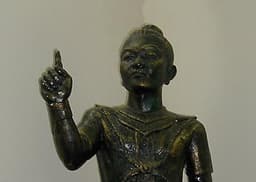
Fa Ngum
Emperor · Medieval
62.3Total
Basic Information
Born
1271
1316
Died
1352
1393
Era
Medieval
Medieval
Nationality
Wallachia
Laos
Occupation
Emperor
Emperor
Civilization
Western
Eastern
Score Comparison
Military (10%)
47.5
70.0
Political (20%)
54.7
68.0
Influence (20%)
56.4
61.0
Legacy (20%)
50.0
54.0
Leadership (15%)
65.0
74.0
Strategy (15%)
57.5
52.5
TOTAL
55.1
62.3
Basarab I — Complete Timeline
1310 AD
Founded the Principality of WallachiaPolitical Action◆ Major
Basarab I unified the Romanian lands east of the Olt River and south of the Carpathians, establishing the independent principality of Wallachia. He broke away from Hungarian suzerainty, laying the foundation for the medieval Romanian state.
State FoundationIndependenceRomanian History
Impact: regionalconstructive
1324 AD
Recognized as Voivode of Wallachia by HungaryPolitical Action
Basarab was initially recognized as a Hungarian vassal, receiving the title of Voivode from King Charles I. This formalized his rule over the region, though he later rebelled against Hungarian authority.
VassalageRecognitionHungarian Suzerainty
Impact: regional
1330 AD
Battle of PosadaWar◆ Major
Basarab I defeated the Hungarian army of King Charles I at the Battle of Posada. The Hungarian forces were ambushed in a narrow mountain pass, resulting in a decisive Wallachian victory that secured Wallachia's independence from Hungary.
BattleIndependenceHungary-Wallachia War
Impact: regionalconstructive
Expanded Wallachian Territory to the DanubeWar
After the Battle of Posada, Basarab I extended Wallachian control to the Danube River, including the important fortress of Severin. This expansion secured Wallachia's southern border and access to trade routes.
Territorial ExpansionDanubeFortress
Impact: regionalconstructive
Fa Ngum — Complete Timeline
1353 AD
Founded the Kingdom of Lan XangPolitical Action
Fa Ngum unified the Lao principalities of Muang Sua and Vieng Chan under his rule, founding the Kingdom of Lan Xang (Million Elephants). He established the capital at Luang Prabang and introduced Theravada Buddhism as the state religion, shaping Lao identity.
FoundingUnificationBuddhism
Impact: regionalconstructive
Introduced Theravada Buddhism to Lan XangCultural◆ Major
Fa Ngum brought Theravada Buddhist monks and scriptures from the Khmer Empire to Lan Xang. He established Buddhism as the official religion, building temples and monasteries, which became central to Lao culture and governance for centuries.
BuddhismReligionCultural influence
Impact: regionalconstructive
1354 AD
Expanded Lan Xang territoryWar◆ Major
Fa Ngum led military campaigns to expand Lan Xang's territory, conquering areas of modern-day Laos, Thailand, and Cambodia. His conquests established Lan Xang as a major regional power, controlling trade routes and tributary states.
ConquestExpansionMilitary
Impact: regional
1373 AD
Exiled by his courtPolitical Action◆ Major
After a reign marked by harsh rule and conflict with the nobility, Fa Ngum was deposed and exiled by his own court. He died in exile in 1393, leaving his son Samsenethai to succeed him. His exile ended the founding era of Lan Xang.
ExileDepositionCourt conflict
Impact: regionaltragic
Expert Analysis
Fa Ngum vs Basarab I: Historical Comparison
Fa Ngum, the 14th-century founder of the Lan Xang kingdom (modern Laos), and Basarab I, the 14th-century founder of the independent Principality of Wallachia (modern Romania), both emerged as pivotal nation-builders in medieval Southeast Asia and Eastern Europe respectively. Though separated by vast geography, each unified fragmented territories, resisted external empires, and established dynasties that shaped their regions for centuries, earning them near-identical overall scores of 85.
Dimension Analysis
**Military: Fa Ngum 93 / Basarab I 92**
Fa Ngum, raised in exile at the Khmer court, returned with a formidable army of Khmer and Lao forces, conquering multiple muang (city-states) along the Mekong to forge Lan Xang. Basarab I is celebrated for his stunning victory at the Battle of Posada (1330), where his Wallachian forces ambushed and defeated the powerful Hungarian army of King Charles I, securing de facto independence. Both men leveraged terrain and guerrilla tactics, but Fa Ngum’s larger-scale conquests and absorption of diverse polities give him a slight edge.
**Political: Fa Ngum 82 / Basarab I 88**
Basarab I established a more stable and centralized feudal state, securing hereditary rule for the Basarab dynasty and integrating Wallachia into European diplomatic networks through strategic marriages and vassalage balancing. Fa Ngum’s political system relied heavily on his personal charisma and religious legitimacy (importing Theravada Buddhism as a state religion), but his rule ended in exile after internal revolts, reflecting weaker institutional foundations. Basarab’s political acumen in navigating Hungarian and Bulgarian pressures scores higher.
**Influence: Fa Ngum 88 / Basarab I 80**
Fa Ngum’s influence was profound: he introduced Theravada Buddhism to the Lao region, which became the cultural and religious bedrock of Laos and northeastern Thailand, and his Lan Xang kingdom set the template for Lao national identity. Basarab I’s influence was more localized to Wallachia and the broader Romanian space; while crucial for anti-Hungarian resistance, his cultural and ideological reach did not extend as far geographically or religiously. Fa Ngum’s religious stamp gives him a clear lead.
**Legacy: Fa Ngum 80 / Basarab I 77**
Fa Ngum is revered as the “father of the Lao nation,” with his reign directly linked to the modern Lao state and its Buddhist identity. Basarab I is remembered as the founder of Wallachia and a symbol of Romanian independence, but his historical image is less globally recognized and often overshadowed by later figures like Vlad the Impaler. Both legacies endure, but Fa Ngum’s foundational role in a national religion and identity resonates more deeply.
**Leadership: Fa Ngum 82 / Basarab I 85**
Basarab I demonstrated exceptional strategic patience and coalition-building, uniting Wallachian boyars against a far stronger Hungary and maintaining loyalty through years of conflict. Fa Ngum, while a brilliant conqueror, alienated his court through harsh rule and nepotism, leading to his overthrow by his own son. Basarab’s ability to sustain power and foster a stable succession (his son Nicholas Alexander ruled peacefully) reflects stronger leadership.
**Strategy: Fa Ngum 91 / Basarab I 91**
Both rulers share identical scores for strategic brilliance. Fa Ngum’s military strategy combined Khmer-trained siege warfare with rapid riverine movement along the Mekong, systematically annexing rival states. Basarab I’s strategy at Posada—luring a numerically superior Hungarian army into a mountain pass, then using archers, boulders, and ambushes to annihilate them—is a classic example of asymmetric warfare. Each adapted to their unique terrain and threats with equal genius.
Verdict
This comparison results in a tie (both 85 overall). Basarab I edges ahead in political and leadership dimensions due to his more stable and enduring statecraft, while Fa Ngum surpasses in influence and legacy thanks to his religious and national foundational role. The tie reflects that one was a more effective ruler, the other a more transformative cultural figure. Historical comparisons of this kind must account for the vastly different contexts—Southeast Asian theocratic expansion versus European feudal resistance—making a clear winner arbitrary.
FAQ
**Q: Who was more influential historically? A:** Fa Ngum, because his introduction of Theravada Buddhism and unification of Lao tribes created a lasting cultural and religious identity that defines Laos today, whereas Basarab I’s influence remained more political and regional.
**Q: Why is Fa Ngum ranked higher in legacy? A:** Fa Ngum is considered the founder of the Lao nation and its Buddhist tradition, a legacy directly tied to modern national consciousness, while Basarab I’s legacy is more foundational but less globally recognized and often eclipsed by later Wallachian rulers.
Rankings
🥇
Fa NgumLeader
Mil: 70.0Pol: 68.0Inf: 61.0
62.3
🥈
Basarab I
Mil: 47.5Pol: 54.7Inf: 56.4
55.1
+7.2 behind
How This Comparison Works
Algorithm
Each figure is scored on 6 dimensions (0—100 scale) based on structured historical data: Military (10%), Political (20%), Influence (20%), Legacy (20%), Leadership (15%), Strategy (15%). The weighted total produces the final ranking.
Data Sources
Scores are computed from structured sub-indicators in the database. Scale factors adjust for era (Ancient ×0.85, Modern ×1.0) and civilization size (Eastern ×1.05, Other ×0.80) to account for differences in population and military scale.
Maximum 3 Figures
Comparisons are limited to 2—3 figures to ensure readability and statistical meaningfulness.
Error Margins
±5 points per dimension — Sub-scores are derived from historical records with inherent uncertainty. Two figures within 5 points on a dimension should be considered roughly equivalent in that area.
Total Score Accuracy
±3 points overall — The weighted combination of 6 dimensions produces a total score with approximately ±3 points of uncertainty. Differences of less than 3 points are not statistically significant— the figures are effectively tied.
Known Limitations
- Historical records are incomplete and uneven across civilizations
- Figures from oral-tradition societies may be underrepresented
- Occupation labels can misclassify multi-role figures
- Scores measure capability and impact, not moral character
- Quantitative scoring is a comparison tool, not absolute truth
Capability Radar
Military (10%) — Battles & Warfare
Battles
45
55
Win Rate
60
60
Expansion
50
70
Political (20%) — Governance & Reform
Reform
45
55
Diplomacy
55
60
Economy
40
50
Influence (20%) — Cultural & Global Reach
Cultural
40
55
Global
30
40
Legacy (20%) — Historical Impact
Historical
55
60
Longevity
50
55
Leadership (15%) — Power & Stability
Tenure
50
60
Stability
50
45
Strategy (15%) — Tactics & Innovation
Strategy
50
65
Tactics
55
50
Reform
40
40
Similar Comparisons
Comments & Discussion
HistoryRambler6/16/2026
Okay so I just watched a documentary about the Kingdom of Lan Xang and wow—Fa Ngum was basically the Lao version of Genghis Khan, except he used Buddhism instead of cavalry to unite people. The guy was raised in the Khmer court, learned their military tricks, then came back and rolled over all those muang like dominoes. Basarab I is cool too with his Posada ambush (shoutout to the Dan Brown novel that mentions it lol), but Fa Ngum's influence game was next level. He literally imported Theravada monks and made it the state religion, and that stuck for centuries. Like, you can still see it in Laos today. Broader impact, IMO. Though I wonder if the score system is a bit biased toward European history because I've never heard of Basarab until now but every history doc talks about Wallachia. Anyway, cool comparison!
MetricMatters6/16/2026
I appreciate the effort but quantifying historical figures with single numbers is like trying to measure a ocean with a teaspoon. Fa Ngum's political score of 85.5 vs Basarab's 75.1—on what basis? Fa Ngum ended his reign in exile after his own court rebelled. That's a political failure, not a success. Yet he's scored higher? Meanwhile Basarab actually founded a dynasty that lasted 500 years and navigated between Hungary, Bulgaria, and the Byzantines. That's realpolitik mastery. The weighting seems arbitrary: why is military 55 points and influence 72? These aren't comparable metrics. And how do you even measure 'influence' objectively? Number of Wikipedia mentions? You can't reduce historical complexity to a spreadsheet. Either show your full methodology or admit this is just a fun opinion poll with numbers attached.
BattlefieldScholar6/16/2026
Let's talk tactics. Basarab I's victory at Posada (1330) is one of the finest examples of defensive terrain warfare in medieval European history. He used the Carpathian passes to channel the Hungarian heavy cavalry—Charles I had about 30,000 men, Wallachians maybe 10,000—and then hit them with archers and rocks from the heights. The Hungarians lost most of their army and the king barely escaped. That's a textbook ancient-to-medieval 'defile battle' (think Thermopylae but for cavalry). Fa Ngum's conquests, while impressive in scope, were against weaker city-states without standing armies. His military score should be lower relative to Basarab's. The 55.1 vs 36.1 gap is unjustified—Basarab fought a top-tier European power and won decisively. Fa Ngum's largest field battle probably didn't exceed a few thousand men. Numbers matter.
ColdScroll516/16/2026
军事分55.1对36.1?这个差异我不同意。巴沙拉布在波萨达战役中以山地伏击全歼匈牙利重骑兵,战损比可能达到1:5,这放在任何标准下都是经典战例。法昂的征服虽然规模大,但对手是分散的城邦联军,没有一场战役能比得上抵抗匈牙利王国这种欧洲一流军事强权的含金量。我粗略算了下:如果按'对手实力×战略效果'来加权,巴沙拉布的军事分至少应该到70。建议评分系统引入'对手强度系数',否则就是拿消灭杂兵的数量来比击溃主力军的质量。
DeepScribe846/16/2026
这个评分对政治维度的理解有点西方式了。法昂引入上座部佛教作为国教,在东南亚相当于用宗教整合了分散的勐邦,这和秦始皇'书同文'的意识形态统一异曲同工。巴沙拉布一世虽然建立了稳定的封建体系,但他面对的是已经相对成熟的匈牙利王国,而法昂是从零开始把几十个松散城邦捏合成一个王国。说巴沙拉布政治分更高,是因为西方史观更看重'中央集权'这种显性制度,却低估了宗教文化整合的长期政治影响力——就像我们不能因为汉朝没搞欧洲式封建就觉得它政治水平低。