Loading...
Bartolome Mitre vs Pancho Villa
Bartolome Mitre leads by 11.1 pts · 2 figures compared
…

Bartolome Mitre
General · Modern
63.0Total
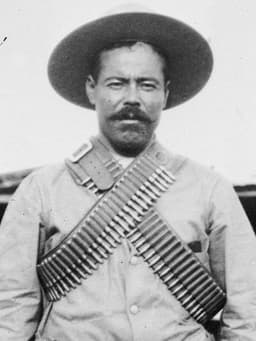
Pancho Villa
General · Modern
51.9Total
Basic Information
Born
1821
1878
Died
1906
1923
Era
Modern
Modern
Nationality
Argentina
Mexico
Occupation
General
General
Civilization
Western
Western
Score Comparison
Military (10%)
67.5
70.0
Political (20%)
70.0
35.1
Influence (20%)
62.0
55.0
Legacy (20%)
56.0
54.0
Leadership (15%)
72.0
47.3
Strategy (15%)
55.0
52.5
TOTAL
63.0
51.9
Bartolome Mitre — Complete Timeline
1861 AD
Defeated Justo José de Urquiza at the Battle of PavónWar
Mitre's forces defeated Urquiza's army at the Battle of Pav
BattleUnificationCivil War
Impact: national
1862 AD
Elected President of ArgentinaPolitical Action
Mitre was elected the first president of the unified Argentine Republic, serving from 1862 to 1868. His presidency consolidated national unity and promoted economic development.
PresidencyUnificationArgentina
Impact: nationalconstructive
1865 AD
Led the Triple Alliance in the Paraguayan WarWar◆ Major
Mitre commanded the allied forces of Argentina, Brazil, and Uruguay in the Paraguayan War against Paraguay. The war lasted until 1870 and resulted in the devastation of Paraguay, but Mitre's leadership was criticized for strategic failures.
WarParaguayTriple Alliance
Impact: regionaldestructive
1870 AD
Founded the newspaper 'La Nación'Cultural◆ Major
Mitre founded 'La Naci
JournalismMediaLiberalism
Impact: nationalconstructive
Pancho Villa — Complete Timeline
1911 AD
Battle of Ciudad JuarezWar◆ Major
Villa's forces, under Madero's command, captured Ciudad Juarez, a key border city. The victory forced Porfirio Diaz to resign and sign the Treaty of Ciudad Juarez, ending the first phase of the revolution.
BattleRevolutionDiaz Resignation
Impact: national
1913 AD
Division of the North CommandWar◆ Major
After Victoriano Huerta's coup, Villa formed the Division of the North, a powerful military force. He led it to victories at Torreon and Zacatecas, becoming a dominant revolutionary general.
Military CommandRevolutionary ArmyVictories
Impact: regional
1914 AD
Battle of ZacatecasWar
Villa's Division of the North decisively defeated Huerta's federal forces at Zacatecas. The victory broke Huerta's military power and led to his resignation, but also caused a rift with Carranza.
BattleHuerta DefeatRevolutionary Victory
Impact: national
1916 AD
Columbus RaidWar◆ Major
Villa's forces attacked Columbus, New Mexico, killing 18 Americans. The raid prompted U.S. President Wilson to send a punitive expedition under General Pershing into Mexico, which failed to capture Villa.
Cross-Border RaidUS InterventionPunitive Expedition
Impact: regionaldestructive
1923 AD
Assassination of Pancho VillaPolitical Action◆ Major
Villa was assassinated by gunmen while driving in Parral, Chihuahua. The attack was likely ordered by political rivals, ending his post-revolutionary influence and securing the government's control.
AssassinationPolitical ViolenceEnd of Era
Impact: nationaltragic
Expert Analysis
Origins
Bartolomé Mitre was born on June 26, 1821, in Buenos Aires, Argentina, into a family of Spanish descent. His father was a merchant, and Mitre received a solid education in the humanities and military sciences. He developed early interests in literature and history, which later influenced his work as a journalist and historian. Mitre's formative years were shaped by the turbulent aftermath of the Argentine War of Independence, with ongoing conflicts between unitarios and federalistas.
Pancho Villa, born Doroteo Arango on June 5, 1878, in San Juan del Río, Durango, Mexico, came from a poor peasant family. His father died when Villa was young, and he worked as a sharecropper. After killing a hacienda owner who assaulted his sister, Villa fled to the mountains, becoming a bandit. This early life of hardship and rebellion forged his fierce independence and distrust of authority.
Rise to Power
Mitre rose through military and political ranks in the Argentine Confederation. He fought in the battles of Caseros (1852) and Cepeda (1859), gaining prominence. His decisive victory at the Battle of Pavón on September 17, 1861, over Justo José de Urquiza's forces was a turning point. Mitre's triumph led to the reunification of Argentina under Buenos Aires, and he was elected the first president of the unified Argentine Republic in 1862, serving until 1868.
Villa's rise began with the Mexican Revolution in 1910. He joined Francisco I. Madero's rebellion against Porfirio Díaz, capturing Ciudad Juárez in May 1911. After Madero's assassination in 1913, Villa formed the formidable Division of the North. His military skill peaked with the capture of Torreón in March 1914 and the decisive victory at the Battle of Zacatecas on June 23, 1914, which broke Victoriano Huerta's regime. Villa became a key figure in the Conventionist faction, controlling northern Mexico.
Leadership & Governance
Mitre's leadership was characterized by institution-building and liberal reforms. As president, he promoted education, established the Colegio Nacional de Buenos Aires, and founded the influential newspaper 'La Nación' in 1870. His governance focused on unifying Argentina under a centralized federal system, balancing provincial autonomy with national authority. Mitre's military score of 67.5 reflects his competence, but his political score of 70.0 highlights his true strength.
Villa's leadership was charismatic but erratic. He was a brilliant military commander (military score 70.0) but lacked political acumen (political score 35.1). Villa governed the territories he controlled through personal loyalty and redistribution of land to peasants, but he failed to establish stable institutions. His strategy score of 52.5 indicates tactical brilliance but strategic shortcomings, such as the ill-advised raid on Columbus, New Mexico, on March 9, 1916, which provoked a U.S. punitive expedition.
Triumph & Tragedy
Mitre's greatest success was unifying Argentina after decades of civil war, ending the conflict between Buenos Aires and the provinces. His presidency laid the foundations for modern Argentina. However, his leadership in the Paraguayan War (1864-1870) as commander of the Triple Alliance forces was controversial; the war was devastating, causing massive casualties and economic damage. Mitre's legacy includes the newspaper 'La Nación', which shaped public opinion for generations.
Villa's triumphs were military: his Division of the North defeated federal forces repeatedly, and he controlled a vast territory. His worst failure was the Columbus Raid, which led to a U.S. military intervention and tarnished his reputation. Villa's inability to transition from revolutionary general to political leader resulted in his marginalization after the revolution. He was assassinated on July 20, 1923, in Parral, Chihuahua, by political rivals.
Character & Destiny
Mitre was pragmatic, disciplined, and intellectually inclined. He valued order and progress, which drove his unification efforts. His character shaped a destiny of nation-building; he died on January 19, 1906, respected as a historian and statesman. His total score of 63.0 reflects balanced abilities.
Villa was impulsive, courageous, and deeply connected to the peasantry. His charisma inspired fierce loyalty, but his lack of discipline led to strategic errors. His destiny was that of a folk hero, but he failed to achieve lasting political power. His total score of 51.9 reflects his military prowess but political weakness.
Legacy
Mitre's legacy is institutional: he unified Argentina, founded a major newspaper, and wrote influential histories. His political and legal structures endured, shaping Argentina's development. He is remembered as a founding father.
Villa's legacy is symbolic: he represents the fight for social justice and land reform. He remains a folk hero in Mexico and abroad. However, his revolutionary goals were not fully realized, and his impact on Mexico's political institutions was limited.
Conclusion
Bartolomé Mitre had a greater impact than Pancho Villa. Mitre's total score of 63.0 vs Villa's 51.9 reflects his superior political and leadership abilities. Mitre unified a nation and built lasting institutions, while Villa's military victories did not translate into stable governance. Villa's legacy is powerful culturally, but Mitre's contributions to Argentina's statehood are more foundational and enduring. In a data-driven comparison, Mitre emerges as the more influential figure.
Rankings
🥇
Bartolome MitreLeader
Mil: 67.5Pol: 70.0Inf: 62.0
63.0
🥈
Pancho Villa
Mil: 70.0Pol: 35.1Inf: 55.0
51.9
+11.1 behind
How This Comparison Works
Algorithm
Each figure is scored on 6 dimensions (0—100 scale) based on structured historical data: Military (10%), Political (20%), Influence (20%), Legacy (20%), Leadership (15%), Strategy (15%). The weighted total produces the final ranking.
Data Sources
Scores are computed from structured sub-indicators in the database. Scale factors adjust for era (Ancient ×0.85, Modern ×1.0) and civilization size (Eastern ×1.05, Other ×0.80) to account for differences in population and military scale.
Maximum 3 Figures
Comparisons are limited to 2—3 figures to ensure readability and statistical meaningfulness.
Error Margins
±5 points per dimension — Sub-scores are derived from historical records with inherent uncertainty. Two figures within 5 points on a dimension should be considered roughly equivalent in that area.
Total Score Accuracy
±3 points overall — The weighted combination of 6 dimensions produces a total score with approximately ±3 points of uncertainty. Differences of less than 3 points are not statistically significant— the figures are effectively tied.
Known Limitations
- Historical records are incomplete and uneven across civilizations
- Figures from oral-tradition societies may be underrepresented
- Occupation labels can misclassify multi-role figures
- Scores measure capability and impact, not moral character
- Quantitative scoring is a comparison tool, not absolute truth
Capability Radar
Military (10%) — Battles & Warfare
Battles
65
65
Win Rate
60
60
Expansion
55
40
Political (20%) — Governance & Reform
Reform
75
20
Diplomacy
65
25
Economy
60
15
Influence (20%) — Cultural & Global Reach
Cultural
55
55
Global
45
50
Legacy (20%) — Historical Impact
Historical
60
60
Longevity
50
45
Leadership (15%) — Power & Stability
Tenure
70
35
Stability
55
10
Strategy (15%) — Tactics & Innovation
Strategy
65
55
Tactics
55
70
Reform
70
30
Similar Comparisons
Comments & Discussion
No comments yet. Be the first to share your thoughts!