Loading...
Ahmad Yani vs Pancho Villa
Pancho Villa leads by 8.6 pts · 2 figures compared
…

Ahmad Yani
General · Modern
43.3Total
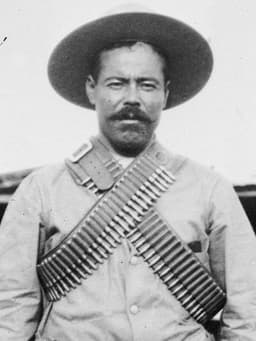
Pancho Villa
General · Modern
51.9Total
Basic Information
Born
1922
1878
Died
—
1923
Era
Modern
Modern
Nationality
Indonesia
Mexico
Occupation
General
General
Civilization
Eastern
Western
Score Comparison
Military (10%)
50.0
70.0
Political (20%)
30.8
35.1
Influence (20%)
51.8
55.0
Legacy (20%)
44.2
54.0
Leadership (15%)
36.9
47.3
Strategy (15%)
41.7
52.5
TOTAL
43.3
51.9
Ahmad Yani — Complete Timeline
1962 AD
Appointed Army Chief of StaffPolitical Action◆ Major
Ahmad Yani was appointed Chief of Staff of the Indonesian Army. He was a key figure in the military's modernization and its role in national politics under President Sukarno.
MilitaryAppointmentIndonesia
Impact: national
1965 AD
Kidnapped and Killed in the 30 September MovementWar
Yani was kidnapped and executed by members of the 30 September Movement, a coup attempt by leftist forces. His death triggered a violent anti-communist purge led by General Soeharto.
CoupDeathPolitical Violence
Impact: nationaltragic
Pancho Villa — Complete Timeline
1911 AD
Battle of Ciudad JuarezWar◆ Major
Villa's forces, under Madero's command, captured Ciudad Juarez, a key border city. The victory forced Porfirio Diaz to resign and sign the Treaty of Ciudad Juarez, ending the first phase of the revolution.
BattleRevolutionDiaz Resignation
Impact: national
1913 AD
Division of the North CommandWar◆ Major
After Victoriano Huerta's coup, Villa formed the Division of the North, a powerful military force. He led it to victories at Torreon and Zacatecas, becoming a dominant revolutionary general.
Military CommandRevolutionary ArmyVictories
Impact: regional
1914 AD
Battle of ZacatecasWar
Villa's Division of the North decisively defeated Huerta's federal forces at Zacatecas. The victory broke Huerta's military power and led to his resignation, but also caused a rift with Carranza.
BattleHuerta DefeatRevolutionary Victory
Impact: national
1916 AD
Columbus RaidWar◆ Major
Villa's forces attacked Columbus, New Mexico, killing 18 Americans. The raid prompted U.S. President Wilson to send a punitive expedition under General Pershing into Mexico, which failed to capture Villa.
Cross-Border RaidUS InterventionPunitive Expedition
Impact: regionaldestructive
1923 AD
Assassination of Pancho VillaPolitical Action◆ Major
Villa was assassinated by gunmen while driving in Parral, Chihuahua. The attack was likely ordered by political rivals, ending his post-revolutionary influence and securing the government's control.
AssassinationPolitical ViolenceEnd of Era
Impact: nationaltragic
Expert Analysis
Origins
Ahmad Yani was born in 1922 in Jenar, Central Java, Dutch East Indies. His father was a government clerk. Yani attended Dutch-run schools and later joined the colonial army, the Royal Netherlands East Indies Army, where he received military training. After Indonesian independence, he joined the Indonesian Army and rose through the ranks.
Pancho Villa was born José Doroteo Arango Arámbula in 1878 in San Juan del Río, Durango, Mexico, into a poor peasant family. He became a bandit after killing a hacienda owner who assaulted his sister. Villa later joined the Mexican Revolution, becoming a self-taught military leader.
Rise to Power
Yani's rise began during the Indonesian National Revolution (1945-1949), where he fought against Dutch forces. He gained prominence for his role in suppressing regional rebellions, such as the PRRI/Permesta revolt in the late 1950s. In 1962, he was appointed Army Chief of Staff, succeeding General Abdul Haris Nasution. Yani focused on modernizing the army and increasing its political influence.
Villa rose to power through the Mexican Revolution. In 1910, he joined Francisco I. Madero's uprising against Porfirio Díaz. After Madero's assassination by Victoriano Huerta in 1913, Villa formed the Division of the North, a formidable military force. His victory at the Battle of Zacatecas in 1914 broke Huerta's power, making Villa a key figure in the revolution.
Leadership & Governance
Yani's leadership was characterized by loyalty to President Sukarno and the military's institutional role. He implemented reforms to professionalize the army, including training programs and modernization of equipment. Yani maintained a balance between the army and the Communist Party of Indonesia (PKI), which was growing in influence. He scored 36.9 in leadership and 41.7 in strategy, reflecting his cautious, bureaucratic approach.
Villa was a charismatic, populist leader who inspired fierce loyalty among his troops. He governed territories he controlled with a focus on land reform and social justice, often redistributing hacienda lands to peasants. However, his leadership was erratic; he scored 47.3 in leadership and 52.5 in strategy. Villa's military tactics were innovative, using cavalry and railways for rapid movement, but his political governance lacked institutional structure.
Triumph & Tragedy
Yani's greatest success was modernizing the Indonesian Army and maintaining its cohesion amid political turmoil. His tragedy was his death: on October 1, 1965, he was kidnapped and killed by members of the 30 September Movement, a leftist coup attempt. His murder triggered a violent anti-communist purge that killed hundreds of thousands. Yani's failure to anticipate the coup or secure his own safety scored him 50.0 in military and 30.8 in political.
Villa's triumphs include the Battle of Zacatecas, where his 20,000-strong Division of the North defeated Huerta's forces, and the capture of Ciudad Juárez in 1911. His tragedy includes the Columbus Raid in 1916, where his attack on New Mexico killed 18 Americans, prompting a U.S. punitive expedition that failed to capture him. Villa was assassinated in 1923, likely by political rivals. His military score of 70.0 reflects his battlefield prowess, but his political score of 35.1 shows his inability to secure lasting political power.
Character & Destiny
Yani was a disciplined, professional soldier who believed in the military's role as a stabilizing force. His character was cautious and loyal, which led him to avoid confrontation with the PKI. This caution ultimately contributed to his death: he ignored warnings of a coup. His destiny was to become a martyr for the Indonesian Army, used to justify the subsequent military regime.
Villa was impulsive, daring, and driven by personal vengeance and social justice. His character led him to take risks, like the Columbus Raid, which backfired. Villa's destiny was to be a folk hero, but also a figure who could not transition from revolutionary to statesman. His assassination ended his influence, but his legend grew.
Legacy
Yani's legacy is complex. He is remembered as a national hero in Indonesia, with a military academy named after him. His death catalyzed the rise of General Suharto and the New Order regime, which ruled for 32 years. Yani's modernization efforts laid groundwork for the Indonesian Army's professional development. His legacy score is 44.2.
Villa's legacy is immense in Mexican culture. He is a symbol of the revolution, featured in corridos, films, and folklore. His tactics influenced guerrilla warfare. However, his failure to consolidate political power meant his ideals of land reform were only partially realized. Villa's legacy score is 54.0, reflecting his enduring cultural impact.
Conclusion
Pancho Villa had a greater impact than Ahmad Yani. Villa scored 51.9 total versus Yani's 43.3, a gap of 8.6 points. Villa's military achievements, such as the Battle of Zacatecas, directly altered the course of the Mexican Revolution, while Yani's death, though consequential, was a reaction to events rather than a shaping force. Villa's cultural legacy persists globally, whereas Yani's legacy is primarily national. Villa's higher military (70.0 vs 50.0) and influence (55.0 vs 51.8) scores confirm his broader impact. While Yani's role in the Indonesian Army's modernization was significant, Villa's role as a revolutionary leader who challenged both domestic and foreign powers gives him a more profound historical footprint.
Rankings
🥇
Pancho VillaLeader
Mil: 70.0Pol: 35.1Inf: 55.0
51.9
🥈
Ahmad Yani
Mil: 50.0Pol: 30.8Inf: 51.8
43.3
+8.6 behind
How This Comparison Works
Algorithm
Each figure is scored on 6 dimensions (0—100 scale) based on structured historical data: Military (10%), Political (20%), Influence (20%), Legacy (20%), Leadership (15%), Strategy (15%). The weighted total produces the final ranking.
Data Sources
Scores are computed from structured sub-indicators in the database. Scale factors adjust for era (Ancient ×0.85, Modern ×1.0) and civilization size (Eastern ×1.05, Other ×0.80) to account for differences in population and military scale.
Maximum 3 Figures
Comparisons are limited to 2—3 figures to ensure readability and statistical meaningfulness.
Error Margins
±5 points per dimension — Sub-scores are derived from historical records with inherent uncertainty. Two figures within 5 points on a dimension should be considered roughly equivalent in that area.
Total Score Accuracy
±3 points overall — The weighted combination of 6 dimensions produces a total score with approximately ±3 points of uncertainty. Differences of less than 3 points are not statistically significant— the figures are effectively tied.
Known Limitations
- Historical records are incomplete and uneven across civilizations
- Figures from oral-tradition societies may be underrepresented
- Occupation labels can misclassify multi-role figures
- Scores measure capability and impact, not moral character
- Quantitative scoring is a comparison tool, not absolute truth
Capability Radar
Military (10%) — Battles & Warfare
Battles
15
65
Win Rate
20
60
Expansion
10
40
Political (20%) — Governance & Reform
Reform
15
20
Diplomacy
20
25
Economy
10
15
Influence (20%) — Cultural & Global Reach
Cultural
25
55
Global
15
50
Legacy (20%) — Historical Impact
Historical
35
60
Longevity
20
45
Leadership (15%) — Power & Stability
Tenure
20
35
Stability
10
10
Strategy (15%) — Tactics & Innovation
Strategy
20
55
Tactics
25
70
Reform
30
30
Similar Comparisons
Comments & Discussion
No comments yet. Be the first to share your thoughts!