Loading...
This comparison has not been analyzed yet.
One-time AI generation (~1 minute). Scores and timeline are already available below.
Barham Salih vs Pedro Sanchez
Barham Salih leads by 4.2 pts · 2 figures compared
…
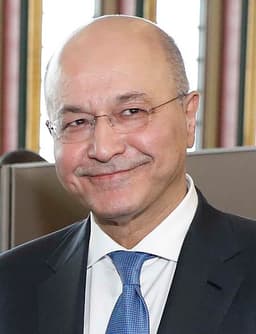
Barham Salih
Politician · Modern
56.4Total

Pedro Sanchez
Politician · Modern
52.2Total
Basic Information
Born
1960
1972
Died
—
—
Era
Modern
Modern
Nationality
Iraq
Spain
Occupation
Politician
Politician
Civilization
Middle Eastern
Western
Score Comparison
Military (10%)
50.0
14.4
Political (20%)
72.0
62.7
Influence (20%)
54.9
60.0
Legacy (20%)
42.5
45.0
Leadership (15%)
80.0
72.0
Strategy (15%)
42.0
42.8
TOTAL
56.4
52.2
Barham Salih — Complete Timeline
2018 AD
Elected President of IraqPolitical Action◆ Major
Barham Salih was elected President of Iraq by parliament, succeeding Fuad Masum. As a Kurdish politician, his election continued the tradition of a Kurdish president in the post-2005 political system.
PresidencyKurdish Leadership
Impact: nationalconstructive
2019 AD
Proposed Reform AgendaReform
Salih proposed a reform agenda including anti-corruption measures, economic diversification, and improved governance. His proposals came amid widespread protests demanding political change and better public services.
ReformAnti-CorruptionProtests
Impact: nationalconstructive
2022 AD
Left Office after Single TermPolitical Action
Barham Salih left the presidency after his single term ended, following the 2022 presidential election. He was succeeded by Abdul Latif Rashid, another Kurdish politician.
End of TermPolitical Transition
Impact: national
Pedro Sanchez — Complete Timeline
2018 AD
Elected Prime Minister of SpainPolitical Action◆ Major
Pedro Sánchez became Prime Minister of Spain on June 2, 2018, after winning a vote of no confidence against Mariano Rajoy. His election ended the People's Party government and brought the Spanish Socialist Workers' Party to power.
Spanish PoliticsGovernment ChangeSocialist Party
Impact: national
2020 AD
Formed coalition government with Unidas PodemosPolitical Action◆ Major
In January 2020, S
Coalition GovernmentSpanish PoliticsLeft Alliance
Impact: nationalconstructive
Managed COVID-19 pandemic responsePolitical Action◆ Major
Sánchez declared a state of alarm on March 14, 2020, imposing one of Europe's strictest lockdowns to combat COVID-19. The response included economic support measures and a vaccination campaign, though it faced criticism over handling of the economic impact.
COVID-19Public HealthCrisis Management
Impact: national
2021 AD
Passed labor reform lawReform
Sánchez's government passed a labor reform in December 2021, replacing the 2012 reform. The new law aimed to reduce temporary contracts, strengthen collective bargaining, and improve workers' rights, with support from unions and business groups.
Labor ReformWorkers' RightsEconomic Policy
Impact: nationalconstructive
Pardoned Catalan separatist leadersPolitical Action◆ Major
In June 2021, S
Catalan IndependencePardonsPolitical Crisis
Impact: national
2023 AD
Called snap general electionPolitical Action◆ Major
After poor results in local elections, S
ElectionPolitical StrategyHung Parliament
Impact: national
This comparison has not been analyzed yet.
One-time AI generation (~1 minute). Scores and timeline are already available below.
Rankings
🥇
Barham SalihLeader
Mil: 50.0Pol: 72.0Inf: 54.9
56.4
🥈
Pedro Sanchez
Mil: 14.4Pol: 62.7Inf: 60.0
52.2
+4.2 behind
How This Comparison Works
Algorithm
Each figure is scored on 6 dimensions (0—100 scale) based on structured historical data: Military (10%), Political (20%), Influence (20%), Legacy (20%), Leadership (15%), Strategy (15%). The weighted total produces the final ranking.
Data Sources
Scores are computed from structured sub-indicators in the database. Scale factors adjust for era (Ancient ×0.85, Modern ×1.0) and civilization size (Eastern ×1.05, Other ×0.80) to account for differences in population and military scale.
Maximum 3 Figures
Comparisons are limited to 2—3 figures to ensure readability and statistical meaningfulness.
Error Margins
±5 points per dimension — Sub-scores are derived from historical records with inherent uncertainty. Two figures within 5 points on a dimension should be considered roughly equivalent in that area.
Total Score Accuracy
±3 points overall — The weighted combination of 6 dimensions produces a total score with approximately ±3 points of uncertainty. Differences of less than 3 points are not statistically significant— the figures are effectively tied.
Known Limitations
- Historical records are incomplete and uneven across civilizations
- Figures from oral-tradition societies may be underrepresented
- Occupation labels can misclassify multi-role figures
- Scores measure capability and impact, not moral character
- Quantitative scoring is a comparison tool, not absolute truth
Capability Radar
Military (10%) — Battles & Warfare
Battles
22
23
Win Rate
27
23
Expansion
29
31
Political (20%) — Governance & Reform
Reform
55
55
Diplomacy
60
60
Economy
45
55
Influence (20%) — Cultural & Global Reach
Cultural
30
40
Global
30
50
Legacy (20%) — Historical Impact
Historical
35
40
Longevity
20
30
Leadership (15%) — Power & Stability
Tenure
40
60
Stability
35
50
Strategy (15%) — Tactics & Innovation
Strategy
30
29
Tactics
35
31
Reform
37
36
Similar Comparisons
Comments & Discussion
No comments yet. Be the first to share your thoughts!