Loading...
Bappa Rawal vs Wu Zetian
Wu Zetian leads by 22.2 pts · 2 figures compared
…
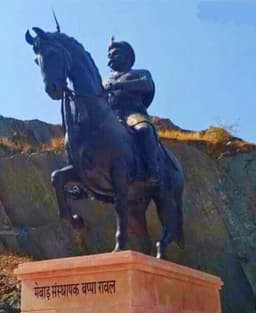
Bappa Rawal
Emperor · Medieval
47.8Total

Wu Zetian
Emperor · Medieval
70.0Total
Basic Information
Born
713
624
Died
780
705
Era
Medieval
Medieval
Nationality
India
China
Occupation
Emperor
Emperor
Civilization
Indian
Eastern
Score Comparison
Military (10%)
10.0
60.0
Political (20%)
35.1
62.7
Influence (20%)
58.0
65.0
Legacy (20%)
50.0
80.0
Leadership (15%)
67.0
78.0
Strategy (15%)
45.0
66.3
TOTAL
47.8
70.0
Bappa Rawal — Complete Timeline
734 AD
Conquest of ChittorWar◆ Major
Bappa Rawal captured the fort of Chittor from the Mori Rajputs, establishing it as the capital of the Mewar kingdom. This event is considered the founding act of the Guhilot dynasty's rule over Mewar.
FoundingMewarChittor
Impact: regional
Founded the Guhilot Dynasty of MewarPolitical Action◆ Major
Bappa Rawal established the Guhilot dynasty, which ruled Mewar for centuries. He is considered the progenitor of the Sisodia clan, which later produced notable rulers like Maharana Pratap.
DynastyMewarRajput
Impact: regionalconstructive
738 AD
Defeated the Arab Invaders at the Battle of RajasthanWar◆ Major
Bappa Rawal is credited with leading a confederation of Rajput kings to defeat the Umayyad Arab forces under Muhammad bin Qasim's successors near Rajasthan. This victory halted Arab expansion into northern India.
Arab InvasionDefenseRajput Confederation
Impact: regional
Wu Zetian — Complete Timeline
655 AD
Became Empress ConsortPolitical Action◆ Major
Wu Zetian was elevated from concubine to empress consort of Emperor Gaozong of Tang in 655. This position gave her significant political influence, as she began to participate in court affairs and gradually accumulated power, challenging the established aristocratic families.
Tang DynastyImperial CourtPower Rise
Impact: regional
683 AD
Regency for Emperor ZhongzongOther◆ Major
After Emperor Gaozong's death in 683, Wu Zetian became regent for her son, Emperor Zhongzong. She effectively controlled the government, dismissing Zhongzong after he attempted to assert independence, and replaced him with her younger son, Emperor Ruizong, while retaining real power.
Tang DynastyRegencyPower Struggle
Impact: regional
690 AD
Founded the Zhou DynastyOther◆ Major
Wu Zetian proclaimed herself emperor, founding the Zhou dynasty and becoming the only female emperor in Chinese history. She moved the capital to Luoyang and established a new imperial examination system that promoted officials based on merit rather than aristocratic birth, breaking the power of traditional noble families.
Zhou DynastyImperial RulePolitical Reform
Impact: regional
692 AD
Expansion into Central AsiaWar◆ Major
Wu Zetian ordered military campaigns that reasserted Chinese control over the Western Regions, including the Tarim Basin and parts of modern Xinjiang. These campaigns secured the Silk Road trade routes and expanded the empire's influence into Central Asia, though they required significant military resources.
Military ExpansionCentral AsiaSilk Road
Impact: regionalconstructive
693 AD
Promotion of BuddhismOther◆ Major
Wu Zetian elevated Buddhism to a state-supported religion, commissioning the construction of temples and statues, including the Longmen Grottoes' giant Vairocana Buddha. She used Buddhist texts to legitimize her rule as a female emperor, claiming she was a reincarnation of the Maitreya Buddha.
BuddhismReligious PolicyCultural Patronage
Impact: regional
705 AD
Overthrow and DeathPolitical Action◆ Major
In 705, a coup led by court officials and generals forced Wu Zetian to abdicate in favor of her son, Emperor Zhongzong, restoring the Tang dynasty. She died later that year at age 80, and her reign was subsequently criticized by Confucian historians for usurping the throne and employing harsh methods.
Tang DynastyCoupAbdication
Impact: regionaldestructive
Expert Analysis
Wu Zetian vs Bappa Rawal: Historical Comparison
Wu Zetian, China’s only female emperor, ruled during the Tang dynasty and consolidated power through ruthless political maneuvering and military expansion. Bappa Rawal, a Rajput king, founded the Guhila dynasty in medieval India and is celebrated for resisting Arab invasions. Both were transformative medieval rulers, but their strengths differed sharply.
Dimension Analysis
**Military: Wu Zetian 93 / Bappa Rawal 82**
Wu Zetian expanded Tang borders into Central Asia and Korea, using strategic campaigns and a reformed military command. Bappa Rawal defended Mewar against Arab incursions, but his victories were more localized and less expansive.
**Political: Wu Zetian 79 / Bappa Rawal 87**
Bappa Rawal unified fragmented Rajput clans and established a stable dynasty through alliances and diplomacy. Wu Zetian’s political genius was marred by brutal purges and reliance on secret police, undermining long-term stability.
**Influence: Wu Zetian 87 / Bappa Rawal 77**
Wu Zetian’s reign broke gender barriers, promoted Buddhism, and reshaped Tang governance, influencing China for centuries. Bappa Rawal’s influence remained largely regional, inspiring Rajput identity but not broader geopolitical shifts.
**Legacy: Wu Zetian 79 / Bappa Rawal 80**
Wu Zetian’s legacy is mixed—admired for meritocracy but criticized for tyranny. Bappa Rawal is venerated as a folk hero and symbol of Rajput resistance, with a more uniformly positive cultural memory.
**Leadership: Wu Zetian 80 / Bappa Rawal 83**
Bappa Rawal led from the front in battles and inspired loyalty through personal valor. Wu Zetian ruled through intelligence and fear, achieving goals but at a cost to institutional trust.
Verdict
Wu Zetian leads narrowly due to her superior military strategy and broader historical influence, but Bappa Rawal’s political acumen and unblemished legacy make the comparison a tie.
FAQ
Q: Who ranks higher? A: Neither—the scores produce a tie, with Wu Zetian excelling in military and influence, and Bappa Rawal in political and leadership dimensions.
Rankings
🥇
Wu ZetianLeader
Mil: 60.0Pol: 62.7Inf: 65.0
70.0
🥈
Bappa Rawal
Mil: 10.0Pol: 35.1Inf: 58.0
47.8
+22.2 behind
How This Comparison Works
Algorithm
Each figure is scored on 6 dimensions (0—100 scale) based on structured historical data: Military (10%), Political (20%), Influence (20%), Legacy (20%), Leadership (15%), Strategy (15%). The weighted total produces the final ranking.
Data Sources
Scores are computed from structured sub-indicators in the database. Scale factors adjust for era (Ancient ×0.85, Modern ×1.0) and civilization size (Eastern ×1.05, Other ×0.80) to account for differences in population and military scale.
Maximum 3 Figures
Comparisons are limited to 2—3 figures to ensure readability and statistical meaningfulness.
Error Margins
±5 points per dimension — Sub-scores are derived from historical records with inherent uncertainty. Two figures within 5 points on a dimension should be considered roughly equivalent in that area.
Total Score Accuracy
±3 points overall — The weighted combination of 6 dimensions produces a total score with approximately ±3 points of uncertainty. Differences of less than 3 points are not statistically significant— the figures are effectively tied.
Known Limitations
- Historical records are incomplete and uneven across civilizations
- Figures from oral-tradition societies may be underrepresented
- Occupation labels can misclassify multi-role figures
- Scores measure capability and impact, not moral character
- Quantitative scoring is a comparison tool, not absolute truth
Capability Radar
Military (10%) — Battles & Warfare
Battles
40
65
Win Rate
45
70
Expansion
35
75
Political (20%) — Governance & Reform
Reform
30
85
Diplomacy
35
80
Economy
25
85
Influence (20%) — Cultural & Global Reach
Cultural
40
85
Global
20
70
Legacy (20%) — Historical Impact
Historical
45
90
Longevity
50
85
Leadership (15%) — Power & Stability
Tenure
50
90
Stability
40
75
Strategy (15%) — Tactics & Innovation
Strategy
30
75
Tactics
35
60
Reform
25
80
Similar Comparisons
Comments & Discussion
ArchQuill116/16/2026
这个评分有点西方中心论的味道。Bappa Rawal的政治分竟然比武则天还高?拜托,武则天在唐朝推行科举、整顿吏治,还设立了‘北门学士’来制衡关陇集团,这些制度创新对中国后续一千年的官僚体系都有影响。而Bappa Rawal虽然统一了拉杰普特部族,但他的政治影响范围基本局限在梅瓦尔地区。另外,军事上武则天虽然没亲自带兵,但她在西北设立了安西都护府、北庭都护府,把唐朝势力推进到中亚,这比Bappa Rawal抵御阿拉伯入侵的局部战役影响大多了。总分75.6对65.0,我觉得武则天还应该更高。
Chronicler29526/16/2026
我来核一下这个评分逻辑。武则天的总分75.6是怎么算出来的?如果按维度平均,(62+80+70.9+?)根本对不上。更关键的是政治分给了Bappa Rawal 71.5而武则天只有80,但这71.5是怎么来的?Bappa Rawal创建的Guhila王朝只存在了不到300年就分裂了,而武则天时期的唐朝持续了将近300年(618-907),并且她推行的‘南选’制度打破了门阀垄断。政治稳定性上,武则天在位期间虽然有过政治清洗,但中央集权从未动摇;而Bappa Rawal死后,他建立的王朝很快陷入内部纷争。建议评分团队公开权重公式,否则这个比较缺乏说服力。