Loading...
Ban Ki-moon vs Ram Jethmalani
Ban Ki-moon leads by 2.1 pts · 2 figures compared
…
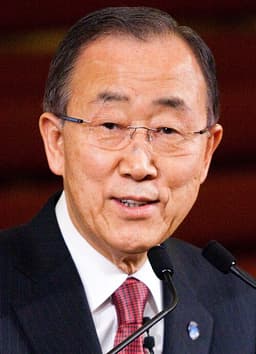
Ban Ki-moon
Politician · Modern
53.2Total

Ram Jethmalani
Politician · Modern
51.1Total
Basic Information
Born
1944
1923
Died
—
—
Era
Modern
Modern
Nationality
Korea
India
Occupation
Politician
Politician
Civilization
Eastern
Indian
Score Comparison
Military (10%)
15.2
48.1
Political (20%)
68.0
37.9
Influence (20%)
58.0
58.0
Legacy (20%)
46.7
45.0
Leadership (15%)
72.0
58.8
Strategy (15%)
44.8
60.0
TOTAL
53.2
51.1
Ban Ki-moon — Complete Timeline
2007 AD
Elected Secretary-General of the United NationsPolitical Action◆ Major
Ban Ki-moon became the eighth Secretary-General of the United Nations, succeeding Kofi Annan. His election was seen as a consensus choice, and he focused on climate change, peacekeeping, and UN reform.
UN Secretary-GeneralLeadershipGlobal Governance
Impact: globalconstructive
2011 AD
Launched the Sustainable Energy for All initiativeReform◆ Major
Ban launched the Sustainable Energy for All initiative, aiming to achieve universal energy access, double energy efficiency, and double renewable energy use by 2030. The initiative mobilized governments and private sector partners.
EnergySustainabilityClimate Change
Impact: globalconstructive
Oversaw UN response to the Syrian Civil WarPolitical Action◆ Major
Ban Ki-moon led UN efforts to address the Syrian Civil War, including humanitarian aid and peace negotiations. The UN faced criticism for failing to stop the conflict, which killed hundreds of thousands and displaced millions.
SyriaHumanitarian CrisisUN Failure
Impact: globaltragic
2015 AD
Adopted the Sustainable Development GoalsReform◆ Major
Ban oversaw the adoption of the 2030 Agenda for Sustainable Development, including 17 Sustainable Development Goals to end poverty, protect the planet, and ensure prosperity for all by 2030.
SDGsDevelopmentGlobal Goals
Impact: globalconstructive
Adopted the Paris Agreement on climate changePolitical Action◆ Major
Ban played a key role in the adoption of the Paris Agreement at COP21, a global treaty to limit global warming to well below 2
Climate ChangeParis AgreementCOP21
Impact: globalconstructive
Ram Jethmalani — Complete Timeline
1975 AD
Defended Indira Gandhi in election petition casePolitical Action◆ Major
Ram Jethmalani represented Prime Minister Indira Gandhi in the Supreme Court against the Allahabad High Court's decision to unseat her for electoral malpractice. He successfully argued for a stay, but the case led to the declaration of Emergency in India.
LegalEmergencyIndira Gandhi
Impact: national
1993 AD
Defended accused in the 1993 Bombay blasts casePolitical Action◆ Major
Jethmalani defended several accused in the 1993 Bombay serial blasts case, including underworld don Dawood Ibrahim's associates. His legal arguments challenged the prosecution's evidence, though many accused were convicted.
LegalTerrorismBombay Blasts
Impact: national
1999 AD
Served as Union Law Minister under VajpayeePolitical Action
Jethmalani was appointed Law Minister in the Vajpayee government. He pushed for judicial reforms and the appointment of more judges, but resigned in 2000 after differences with the government over the appointment of a chief justice.
LawMinisterReform
Impact: nationalconstructive
Expert Analysis
Origins
Ban Ki-moon was born on June 13, 1944, in Eumseong, Korea, during Japanese occupation. His family was poor; his father worked as a warehouse clerk. Ban excelled academically, winning a scholarship to study international relations at Seoul National University. He later earned a master's degree from Harvard's Kennedy School. His early career included diplomatic posts in India and the UN.
Ram Jethmalani was born on September 14, 1923, in Shikarpur, Sindh (now Pakistan). His family was well-off, but they lost everything after Partition. Jethmalani studied law at the D.G. National College in Hyderabad and later at the University of Karachi. He began practicing law in Karachi but fled to India after the 1947 riots. He rebuilt his career in Mumbai, becoming a leading criminal lawyer.
Rise to Power
Ban Ki-moon's rise was steady within South Korea's foreign ministry. He served as ambassador to Austria and later as Foreign Minister under President Roh Moo-hyun. His big break came in 2006 when he was elected UN Secretary-General, succeeding Kofi Annan. He was seen as a consensus candidate, acceptable to both the US and China. His tenure began in 2007.
Ram Jethmalani's rise came through high-profile criminal cases. He gained fame in the 1970s defending Indira Gandhi in an election petition case, securing her victory in the Supreme Court. He later entered politics, joining the Bharatiya Janata Party (BJP) and serving as a Rajya Sabha member. He was appointed Law Minister in 1999 under Prime Minister Atal Bihari Vajpayee.
Leadership & Governance
Ban Ki-moon's leadership was characterized by quiet diplomacy. He focused on consensus-building, avoiding confrontation with powerful member states. He launched the Sustainable Energy for All initiative and pushed for the Paris Agreement (2015). His governance style was bureaucratic and cautious, leading to criticism for not intervening decisively in conflicts like Syria. He scored 72.0 in Leadership and 44.8 in Strategy.
Ram Jethmalani's leadership was combative and independent. As Law Minister, he pushed for judicial reforms, including increasing judge strength and fast-track courts. He resigned in 2000 over differences with the government on the appointment of judges. He was known for his maverick views, often clashing with his own party. His political score was 37.9, reflecting his limited formal power.
Triumph & Tragedy
Ban Ki-moon's greatest triumph was the adoption of the Paris Agreement in 2015, a landmark climate treaty signed by 195 countries. He also oversaw the adoption of the Sustainable Development Goals (2015). However, his tenure was marred by the UN's failure to stop the Syrian Civil War, leading to over 500,000 deaths. He was criticized for a lack of decisive action.
Ram Jethmalani's greatest triumph was his defense of Indira Gandhi, which saved her premiership. He also successfully defended accused in the 1993 Bombay blasts case, arguing for fair trial. His tragedy was his political isolation; he was often seen as a maverick unable to build lasting coalitions. He resigned as Law Minister after just one year.
Character & Destiny
Ban Ki-moon was known for his patience, humility, and diplomatic calm. He avoided personal conflicts, but this also made him appear weak. His character led him to prioritize process over results, limiting his impact in crises. His destiny was to be a caretaker leader, remembered more for process than passion.
Ram Jethmalani was fearless, outspoken, and independent. He took on unpopular cases, defending terrorists and criminals, which damaged his reputation. His character made him a compelling advocate but a poor politician. He thrived in adversarial settings but struggled in collaborative roles.
Legacy
Ban Ki-moon's legacy is the Paris Agreement and the Sustainable Development Goals, which continue to shape global policy. He scored 46.7 in Legacy. The UN's role in climate change is a direct outcome of his tenure. However, his passive approach to conflicts reduced his long-term impact.
Ram Jethmalani's legacy is his influence on Indian criminal law and the legal profession. He championed the right to legal representation and fair trial. He scored 45.0 in Legacy. His political legacy is limited, but he remains a symbol of fearless advocacy.
Conclusion
Ban Ki-moon had greater impact on a global scale. His scores (53.2 total vs 51.1) reflect his broader influence. While Jethmalani was a master of the courtroom, his political and strategic scores were lower (37.9 political, 60.0 strategy vs Ban's 68.0 and 44.8). Ban's leadership (72.0) and key achievements like the Paris Agreement reshape international norms. Jethmalani's legacy is confined to India's legal system. Therefore, Ban Ki-moon holds the edge in overall historical significance.
Rankings
🥇
Ban Ki-moonLeader
Mil: 15.2Pol: 68.0Inf: 58.0
53.2
🥈
Ram Jethmalani
Mil: 48.1Pol: 37.9Inf: 58.0
51.1
+2.1 behind
How This Comparison Works
Algorithm
Each figure is scored on 6 dimensions (0—100 scale) based on structured historical data: Military (10%), Political (20%), Influence (20%), Legacy (20%), Leadership (15%), Strategy (15%). The weighted total produces the final ranking.
Data Sources
Scores are computed from structured sub-indicators in the database. Scale factors adjust for era (Ancient ×0.85, Modern ×1.0) and civilization size (Eastern ×1.05, Other ×0.80) to account for differences in population and military scale.
Maximum 3 Figures
Comparisons are limited to 2—3 figures to ensure readability and statistical meaningfulness.
Error Margins
±5 points per dimension — Sub-scores are derived from historical records with inherent uncertainty. Two figures within 5 points on a dimension should be considered roughly equivalent in that area.
Total Score Accuracy
±3 points overall — The weighted combination of 6 dimensions produces a total score with approximately ±3 points of uncertainty. Differences of less than 3 points are not statistically significant— the figures are effectively tied.
Known Limitations
- Historical records are incomplete and uneven across civilizations
- Figures from oral-tradition societies may be underrepresented
- Occupation labels can misclassify multi-role figures
- Scores measure capability and impact, not moral character
- Quantitative scoring is a comparison tool, not absolute truth
Capability Radar
Military (10%) — Battles & Warfare
Battles
16
41
Win Rate
16
49
Expansion
18
48
Political (20%) — Governance & Reform
Reform
40
30
Diplomacy
75
35
Economy
30
20
Influence (20%) — Cultural & Global Reach
Cultural
20
45
Global
60
35
Legacy (20%) — Historical Impact
Historical
40
40
Longevity
30
30
Leadership (15%) — Power & Stability
Tenure
65
40
Stability
60
15
Strategy (15%) — Tactics & Innovation
Strategy
25
51
Tactics
28
56
Reform
31
59
Similar Comparisons
Comments & Discussion
No comments yet. Be the first to share your thoughts!