Loading...
Ban Ki-moon vs Lim Yew Hock
Ban Ki-moon leads by 6.7 pts · 2 figures compared
…
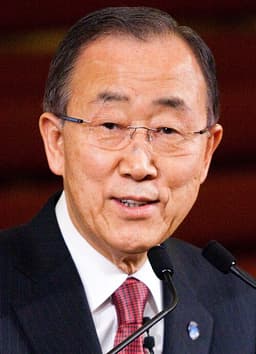
Ban Ki-moon
Politician · Modern
53.2Total

Lim Yew Hock
Politician · Modern
46.5Total
Basic Information
Born
1944
1914
Died
—
1984
Era
Modern
Modern
Nationality
Korea
Singapore
Occupation
Politician
Politician
Civilization
Eastern
Eastern
Score Comparison
Military (10%)
15.2
12.5
Political (20%)
68.0
61.3
Influence (20%)
58.0
51.0
Legacy (20%)
46.7
41.7
Leadership (15%)
72.0
67.0
Strategy (15%)
44.8
28.4
TOTAL
53.2
46.5
Ban Ki-moon — Complete Timeline
2007 AD
Elected Secretary-General of the United NationsPolitical Action◆ Major
Ban Ki-moon became the eighth Secretary-General of the United Nations, succeeding Kofi Annan. His election was seen as a consensus choice, and he focused on climate change, peacekeeping, and UN reform.
UN Secretary-GeneralLeadershipGlobal Governance
Impact: globalconstructive
2011 AD
Launched the Sustainable Energy for All initiativeReform◆ Major
Ban launched the Sustainable Energy for All initiative, aiming to achieve universal energy access, double energy efficiency, and double renewable energy use by 2030. The initiative mobilized governments and private sector partners.
EnergySustainabilityClimate Change
Impact: globalconstructive
Oversaw UN response to the Syrian Civil WarPolitical Action◆ Major
Ban Ki-moon led UN efforts to address the Syrian Civil War, including humanitarian aid and peace negotiations. The UN faced criticism for failing to stop the conflict, which killed hundreds of thousands and displaced millions.
SyriaHumanitarian CrisisUN Failure
Impact: globaltragic
2015 AD
Adopted the Sustainable Development GoalsReform◆ Major
Ban oversaw the adoption of the 2030 Agenda for Sustainable Development, including 17 Sustainable Development Goals to end poverty, protect the planet, and ensure prosperity for all by 2030.
SDGsDevelopmentGlobal Goals
Impact: globalconstructive
Adopted the Paris Agreement on climate changePolitical Action◆ Major
Ban played a key role in the adoption of the Paris Agreement at COP21, a global treaty to limit global warming to well below 2
Climate ChangeParis AgreementCOP21
Impact: globalconstructive
Lim Yew Hock — Complete Timeline
1956 AD
Appointed Second Chief Minister of SingaporePolitical Action◆ Major
Lim Yew Hock succeeded David Marshall as Chief Minister in June 1956. He led a coalition government and adopted a more conciliatory approach toward the British, successfully negotiating internal self-government for Singapore.
Chief MinisterSelf-government
Impact: national
Crackdown on Communist and Leftist GroupsPolitical Action◆ Major
Lim ordered a major crackdown on communist and leftist organizations, arresting hundreds of activists and union leaders. This action weakened the leftist movement but also drew criticism for suppressing political dissent.
Anti-communistSuppression
Impact: nationaldestructive
1957 AD
Led Successful Self-Government Talks in LondonPolitical Action◆ Major
Lim led a delegation to London in 1957 and secured an agreement for full internal self-government for Singapore. The British retained control over defense and foreign affairs, but Singapore gained control over domestic matters.
Merdeka talksSelf-government
Impact: nationalconstructive
1959 AD
Defeated in the 1959 General ElectionPolitical Action◆ Major
Lim's party, the Singapore People's Alliance, was decisively defeated by the PAP in the 1959 general election. The PAP won 43 of 51 seats, and Lim lost his own seat, ending his tenure as Chief Minister.
Election defeatPAP victory
Impact: national
1963 AD
Appointed Singapore's High Commissioner to MalaysiaPolitical Action
After leaving office, Lim served as Singapore's High Commissioner to Malaysia from 1963 to 1965. He represented Singapore's interests during the merger and separation period.
DiplomacyHigh Commissioner
Impact: national
Expert Analysis
Origins
Ban Ki-moon was born on June 13, 1944, in Eumseong, Japanese Korea (now South Korea). His father was a warehouse keeper, and the family struggled financially. Ban excelled in school and won a scholarship to study at Seoul National University, where he earned a degree in international relations. He later earned a master's from Harvard's Kennedy School of Government. His early career included work as a diplomat for South Korea, serving in New Delhi and the UN.
Lim Yew Hock was born on August 15, 1914, in Singapore, then a British colony. His father was a clerk, and Lim received an English education at Raffles Institution. He worked as a clerk and later as a union leader, becoming involved in politics through the Singapore Labour Party. He was a key figure in the anti-colonial movement, but his background was less elite than Ban's.
Rise to Power
Ban Ki-moon's rise was steady through the South Korean foreign service. He served as Foreign Minister under President Roh Moo-hyun from 2004 to 2006, gaining international respect. In 2006, he was elected Secretary-General of the United Nations, succeeding Kofi Annan. His diplomatic style was consensus-building, and he scored 68.0 in political skill.
Lim Yew Hock rose quickly after World War II. He became a leader in the Labour Party and was appointed Chief Minister in 1956 after David Marshall resigned. He led a coalition government and adopted a more conciliatory stance toward the British, which led to successful self-government talks in London in 1957. This secured internal self-government for Singapore, with Britain retaining defense and foreign affairs. His political score is 61.3.
Leadership & Governance
Ban Ki-moon's leadership at the UN was characterized by quiet diplomacy and a focus on global issues. He launched the Sustainable Energy for All initiative and oversaw the adoption of the Paris Agreement and the Sustainable Development Goals. However, he was criticized for his handling of the Syrian Civil War, where the UN failed to stop the conflict. His leadership score is 72.0, but his strategy score is only 44.8, reflecting a lack of decisive action in crises.
Lim Yew Hock governed Singapore with a pragmatic approach, but his key action was a crackdown on communist and leftist groups in 1956-1957. He arrested hundreds, weakening the left but also alienating popular support. He secured self-government, but his governance was seen as authoritarian and tied to British interests. His leadership score is 67.0, but his strategy is low at 28.4, as his actions ultimately led to his party's defeat.
Triumph & Tragedy
Ban Ki-moon's greatest triumph was the adoption of the Paris Agreement in 2015, a landmark global climate treaty. He also championed the Sustainable Development Goals, which set a global agenda for poverty and sustainability. His tragedy was the UN's failure in Syria, where over 500,000 died despite his efforts. He also faced criticism for not doing enough on human rights in countries like China and Russia.
Lim Yew Hock's triumph was securing self-government for Singapore in 1957, a major step toward independence. His tragedy was his defeat in the 1959 election, where his party won only 4 seats against the PAP's 43. He is often overshadowed by Lee Kuan Yew, who built modern Singapore. Lim's legacy is mixed: he is credited with fighting communism but criticized for his heavy-handed tactics.
Character & Destiny
Ban Ki-moon was known as a cautious, bureaucratic diplomat. He avoided confrontation and sought consensus, which sometimes made him appear weak. His character shaped his fate: he achieved major international agreements but failed in conflict zones. He scored 72.0 in leadership but only 44.8 in strategy, reflecting his preference for process over decisive action.
Lim Yew Hock was more confrontational and pragmatic. He was willing to use state power to crush opponents, which secured self-government but cost him popular support. His character led to a short political career; he was defeated by a more charismatic and organized PAP. His destiny was to be a transitional figure, not a founder.
Legacy
Ban Ki-moon's legacy is the Paris Agreement and the SDGs, which continue to shape global policy. He is remembered as a competent but not transformative UN leader. His influence score is 58.0, and legacy is 46.7. He set a foundation for climate action but failed to address systemic UN weaknesses.
Lim Yew Hock's legacy is more contested. He is often forgotten, as Lee Kuan Yew's narrative dominates Singapore history. However, his self-government deal paved the way for Singapore's independence. His legacy score is 41.7, and influence is 51.0. He is a footnote, but his actions were crucial.
Conclusion
Ban Ki-moon had greater global impact. His total score of 53.2 exceeds Lim's 46.5, and his achievements on climate and development affect billions. Lim's work was important but limited to Singapore and short-lived. Ban's legacy endures through the Paris Agreement and SDGs, while Lim's is largely historical. The data supports Ban as the more significant figure.
Rankings
🥇
Ban Ki-moonLeader
Mil: 15.2Pol: 68.0Inf: 58.0
53.2
🥈
Lim Yew Hock
Mil: 12.5Pol: 61.3Inf: 51.0
46.5
+6.7 behind
How This Comparison Works
Algorithm
Each figure is scored on 6 dimensions (0—100 scale) based on structured historical data: Military (10%), Political (20%), Influence (20%), Legacy (20%), Leadership (15%), Strategy (15%). The weighted total produces the final ranking.
Data Sources
Scores are computed from structured sub-indicators in the database. Scale factors adjust for era (Ancient ×0.85, Modern ×1.0) and civilization size (Eastern ×1.05, Other ×0.80) to account for differences in population and military scale.
Maximum 3 Figures
Comparisons are limited to 2—3 figures to ensure readability and statistical meaningfulness.
Error Margins
±5 points per dimension — Sub-scores are derived from historical records with inherent uncertainty. Two figures within 5 points on a dimension should be considered roughly equivalent in that area.
Total Score Accuracy
±3 points overall — The weighted combination of 6 dimensions produces a total score with approximately ±3 points of uncertainty. Differences of less than 3 points are not statistically significant— the figures are effectively tied.
Known Limitations
- Historical records are incomplete and uneven across civilizations
- Figures from oral-tradition societies may be underrepresented
- Occupation labels can misclassify multi-role figures
- Scores measure capability and impact, not moral character
- Quantitative scoring is a comparison tool, not absolute truth
Capability Radar
Military (10%) — Battles & Warfare
Battles
16
14
Win Rate
16
16
Expansion
18
22
Political (20%) — Governance & Reform
Reform
40
45
Diplomacy
75
50
Economy
30
35
Influence (20%) — Cultural & Global Reach
Cultural
20
20
Global
60
15
Legacy (20%) — Historical Impact
Historical
40
30
Longevity
30
20
Leadership (15%) — Power & Stability
Tenure
65
40
Stability
60
30
Strategy (15%) — Tactics & Innovation
Strategy
25
24
Tactics
28
28
Reform
31
32
Similar Comparisons
Comments & Discussion
No comments yet. Be the first to share your thoughts!