Loading...
Ban Ki-moon vs P. J. Patterson
P. J. Patterson leads by 4.7 pts · 2 figures compared
…
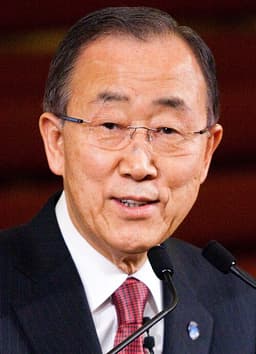
Ban Ki-moon
Politician · Modern
53.2Total

P. J. Patterson
Politician · Modern
57.9Total
Basic Information
Born
1944
1935
Died
—
—
Era
Modern
Modern
Nationality
Korea
Jamaica
Occupation
Politician
Politician
Civilization
Eastern
Other
Score Comparison
Military (10%)
15.2
48.1
Political (20%)
68.0
61.0
Influence (20%)
58.0
61.0
Legacy (20%)
46.7
50.0
Leadership (15%)
72.0
78.0
Strategy (15%)
44.8
44.6
TOTAL
53.2
57.9
Ban Ki-moon — Complete Timeline
2007 AD
Elected Secretary-General of the United NationsPolitical Action◆ Major
Ban Ki-moon became the eighth Secretary-General of the United Nations, succeeding Kofi Annan. His election was seen as a consensus choice, and he focused on climate change, peacekeeping, and UN reform.
UN Secretary-GeneralLeadershipGlobal Governance
Impact: globalconstructive
2011 AD
Launched the Sustainable Energy for All initiativeReform◆ Major
Ban launched the Sustainable Energy for All initiative, aiming to achieve universal energy access, double energy efficiency, and double renewable energy use by 2030. The initiative mobilized governments and private sector partners.
EnergySustainabilityClimate Change
Impact: globalconstructive
Oversaw UN response to the Syrian Civil WarPolitical Action◆ Major
Ban Ki-moon led UN efforts to address the Syrian Civil War, including humanitarian aid and peace negotiations. The UN faced criticism for failing to stop the conflict, which killed hundreds of thousands and displaced millions.
SyriaHumanitarian CrisisUN Failure
Impact: globaltragic
2015 AD
Adopted the Sustainable Development GoalsReform◆ Major
Ban oversaw the adoption of the 2030 Agenda for Sustainable Development, including 17 Sustainable Development Goals to end poverty, protect the planet, and ensure prosperity for all by 2030.
SDGsDevelopmentGlobal Goals
Impact: globalconstructive
Adopted the Paris Agreement on climate changePolitical Action◆ Major
Ban played a key role in the adoption of the Paris Agreement at COP21, a global treaty to limit global warming to well below 2
Climate ChangeParis AgreementCOP21
Impact: globalconstructive
P. J. Patterson — Complete Timeline
1992 AD
Became Prime Minister of JamaicaPolitical Action◆ Major
P. J. Patterson succeeded Michael Manley as Prime Minister of Jamaica, becoming the country's fourth prime minister. He led the People's National Party (PNP) and would go on to serve for 14 years, the longest tenure in Jamaican history.
Prime MinisterPNPJamaica
Impact: national
1993 AD
Won 1993 general electionPolitical Action◆ Major
Patterson led the PNP to victory in the 1993 Jamaican general election, securing a majority in Parliament. This was his first electoral win as party leader and prime minister, consolidating his mandate.
ElectionPNPMandate
Impact: nationalconstructive
1994 AD
Implemented economic liberalization policiesReform◆ Major
Patterson's government pursued economic liberalization, including privatization of state-owned enterprises and trade liberalization. These policies aimed to stimulate growth but also led to increased unemployment and social inequality.
Economic ReformPrivatizationLiberalization
Impact: national
1997 AD
Won 1997 general electionPolitical Action◆ Major
Patterson led the PNP to a second consecutive victory in the 1997 general election, winning 50 of 60 seats. The election was marked by low voter turnout and allegations of irregularities.
ElectionPNPLandslide
Impact: national
2001 AD
Established the Caribbean Court of JusticePolitical Action◆ Major
Patterson played a key role in establishing the Caribbean Court of Justice (CCJ) as the final appellate court for CARICOM member states. Jamaica initially signed on, though full implementation faced delays.
CARICOMJudicial ReformCCJ
Impact: regionalconstructive
2006 AD
Retired as Prime MinisterPolitical Action◆ Major
Patterson stepped down as Prime Minister and leader of the PNP after 14 years in office. He was succeeded by Portia Simpson-Miller, Jamaica's first female prime minister.
RetirementSuccessionPNP
Impact: national
Expert Analysis
Origins
Ban Ki-moon was born on June 13, 1944, in Eumseong, Japanese-occupied Korea (now South Korea). His father was a warehouse keeper, and the family faced poverty during the Korean War. Ban studied international relations at Seoul National University, earning a bachelor's degree in 1970, and later a master's degree in public administration from the Kennedy School of Government at Harvard University in 1985. His early career in diplomacy began in 1975 when he joined the Ministry of Foreign Affairs.
P. J. Patterson was born on April 10, 1935, in Westmoreland, Jamaica. His father was a plantation overseer, and his mother a teacher. He attended the University of the West Indies (UWI), earning a law degree, and later studied at the London School of Economics. Patterson was involved in politics from a young age, joining the People's National Party (PNP) in the 1950s and becoming a close associate of Michael Manley.
Rise to Power
Ban Ki-moon's diplomatic career included postings in India, the United States, and at the UN. He served as South Korea's Foreign Minister from 2004 to 2006, where he played a key role in the six-party talks on North Korea's nuclear program. In October 2006, he was elected the eighth Secretary-General of the United Nations, succeeding Kofi Annan, and took office on January 1, 2007. His election was seen as a consensus choice among member states.
P. J. Patterson entered Jamaican politics in the 1960s, serving as a senator and later as a minister in Michael Manley's government. He held various portfolios, including Minister of Finance and Planning. After the PNP lost the 1980 election, Patterson remained a key opposition figure. When Manley retired in 1992, Patterson succeeded him as party leader and became Prime Minister on March 30, 1992. He led the PNP to victory in the 1993 general election, securing a majority in Parliament.
Leadership & Governance
Ban Ki-moon's leadership style was characterized by quiet diplomacy and consensus-building. He emphasized multilateralism and focused on global issues such as climate change, sustainable development, and human rights. Under his tenure, the UN adopted the Sustainable Development Goals (SDGs) in 2015 and the Paris Agreement on climate change in 2016. He launched the Sustainable Energy for All initiative in 2011. However, his approach to crises like the Syrian Civil War was criticized for being too cautious and ineffective, as the UN failed to stop the violence.
P. J. Patterson governed with a focus on economic reform and regional integration. He implemented economic liberalization policies, including privatization of state-owned enterprises and trade liberalization, aiming to stabilize Jamaica's economy. He played a key role in establishing the Caribbean Court of Justice (CCJ) in 2001, replacing the UK Privy Council as the final appellate court for CARICOM states. Patterson also maintained social programs, but his economic policies faced criticism for increasing inequality and debt. His leadership style was pragmatic and consensus-oriented, often working with opposition parties.
Triumph & Tragedy
Ban Ki-moon's greatest triumph was the adoption of the Paris Agreement, a landmark global treaty to limit global warming. He also oversaw the creation of the SDGs, a comprehensive framework for global development. However, his tenure was marred by the UN's inability to effectively address the Syrian Civil War, resulting in a humanitarian catastrophe. The UN also faced criticism for its response to the 2010 Haiti cholera outbreak, which was linked to UN peacekeepers.
P. J. Patterson's greatest success was his role in establishing the CCJ, which symbolized Caribbean judicial independence. He also won three consecutive general elections (1993, 1997, 2002), demonstrating sustained political dominance. However, his economic liberalization policies led to high unemployment and debt, and Jamaica's crime rate increased during his tenure. The 1997 election was marked by low voter turnout, indicating public disillusionment.
Character & Destiny
Ban Ki-moon was known for his cautious, methodical approach, often avoiding confrontation. He scored 72.0 in leadership, reflecting his ability to navigate complex international politics, but his strategy score of 44.8 suggests a lack of bold vision. His character was shaped by his humble origins and diplomatic training, leading him to prioritize process over results. This made him effective in achieving consensus on issues like climate change but less so in crisis management.
P. J. Patterson scored 78.0 in leadership, the highest among the categories, indicating his strong political acumen and ability to maintain power. His strategy score of 44.6 matches Ban's, showing a similar preference for incremental change. Patterson's character was pragmatic and resilient; he survived internal party challenges and maintained stability in Jamaica. However, his legacy is mixed due to economic challenges.
Legacy
Ban Ki-moon's legacy is tied to the SDGs and the Paris Agreement, which continue to shape global policy. He raised the profile of climate change and sustainable development, scoring 46.7 in legacy. However, his tenure is often seen as less impactful than his predecessor Kofi Annan or successor António Guterres. The UN's credibility was damaged by the Syrian crisis under his watch.
P. J. Patterson's legacy includes the CCJ and his role in modernizing Jamaica's economy. He scored 50.0 in legacy, slightly higher than Ban. His policies laid the groundwork for later economic reforms, but the debt and inequality issues persist. He is remembered as a skilled politician who maintained stability but failed to address systemic problems.
Conclusion
While Ban Ki-moon achieved global milestones like the Paris Agreement, his overall impact is constrained by the UN's limitations and his cautious leadership. P. J. Patterson, with a total score of 57.9 vs Ban's 53.2, had a more direct influence on his nation's trajectory. Patterson's establishment of the CCJ and his long tenure demonstrate lasting regional impact. Therefore, P. J. Patterson had a greater impact within his sphere, despite Ban's broader global stage.
Rankings
🥇
P. J. PattersonLeader
Mil: 48.1Pol: 61.0Inf: 61.0
57.9
🥈
Ban Ki-moon
Mil: 15.2Pol: 68.0Inf: 58.0
53.2
+4.7 behind
How This Comparison Works
Algorithm
Each figure is scored on 6 dimensions (0—100 scale) based on structured historical data: Military (10%), Political (20%), Influence (20%), Legacy (20%), Leadership (15%), Strategy (15%). The weighted total produces the final ranking.
Data Sources
Scores are computed from structured sub-indicators in the database. Scale factors adjust for era (Ancient ×0.85, Modern ×1.0) and civilization size (Eastern ×1.05, Other ×0.80) to account for differences in population and military scale.
Maximum 3 Figures
Comparisons are limited to 2—3 figures to ensure readability and statistical meaningfulness.
Error Margins
±5 points per dimension — Sub-scores are derived from historical records with inherent uncertainty. Two figures within 5 points on a dimension should be considered roughly equivalent in that area.
Total Score Accuracy
±3 points overall — The weighted combination of 6 dimensions produces a total score with approximately ±3 points of uncertainty. Differences of less than 3 points are not statistically significant— the figures are effectively tied.
Known Limitations
- Historical records are incomplete and uneven across civilizations
- Figures from oral-tradition societies may be underrepresented
- Occupation labels can misclassify multi-role figures
- Scores measure capability and impact, not moral character
- Quantitative scoring is a comparison tool, not absolute truth
Capability Radar
Military (10%) — Battles & Warfare
Battles
16
24
Win Rate
16
26
Expansion
18
25
Political (20%) — Governance & Reform
Reform
40
65
Diplomacy
75
70
Economy
30
68
Influence (20%) — Cultural & Global Reach
Cultural
20
55
Global
60
50
Legacy (20%) — Historical Impact
Historical
40
55
Longevity
30
50
Leadership (15%) — Power & Stability
Tenure
65
75
Stability
60
72
Strategy (15%) — Tactics & Innovation
Strategy
25
29
Tactics
28
34
Reform
31
36
Similar Comparisons
Comments & Discussion
No comments yet. Be the first to share your thoughts!