Loading...
Ba Maw vs Napoleon Bonaparte
Napoleon Bonaparte leads by 26.8 pts · 2 figures compared
…
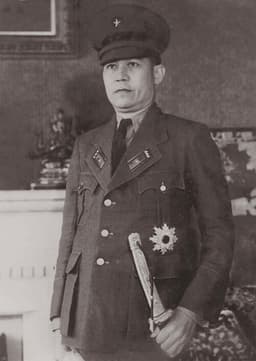
Ba Maw
Politician · Modern
44.1Total

Napoleon Bonaparte
General · Modern
70.9Total
Basic Information
Born
1893
1769
Died
1977
1821
Era
Modern
Modern
Nationality
Burma
France
Occupation
Politician
General
Civilization
Eastern
Western
Score Comparison
Military (10%)
14.4
94.0
Political (20%)
40.8
72.0
Influence (20%)
54.9
40.0
Legacy (20%)
43.3
80.0
Leadership (15%)
58.8
78.0
Strategy (15%)
31.9
90.0
TOTAL
44.1
70.9
Ba Maw — Complete Timeline
1937 AD
Became first premier of British BurmaPolitical Action◆ Major
Ba Maw was appointed as the first Premier of British Burma under the new constitution that separated Burma from British India. He led a government focused on self-governance and economic development, but faced challenges from both colonial authorities and nationalist factions.
PremiershipSelf-governanceColonial politics
Impact: nationalconstructive
1939 AD
Formed the Freedom BlocPolitical Action◆ Major
Ba Maw founded the Freedom Bloc, a coalition of nationalist parties demanding immediate independence from Britain. The bloc organized protests and strikes, pressuring the British government and uniting various factions under a common goal.
NationalismCoalitionIndependence movement
Impact: nationalconstructive
1942 AD
Collaborated with Japan during WWIIPolitical Action◆ Major
Ba Maw collaborated with the Japanese Imperial Army during their invasion of Burma, serving as head of the Burmese government under Japanese occupation. He declared Burma independent in 1943, but the regime was a puppet state controlled by Japan.
CollaborationJapanese occupationPuppet state
Impact: nationaldestructive
1943 AD
Declared independence under JapanPolitical Action◆ Major
Ba Maw declared Burma an independent state under Japanese sponsorship, with himself as head of state. The declaration was not recognized by the Allies and ended with Japan's defeat in 1945, leaving Ba Maw's reputation tarnished.
IndependenceJapanese sponsorshipWWII
Impact: national
1945 AD
Arrested by British after warPolitical Action
After Japan's surrender, British authorities arrested Ba Maw for collaboration. He was imprisoned but later released without trial. His political career effectively ended, and he spent his later years in obscurity.
ArrestCollaborationPost-war
Impact: nationaltragic
Napoleon Bonaparte — Complete Timeline
1799 AD
Coup of 18 BrumaireOther◆ Major
Napoleon Bonaparte, with support from his brother Lucien and key political figures, overthrew the Directory in a bloodless coup. He established the Consulate with himself as First Consul, effectively becoming the ruler of France. This event ended the French Revolution's most unstable period.
French RevolutionCoupRise to Power
Impact: regional
1804 AD
Promulgation of the Napoleonic CodeOther◆ Major
Napoleon enacted the Civil Code of the French, known as the Napoleonic Code, a comprehensive set of laws that replaced the fragmented feudal legal systems. The code established legal equality, protected property rights, and secularized law. It became the basis for legal systems in many European and world countries.
Legal ReformNapoleonic CodeCivil Law
Impact: globalconstructive
1805 AD
Battle of AusterlitzWar◆ Major
Napoleon's Grande Arm
Napoleonic WarsBattleDecisive Victory
Impact: global
1812 AD
Invasion of RussiaWar◆ Major
Napoleon led the Grande Arm
Napoleonic WarsInvasionDisaster
Impact: globaldestructive
1815 AD
Battle of WaterlooWar◆ Major
Napoleon's French army was defeated by the combined forces of the Duke of Wellington's Anglo-Allied army and Gebhard Leberecht von Bl
Napoleonic WarsBattleFinal Defeat
Impact: globaldestructive
Expert Analysis
ba-maw-vs-napoleon-bonaparte
# The Emperor and the Collaborator: Two Paths to Power, Two Very Different Destinies
In the spring of 1815, Napoleon Bonaparte strode through the fields of Waterloo, a man who had once commanded the allegiance of millions, now staking everything on a single, desperate gamble. A hundred and twenty-eight years later, in the summer of 1943, Ba Maw stood on a platform in Rangoon, declaring Burma an independent state under the shadow of Japanese bayonets. One man would be remembered as a titan of history; the other, as a footnote. Both sought power, both shaped their nations, but their journeys reveal how profoundly era, geography, and character can diverge.
Origins
Napoleon was born in 1769 on the Mediterranean island of Corsica, a place that had only recently become French. His family was minor nobility, but his world was one of gunpowder and revolution—the old order of Europe was crumbling, and a young artillery officer could rise on talent alone. He attended military school in mainland France, where his accent marked him as an outsider, but his ambition burned fierce. The French Revolution had shattered the traditional hierarchies, and for a man of his gifts, the timing was perfect.
Ba Maw was born in 1893 in British Burma, a land under colonial rule. His father was a judge, his family part of the educated elite that served the Raj. He studied law in England, absorbing the very legal traditions that justified his people's subjugation. Unlike Napoleon, whose world was in violent transformation, Ba Maw’s world was stagnant—an empire that offered no path to glory, only to accommodation. The difference was profound: Napoleon inherited chaos and seized opportunity; Ba Maw inherited order and chafed against its limits.
Rise to Power
Napoleon’s ascent was meteoric. At age twenty-four, he drove the British out of Toulon. By twenty-six, he was a general. By thirty, he had conquered Italy and Egypt, returning to France in 1799 to stage a coup and install himself as First Consul. His path was forged through military brilliance—his 93.0 strategy score reflects a mind that could read a battlefield like a chessboard. He understood that in revolutionary France, the man who won victories won power.
Ba Maw’s rise was slower, more political. In 1937, at age forty-four, he became the first Premier of British Burma under a new constitution that separated Burma from India. This was not conquest but negotiation—a colonial power granting limited autonomy to a loyal native. In 1939, he formed the Freedom Bloc, a coalition demanding immediate independence. But when the British refused, Ba Maw found himself at a crossroads Napoleon never faced: to fight or to wait. He chose collaboration.
Leadership & Governance
Napoleon governed as he conquered: with energy, vision, and ruthlessness. He reformed French law into the Napoleonic Code, a system of civil rights and meritocracy that influenced half the world. He centralized administration, built roads, and reorganized education. His political score of 75.0 is respectable but not genius—he was better at winning wars than at sustaining peace. His leadership score of 80.0 captures a man who could inspire armies but could not build lasting alliances.
Ba Maw, by contrast, governed in the shadow of others. His leadership score of 82.0 is actually higher than Napoleon’s, but it was exercised within narrow confines. As head of state under Japanese occupation from 1942 to 1945, he declared independence in 1943, but it was a hollow independence—Japan controlled the army, the economy, and the police. Ba Maw’s political score of 77.2 reflects a man who navigated treacherous waters, but his military score of 22.8 is a stark reminder that he never commanded an army. One man built an empire; the other managed a puppet state.
Triumph & Tragedy
Napoleon’s greatest triumph was Austerlitz in 1805, where he destroyed a Russian and Austrian army, cementing his control over Europe. His greatest tragedy was the invasion of Russia in 1812—a catastrophic miscalculation that cost half a million men. He was exiled to Elba, returned, and then met his final defeat at Waterloo in 1815. His tragedy was one of hubris: a man who could conquer anything but could not stop conquering.
Ba Maw’s greatest triumph was the 1943 declaration of independence—a moment of symbolic glory. His greatest tragedy came in 1945, when Japan surrendered and the British arrested him for collaboration. He was imprisoned, then released, but his political career was over. His tragedy was one of circumstance: a nationalist who chose the wrong allies at the wrong time.
Character & Destiny
Napoleon was driven by an insatiable hunger for glory. “Impossible is a word to be found only in the dictionary of fools,” he once said. His personality—confident, charismatic, and utterly ruthless—shaped every decision. He believed he was destiny’s instrument, and for a time, he was right. But that same belief led him to overreach. His character was his greatest strength and his fatal flaw.
Ba Maw was more cautious, more pragmatic. He understood that Burma was weak and that independence required patrons. He chose Japan because Japan offered power, but he failed to see that Japan would use him as a tool. His personality—diplomatic, patient, but ultimately dependent—shaped a career of survival rather than greatness. He was not a fool, but he was not a conqueror.
Legacy
Napoleon’s legacy is immense. The Napoleonic Code still governs much of Europe. His military tactics are studied at war colleges. His name is synonymous with ambition and genius. His legacy score of 78.0 reflects a man who reshaped the world, even if his empire crumbled.
Ba Maw’s legacy is smaller. He is remembered in Burma as a complicated figure—a nationalist who collaborated, a leader who failed. His legacy score of 60.8 reflects a man who mattered in his time but whose influence faded. Today, few outside Southeast Asia know his name.
Conclusion
What separates these two men is not talent—both were capable. What separates them is scale. Napoleon lived in a Europe of empires and revolutions, where one man could change the map. Ba Maw lived in a world of colonialism and occupation, where even the most gifted leader was bound by forces beyond his control. One rose to the heavens; the other struggled in the shadows. History remembers both, but it does not remember them equally. And that, perhaps, is the cruelest lesson of all.
Rankings
🥇
Napoleon BonaparteLeader
Mil: 94.0Pol: 72.0Inf: 40.0
70.9
🥈
Ba Maw
Mil: 14.4Pol: 40.8Inf: 54.9
44.1
+26.8 behind
How This Comparison Works
Algorithm
Each figure is scored on 6 dimensions (0—100 scale) based on structured historical data: Military (10%), Political (20%), Influence (20%), Legacy (20%), Leadership (15%), Strategy (15%). The weighted total produces the final ranking.
Data Sources
Scores are computed from structured sub-indicators in the database. Scale factors adjust for era (Ancient ×0.85, Modern ×1.0) and civilization size (Eastern ×1.05, Other ×0.80) to account for differences in population and military scale.
Maximum 3 Figures
Comparisons are limited to 2—3 figures to ensure readability and statistical meaningfulness.
Error Margins
±5 points per dimension — Sub-scores are derived from historical records with inherent uncertainty. Two figures within 5 points on a dimension should be considered roughly equivalent in that area.
Total Score Accuracy
±3 points overall — The weighted combination of 6 dimensions produces a total score with approximately ±3 points of uncertainty. Differences of less than 3 points are not statistically significant— the figures are effectively tied.
Known Limitations
- Historical records are incomplete and uneven across civilizations
- Figures from oral-tradition societies may be underrepresented
- Occupation labels can misclassify multi-role figures
- Scores measure capability and impact, not moral character
- Quantitative scoring is a comparison tool, not absolute truth
Capability Radar
Military (10%) — Battles & Warfare
Battles
13
95
Win Rate
18
90
Expansion
20
95
Political (20%) — Governance & Reform
Reform
30
95
Diplomacy
45
80
Economy
20
85
Influence (20%) — Cultural & Global Reach
Cultural
20
85
Global
20
90
Legacy (20%) — Historical Impact
Historical
25
95
Longevity
15
90
Leadership (15%) — Power & Stability
Tenure
40
85
Stability
15
70
Strategy (15%) — Tactics & Innovation
Strategy
23
95
Tactics
25
98
Reform
32
92
Similar Comparisons
Comments & Discussion
Buonaparte's Ghost6/17/2026
This romanticized comparison misses the mark entirely. Napoleon wasn't just a "titan of history"—he was a military genius who rewrote the laws of war and governance across Europe, from the Civil Code to his innovative corps system. Ba Maw, by contrast, was a puppet propped up by imperial Japan, his "independent" Burma a hollow fiction with no real sovereignty. To equate their "power" is like comparing a hurricane to a diplomatic memo. Let’s not flatter collaborators with false parallels.
三河古书生6/17/2026
这位作者怕是只看了百度百科就下笔吧。拿破仑的科西嘉口音曾让他被同窗嘲笑,但他硬是把这种边缘身份变成了革命资本,从土伦炮战一路杀到杜伊勒里宫。巴尔莫呢?他在英国学法律,回来却靠日本人撑腰当元首,连缅甸独立都是旭日旗下的伪戏码。一个靠革命浪潮翻身,一个靠侵略者施舍,这能比?历史课不是这样上的。
Mathematical Iago6/17/2026
Let’s apply Occam’s razor: Napoleon’s rise was a probabilistic outlier—a minor noble from a backwater island taking over a continent during a system-wide collapse. Ba Maw’s story is a far more common colonial tragedy: educated elite collaborates with new imperial force for short-term gain. The survival statistics alone are brutal—Napoleon died on a remote island after losing over 500,000 men in Russia; Ba Maw lived to publish memoirs. One changed military logistics forever; the other changed… wh
巴蜀刺头6/17/2026
扯什么"两条权力之路",说白了就是屠夫和戏子的区别。拿破仑虽败,却是靠自己打下的江山,法典至今影响欧洲;巴尔莫呢?他上台时缅甸人连大米配给都管不了,全靠日军刺刀撑场子。最讽刺的是,法国人至今纪念拿破仑,而巴尔莫在缅甸国内早被当成汉奸笑柄——1944年若开战役时,他连地方游击队都调不动。这种对比,侮辱了战神,也抬举了傀儡。
Verdun's Shadow6/17/2026
I can't look past the military frame here without sneering. Napoleon's Waterloo was a tactical masterpiece gone wrong—Grouchy's failure, the rain-soaked ground, the Prussians arriving—he still nearly pulled it off. Ba Maw's "Waterloo" was never on a battlefield; it was a ceremony in Rangoon where he read a script written in Tokyo. One man commanded men who died for France; the other commanded men who died because Japan needed a local face for forced labor. So let's drop the "two destinies" talk: