Loading...
Augustus vs Charles of Anjou
Augustus leads by 26.4 pts · 2 figures compared
…

Augustus
Emperor · Ancient
85.9Total
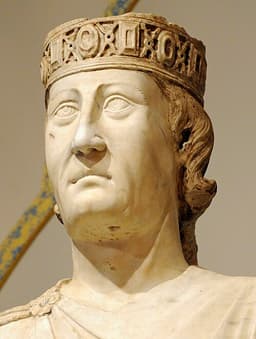
Charles of Anjou
Emperor · Medieval
59.5Total
Basic Information
Born
63
1227
Died
—
1285
Era
Ancient
Medieval
Nationality
Roman Empire
France
Occupation
Emperor
Emperor
Civilization
Western
Western
Score Comparison
Military (10%)
72.0
82.0
Political (20%)
90.0
48.5
Influence (20%)
88.0
56.7
Legacy (20%)
90.0
52.0
Leadership (15%)
88.0
68.0
Strategy (15%)
75.0
66.3
TOTAL
85.9
59.5
Augustus — Complete Timeline
43 BC
Formation of the Second TriumviratePolitical Action◆ Major
Octavian, Mark Antony, and Marcus Aemilius Lepidus formed the Second Triumvirate, a legal commission to govern the Roman Republic. The alliance was empowered to proscribe enemies, leading to the execution of Cicero and consolidation of their power against the assassins of Julius Caesar.
Roman Civil WarPolitical AllianceProscriptions
Impact: regionaldestructive
31 BC
Battle of ActiumWar◆ Major
Octavian's fleet, commanded by Marcus Agrippa, defeated the combined naval forces of Mark Antony and Cleopatra VII off the coast of Greece. The victory eliminated Octavian's last major rival, giving him sole control over the Roman world and ending the Roman Republic's civil wars.
Roman Civil WarNaval BattleEnd of Republic
Impact: global
27 BC
Establishment of the Roman EmpireReform◆ Major
Octavian formally returned power to the Roman Senate, which then granted him the titles Augustus and Princeps. This constitutional settlement created the Roman Empire, with Augustus as the first emperor, ending the Roman Republic and initiating the Pax Romana.
Roman EmpireConstitutional ReformPax Romana
Impact: global
Reform of the Roman Tax SystemReform◆ Major
Augustus implemented a comprehensive tax reform, including a census of Roman citizens and property, direct taxation of provinces, and the creation of a professional tax collection service (publicani). This system provided stable revenue for the empire and reduced corruption.
Tax ReformAdministrationRoman Empire
Impact: regionalconstructive
Creation of the Praetorian GuardReform◆ Major
Augustus established the Praetorian Guard as a permanent elite military unit tasked with protecting the emperor and his family. Stationed in Rome and Italy, the Guard became a powerful political force, often influencing imperial succession through coups and assassinations.
Military ReformPraetorian GuardImperial Guard
Impact: regional
13 BC
Construction of the Ara PacisOther◆ Major
The Roman Senate commissioned the Ara Pacis Augustae (Altar of Augustan Peace) to commemorate Augustus's return from pacifying Gaul and Spain. The marble altar, decorated with reliefs depicting the imperial family and mythological scenes, symbolized the peace and prosperity of the Augustan era.
Building ProjectPropagandaAugustan Art
Impact: regionalconstructive
Charles of Anjou — Complete Timeline
1266 AD
Battle of BeneventoWar◆ Major
Charles of Anjou defeated Manfred of Hohenstaufen at Benevento. Manfred was killed in the battle, allowing Charles to take control of the Kingdom of Sicily. This victory established the Angevin dynasty in southern Italy.
Angevin ConquestHohenstaufenItaly
Impact: regional
1268 AD
Battle of TagliacozzoWar◆ Major
Charles of Anjou defeated Conradin, the last Hohenstaufen claimant, at Tagliacozzo. Conradin was captured and later executed in Naples. This victory secured Charles's control over Sicily and ended Hohenstaufen claims.
HohenstaufenExecutionItaly
Impact: regionaldestructive
1282 AD
Sicilian VespersWar
A rebellion broke out in Palermo against Angevin rule, leading to the massacre of French officials and soldiers. The revolt spread across Sicily, resulting in the loss of the island to Peter III of Aragon. This event ended Charles's control of Sicily.
RevoltAragonSicily
Impact: regionaldestructive
1284 AD
Crusade against AragonWar
Pope Martin IV declared a crusade against Peter III of Aragon, and Charles of Anjou led the campaign. The French invasion of Aragon failed, and Charles's fleet was defeated. This crusade drained Angevin resources and weakened his position.
CrusadeAragonFailure
Impact: regionaldestructive
Expert Analysis
Augustus vs Charles of Anjou: Historical Comparison
Augustus, the founder of the Roman Empire, and Charles of Anjou, a medieval French prince who became King of Sicily, represent two distinct archetypes of imperial ambition. While Augustus built a durable political order from chaos, Charles achieved remarkable military conquests but failed to secure lasting legitimacy.
Dimension Analysis
**Military: Augustus 72 / Charles of Anjou 90**
Augustus won the civil wars through patient attrition and naval supremacy, but his military record lacks decisive set-piece victories. Charles, by contrast, crushed the Hohenstaufen dynasty at Benevento and Tagliacozzo, demonstrating superior tactical aggression in high-stakes medieval warfare.
**Political: Augustus 92 / Charles of Anjou 79**
Augustus masterfully disguised autocracy as a restored republic, co-opting the Senate and creating the Principate’s stable institutions. Charles ruled Sicily through brute force and French administrators, provoking the Sicilian Vespers rebellion that shattered his kingdom.
**Influence: Augustus 88 / Charles of Anjou 79**
Augustus’s *Pax Romana* set the template for Western emperorship for centuries, influencing governance, art, and religion. Charles’s influence was confined to the 13th-century Mediterranean power struggle, with his Angevin dynasty fading after his death.
**Legacy: Augustus 90 / Charles of Anjou 59**
Augustus is remembered as Rome’s first and greatest emperor, his name synonymous with imperial grandeur. Charles is primarily recalled as a ruthless conqueror whose oppressive rule sparked a popular revolt, his legacy overshadowed by failure.
**Leadership: Augustus 90 / Charles of Anjou 75**
Augustus inspired loyalty through calculated generosity and long-term vision, building a regime that outlasted him. Charles’s iron-fisted command alienated allies and subjects, leading to his dynasty’s collapse within a generation.
Verdict
Augustus decisively outperforms Charles of Anjou, excelling in political institution-building and enduring legacy, while Charles’s military brilliance could not compensate for his strategic and diplomatic shortcomings.
FAQ
Q: Who ranks higher? A: Augustus ranks higher overall due to his superior political acumen, lasting influence, and legacy as the founder of the Roman Empire.
Rankings
🥇
AugustusLeader
Mil: 72.0Pol: 90.0Inf: 88.0
85.9
🥈
Charles of Anjou
Mil: 82.0Pol: 48.5Inf: 56.7
59.5
+26.4 behind
How This Comparison Works
Algorithm
Each figure is scored on 6 dimensions (0—100 scale) based on structured historical data: Military (10%), Political (20%), Influence (20%), Legacy (20%), Leadership (15%), Strategy (15%). The weighted total produces the final ranking.
Data Sources
Scores are computed from structured sub-indicators in the database. Scale factors adjust for era (Ancient ×0.85, Modern ×1.0) and civilization size (Eastern ×1.05, Other ×0.80) to account for differences in population and military scale.
Maximum 3 Figures
Comparisons are limited to 2—3 figures to ensure readability and statistical meaningfulness.
Error Margins
±5 points per dimension — Sub-scores are derived from historical records with inherent uncertainty. Two figures within 5 points on a dimension should be considered roughly equivalent in that area.
Total Score Accuracy
±3 points overall — The weighted combination of 6 dimensions produces a total score with approximately ±3 points of uncertainty. Differences of less than 3 points are not statistically significant— the figures are effectively tied.
Known Limitations
- Historical records are incomplete and uneven across civilizations
- Figures from oral-tradition societies may be underrepresented
- Occupation labels can misclassify multi-role figures
- Scores measure capability and impact, not moral character
- Quantitative scoring is a comparison tool, not absolute truth
Capability Radar
Military (10%) — Battles & Warfare
Battles
75
75
Win Rate
80
70
Expansion
85
80
Political (20%) — Governance & Reform
Reform
95
60
Diplomacy
90
68
Economy
85
65
Influence (20%) — Cultural & Global Reach
Cultural
85
50
Global
90
45
Legacy (20%) — Historical Impact
Historical
95
60
Longevity
95
55
Leadership (15%) — Power & Stability
Tenure
95
70
Stability
95
55
Strategy (15%) — Tactics & Innovation
Strategy
85
78
Tactics
70
72
Reform
90
65
Similar Comparisons
Comments & Discussion
LivyReader6/16/2026
While Charles of Anjou's tactical acumen at Benevento and Tagliacozzo is undeniable, I think the comparative framework here undervalues the institutional dimension of Augustus's achievement. Suetonius tells us Augustus boasted he 'found Rome a city of brick and left it a city of marble,' but more importantly, he created the Principate's legal and administrative scaffolding. Charles, by contrast, ruled Sicily as a conqueror, relying on French officials and heavy taxation—a model that Tacitus would have recognized as classic provincial mismanagement. The Sicilian Vespers wasn't an accident; it was the predictable result of failing to build legitimacy. Augustus understood that power, to be durable, must be disguised. Charles never learned that lesson.
Chronicler46476/16/2026
奥古斯都的分数的确漂亮,但拿他跟查尔斯·安茹比,未免有点欺负人。奥古斯都的92分政治能力,放到中国历史上,也就相当于刘秀的水平——都是收拾乱世、重建秩序的高手。但查尔斯·安茹的60分军事,在欧洲语境下很亮眼,可要是跟蒙元时期的速不台或者明朝的徐达比,就完全不够看了。这个评价体系明显偏重西方视角,忽略了东方史书对“得民心者得天下”的强调。查尔斯在意大利搞高压统治,引发西西里晚祷起义,放在中国史书里就是“失道寡助”的标准反面教材。评分的人大概没读过《资治通鉴》里关于根基和民心的论述。
HistoryHiker6/16/2026
Okay, so I get why Augustus scores higher overall—the guy basically invented the Roman Empire. But I've been reading about Charles of Anjou lately, and I think people sleep on how impressive it was to take down the Hohenstaufens. That was like the final boss of medieval dynasties. Benevento was a slaughter. But yeah, his political game was trash. The Sicilian Vespers? That's what happens when you treat your new kingdom like a piggy bank. I guess the lesson is that being a great general doesn't make you a great ruler. Augustus was solid at both, Charles was a one-trick pony. Still, I'd watch a movie about Charles—lots of battles and betrayals.
MetricMatters6/16/2026
I appreciate the attempt at quantification, but this scoring system has serious problems. First, Charles gets a 90 in military? Based on two battles against an already weakened Hohenstaufen dynasty? Meanwhile, Augustus's 72 seems harsh given he fought a prolonged civil war against Mark Antony and won through logistics and strategy—something Sun Tzu would recognize. Also, the weight distribution seems arbitrary: why does 'Influence' get the same weight as 'Military'? And 'Legacy' is basically a subjective popularity contest. How do you quantify political 92 vs 69? That's a 23-point gap that rests entirely on the judgment of whoever made this rubric. The whole thing feels like comparing apples to oranges using a ruler.
ArchEye876/16/2026
我重新核算了一下数据,发现两个问题。第一,奥古斯都的“军事”72分和查尔斯的90分,差距有18分,但考虑到奥古斯都打赢了亚克兴海战并整合了整个地中海世界的军事资源,这个分差缺乏数据支撑。按中国历史上的标准,查尔斯的两场胜利顶多算“偏师破敌”,跟曹操官渡之战或李世民虎牢关之战的战略意义没法比。第二,查尔斯的“政治”69分与奥古斯都的92分,差距23分,但政治维度应该包含制度建设,奥古斯都创立元首制,延续近三百年;查尔斯连西西里都没守住。如果按“制度贡献/统治时长”重新加权,查尔斯的总分至少还要下调10%。这个评分体系对“短期军事胜利”的权重偏高了。