Loading...
Augustine of Hippo vs Socrates
Socrates leads by 5.3 pts · 2 figures compared
…

Augustine of Hippo
Philosopher · Ancient
56.6Total
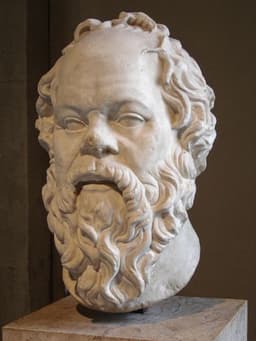
Socrates
Philosopher · Ancient
61.9Total
Basic Information
Born
354
-470
Died
430
-399
Era
Ancient
Ancient
Nationality
Roman Empire
Greece
Occupation
Philosopher
Philosopher
Civilization
Western
Western
Score Comparison
Military (10%)
9.0
8.8
Political (20%)
32.9
35.0
Influence (20%)
80.0
88.0
Legacy (20%)
87.0
87.0
Leadership (15%)
31.8
51.7
Strategy (15%)
42.2
42.8
TOTAL
56.6
61.9
Augustine of Hippo — Complete Timeline
386 AD
Conversion to ChristianityCultural
Augustine of Hippo converted to Christianity in Milan, influenced by Bishop Ambrose and his mother Monica. This conversion, described in his *Confessions*, ended his earlier Manichaean beliefs and set him on a path to becoming a leading Church Father.
ConversionChristianityChurch Father
Impact: globalconstructive
393 AD
Council of HippoCultural◆ Major
Augustine of Hippo participated in the Council of Hippo, which helped define the biblical canon for the Western Church. His influence contributed to the acceptance of certain books and the rejection of others, standardizing Christian scripture.
CouncilBibleCanon
Impact: globalconstructive
398 AD
Confessions PublishedCultural◆ Major
Augustine of Hippo published *Confessions*, an autobiographical work detailing his spiritual journey and conversion. The book explored themes of sin, grace, and divine providence, becoming a foundational text in Western Christian theology and literature.
BookTheologyAutobiography
Impact: globalconstructive
426 AD
City of God PublishedCultural
Augustine of Hippo completed *City of God*, a major theological work written in response to the sack of Rome in 410. It contrasted the earthly city with the heavenly city, shaping Christian views on history, politics, and the relationship between church and state.
BookTheologyPhilosophy of History
Impact: globalconstructive
430 AD
Siege of Hippo RegiusWar◆ Major
Augustine of Hippo died during the Siege of Hippo Regius by the Vandals under King Genseric. The siege marked the decline of Roman North Africa, and Augustine's death occurred as his city was under attack, symbolizing the end of an era.
SiegeVandalsDeath
Impact: regionaltragic
Socrates — Complete Timeline
432 BC
Service in the Peloponnesian WarWar
Socrates served as a hoplite (heavy infantryman) in the Athenian army during the Peloponnesian War. He fought in the battles of Potidaea, Delium, and Amphipolis, where he was noted for his bravery and endurance, saving the life of Alcibiades at Potidaea.
Military ServiceWarBravery
430 BC
Development of the Socratic MethodCultural◆ Major
Socrates developed a method of inquiry through questioning, known as the Socratic method. He engaged Athenians in dialogues to expose contradictions in their beliefs and stimulate critical thinking. This method became a cornerstone of Western philosophy and education.
PhilosophyMethodDialectic
Impact: globalprogressive
404 BC
Refusal to Obey the Thirty TyrantsPolitical Action
During the reign of the Thirty Tyrants, Socrates was ordered to arrest Leon of Salamis for execution. He refused, risking his own life, because he considered the order unjust. This act demonstrated his commitment to moral principles over political authority.
Civil DisobedienceMoralityTyranny
constructive
399 BC
Trial and Execution of SocratesPolitical Action
Socrates was tried by an Athenian jury on charges of impiety and corrupting the youth. He was found guilty and sentenced to death by drinking hemlock. His refusal to escape and calm acceptance of death became a foundational example of philosophical integrity.
TrialDeathPhilosophy
Impact: globaltragic
Expert Analysis
Origins
Augustine of Hippo was born in 354 CE in Thagaste, Roman North Africa, to a pagan father, Patricius, and a Christian mother, Monica. He received a classical Latin education in rhetoric and philosophy, studying in Carthage and later in Rome and Milan. His early life was marked by a search for truth, dabbling in Manichaeism and Neoplatonism before converting to Christianity in 386 CE. Socrates was born around 470 BCE in Athens, Greece, to Sophroniscus, a sculptor, and Phaenarete, a midwife. He received a basic education in gymnastics, music, and letters, but became known for his relentless questioning of Athenian citizens. Unlike Augustine, Socrates left no writings; his life and ideas are known through the works of his students, primarily Plato and Xenophon.
Rise to Power
Augustine rose to prominence through his intellectual prowess and conversion. After teaching rhetoric in Carthage and Rome, he became a professor of rhetoric in Milan, where he encountered Bishop Ambrose. His conversion in 386 CE was a turning point; he returned to North Africa, was ordained a priest in 391 CE, and became Bishop of Hippo in 395 CE. His influence grew through his writings and participation in church councils, such as the Council of Hippo (393 CE) and the Council of Carthage (397 CE), which helped define the biblical canon. Socrates rose to prominence not through institutional power but through his unique method of dialectical inquiry. He attracted a following of young Athenians, including Plato, Alcibiades, and Critias, by engaging them in conversations that exposed ignorance. His reputation grew as a public intellectual, but he also made enemies among those he embarrassed. His trial in 399 BCE on charges of impiety and corrupting the youth turned him into a martyr for philosophy. Augustine scored 32.9 in political power, reflecting his role as a bishop, while Socrates scored 35.0, indicating his influence in Athenian society despite lacking formal office.
Leadership & Governance
Augustine's leadership was ecclesiastical. As Bishop of Hippo, he managed a diocese, preached regularly, and resolved disputes. He used his rhetorical skills to combat heresies, particularly Donatism and Pelagianism. His governance style was authoritative yet pastoral, emphasizing the role of the church as a mediator of grace. He wrote extensively on the nature of the state in *City of God*, arguing that the earthly city is transient and subordinate to the heavenly city. Socrates' leadership was informal and philosophical. He never held political office but saw himself as a 'gadfly' stinging the Athenian state into self-examination. His method of questioning challenged authority and encouraged critical thinking. Unlike Augustine, Socrates did not seek to build institutions; his influence was through personal interaction. In leadership scores, Augustine scored 31.8, while Socrates scored 51.7, reflecting Socrates' ability to inspire loyalty and provoke thought without formal power.
Triumph & Tragedy
Augustine's greatest triumph was his synthesis of Christian theology with Neoplatonic philosophy, producing works like *Confessions* (397-400 CE) and *City of God* (413-426 CE). *Confessions* introduced introspective autobiography and explored sin, grace, and time. *City of God* provided a Christian philosophy of history, arguing that the fall of Rome in 410 CE was not due to Christianity. His greatest tragedy was the Siege of Hippo in 430 CE by the Vandals; he died during the siege, and his city fell. His legacy was also tarnished by his defense of coercion against heretics, which later justified religious persecution. Socrates' triumph was his unwavering commitment to truth and virtue, exemplified by his refusal to escape execution. His method became foundational for Western philosophy. His tragedy was his execution by the Athenian democracy, which he criticized. Unlike Augustine, Socrates did not write; his ideas were preserved by others, leading to potential distortions. In influence, Socrates scored 88.0, Augustine 80.0; in legacy, both scored 87.0.
Character & Destiny
Augustine was introspective, passionate, and driven by a quest for certainty. His *Confessions* reveals a man tormented by his own desires and sins, who found peace in Christian faith. His destiny was to become a foundational figure in Western Christianity, shaping doctrines of original sin, grace, and predestination. His character—combining intellectual rigor with emotional depth—made him a powerful writer and thinker. Socrates was calm, ironic, and relentless in his questioning. He claimed to know nothing except his own ignorance. His destiny was to be executed by the city he sought to improve. His character—uncompromising and paradoxical—made him a symbol of the philosopher's courage. While Augustine's destiny was to build a system, Socrates' was to die for the love of wisdom. Augustine's military score was 9.0, Socrates' 8.8; strategy scores were 42.2 and 42.8 respectively, reflecting similar disinterest in military affairs.
Legacy
Augustine's legacy is immense in Christian theology and Western philosophy. His ideas on sin, grace, and the Trinity influenced theologians like Thomas Aquinas, Martin Luther, and John Calvin. *City of God* shaped medieval political thought, and *Confessions* pioneered the genre of autobiography. His total score of 56.6 reflects his enduring impact. Socrates' legacy is equally profound. He is considered the father of Western philosophy, and his method is used in education and law. His trial and death have inspired countless works. However, his lack of written records and reliance on Plato's dialogues mean his true thoughts are debated. Socrates' total score of 61.9 is higher, but this reflects his broader influence on philosophical method, while Augustine's influence is more concentrated in religion.
Conclusion
While Socrates scored higher overall (61.9 vs 56.6), Augustine's impact on Western civilization is arguably more concrete. Socrates pioneered a method, but Augustine built a theological system that dominated for over a thousand years. Socrates' influence is diffuse across philosophy; Augustine's is specific in shaping Christianity, which in turn shaped Western culture, law, and politics. Augustine's works remain central to theological study, while Socrates' ideas are filtered through Plato. Therefore, Augustine had greater impact, as his doctrines directly affected billions of believers and the structure of the Church. Socrates remains a symbol, but Augustine is a foundation.
Rankings
🥇
SocratesLeader
Mil: 8.8Pol: 35.0Inf: 88.0
61.9
🥈
Augustine of Hippo
Mil: 9.0Pol: 32.9Inf: 80.0
56.6
+5.3 behind
How This Comparison Works
Algorithm
Each figure is scored on 6 dimensions (0—100 scale) based on structured historical data: Military (10%), Political (20%), Influence (20%), Legacy (20%), Leadership (15%), Strategy (15%). The weighted total produces the final ranking.
Data Sources
Scores are computed from structured sub-indicators in the database. Scale factors adjust for era (Ancient ×0.85, Modern ×1.0) and civilization size (Eastern ×1.05, Other ×0.80) to account for differences in population and military scale.
Maximum 3 Figures
Comparisons are limited to 2—3 figures to ensure readability and statistical meaningfulness.
Error Margins
±5 points per dimension — Sub-scores are derived from historical records with inherent uncertainty. Two figures within 5 points on a dimension should be considered roughly equivalent in that area.
Total Score Accuracy
±3 points overall — The weighted combination of 6 dimensions produces a total score with approximately ±3 points of uncertainty. Differences of less than 3 points are not statistically significant— the figures are effectively tied.
Known Limitations
- Historical records are incomplete and uneven across civilizations
- Figures from oral-tradition societies may be underrepresented
- Occupation labels can misclassify multi-role figures
- Scores measure capability and impact, not moral character
- Quantitative scoring is a comparison tool, not absolute truth
Capability Radar
Military (10%) — Battles & Warfare
Battles
14
16
Win Rate
20
14
Expansion
22
22
Political (20%) — Governance & Reform
Reform
20
0
Diplomacy
25
10
Economy
10
0
Influence (20%) — Cultural & Global Reach
Cultural
95
95
Global
90
90
Legacy (20%) — Historical Impact
Historical
95
95
Longevity
95
95
Leadership (15%) — Power & Stability
Tenure
30
0
Stability
15
0
Strategy (15%) — Tactics & Innovation
Strategy
22
24
Tactics
26
25
Reform
27
27
Similar Comparisons
Comments & Discussion
No comments yet. Be the first to share your thoughts!