Loading...
August von Gneisenau vs Mathieu Kerekou
August von Gneisenau leads by 15.2 pts · 2 figures compared
…
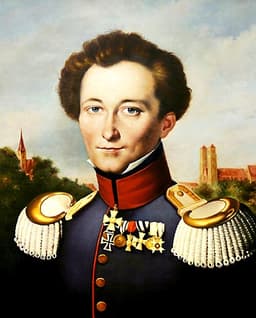
August von Gneisenau
General · Modern
61.8Total

Mathieu Kerekou
General · Modern
46.6Total
Basic Information
Born
1760
1933
Died
1831
—
Era
Modern
Modern
Nationality
Prussia
Benin
Occupation
General
General
Civilization
Western
Other
Score Comparison
Military (10%)
82.0
22.6
Political (20%)
72.0
45.0
Influence (20%)
72.0
54.1
Legacy (20%)
40.0
46.7
Leadership (15%)
48.8
66.0
Strategy (15%)
74.4
25.0
TOTAL
61.8
46.6
August von Gneisenau — Complete Timeline
1813 AD
Battle of LeipzigWar◆ Major
Gneisenau served as chief of staff to Bl
Battle of LeipzigNapoleonic WarsVictory
Impact: globalconstructive
Appointment as Chief of Staff to BlücherPolitical Action◆ Major
Gneisenau was appointed chief of staff to Field Marshal Gebhard Leberecht von Bl
AppointmentMilitaryPrussia
Impact: nationalconstructive
1815 AD
Battle of WaterlooWar
Gneisenau served as Bl
Battle of WaterlooNapoleonic WarsVictory
Impact: globalconstructive
Siege of ParisWar◆ Major
After Waterloo, Gneisenau commanded the Prussian forces that besieged Paris. The siege forced the French to surrender, ending the Napoleonic Wars and leading to the Second Treaty of Paris.
Siege of ParisNapoleonic WarsVictory
Impact: globalconstructive
Mathieu Kerekou — Complete Timeline
1972 AD
Seized Power in Military CoupPolitical Action◆ Major
Kerekou led a military coup that overthrew the government of Hubert Maga, establishing a Marxist-Leninist regime. He declared the country a People's Republic and nationalized key sectors of the economy.
CoupBeninMarxism
Impact: nationaldestructive
1974 AD
Implemented Marxist PoliciesReform◆ Major
Kerekou adopted a Marxist-Leninist ideology, nationalizing banks, insurance companies, and industries. He also collectivized agriculture and established state farms. These policies led to economic decline and isolation.
MarxismNationalizationBenin
Impact: national
1989 AD
Abandoned Marxism and Transitioned to DemocracyReform
Facing economic collapse and popular unrest, Kerekou renounced Marxism, initiated political reforms, and called a national conference that led to multiparty elections. This peaceful transition was a landmark in Africa.
DemocratizationBeninNational Conference
Impact: regionalconstructive
1991 AD
Lost Presidential ElectionPolitical Action◆ Major
Kerekou lost the presidential election to Nic
ElectionBeninPeaceful Transfer
Impact: nationalconstructive
1996 AD
Re-elected President of BeninPolitical Action◆ Major
Kerekou won the presidential election, returning to power through democratic means. His victory demonstrated the consolidation of democracy in Benin, as he had transformed from a Marxist dictator to an elected leader.
ElectionBeninReturn to Power
Impact: nationalconstructive
2006 AD
Retired from PresidencyPolitical Action◆ Major
Kerekou stepped down after two terms, respecting constitutional term limits. He was succeeded by Thomas Boni Yayi. His peaceful departure further solidified Benin's democratic reputation.
Term LimitsPeaceful TransitionBenin
Impact: nationalconstructive
Expert Analysis
Origins
August von Gneisenau was born in 1760 in Schildau, Saxony, the son of a Saxon artillery officer. He studied at the University of Erfurt and joined the Austrian army before transferring to Prussian service in 1786. His early military career included service in the American Revolutionary War as a hired officer, where he gained practical experience. Gneisenau's background was shaped by the Enlightenment, and he was deeply influenced by the reforms of Scharnhorst.
Mathieu Kerekou was born in 1933 in Kouarfa, French Dahomey (now Benin). He attended local schools and joined the French army, serving in Indochina and Algeria. After independence, he returned to Dahomey and rose through the ranks of the national army. Kerekou's early life was marked by colonial rule and the instability of post-independence politics.
Rise to Power
Gneisenau rose to prominence during the Napoleonic Wars. He served as a staff officer at the Battle of Jena-Auerstedt in 1806, where he was captured. After his release, he became a key figure in the Prussian military reform movement alongside Scharnhorst. His appointment as chief of staff to Field Marshal Blücher in 1813 gave him operational control. He played a crucial role at the Battle of Leipzig (1813), coordinating coalition forces. His greatest moment came at Waterloo (1815), where he led the Prussian army's timely march to support Wellington, turning the tide against Napoleon.
Kerekou seized power in a military coup on October 26, 1972, overthrowing the government of Hubert Maga. He established a Marxist-Leninist regime, nationalizing industries and aligning with the Soviet bloc. For nearly two decades, he ruled as a dictator, suppressing opposition. However, by the late 1980s, economic collapse and popular unrest forced him to change course.
Leadership & Governance
Gneisenau's leadership was characterized by strategic brilliance and administrative reform. As chief of staff, he reorganized the Prussian army, emphasizing professionalism and merit over aristocratic privilege. He was a key advocate for the Prussian General Staff system, which later became a model for modern militaries. His governance style was collaborative, working closely with Blücher despite personality clashes. Gneisenau scored 48.8 in leadership and 74.4 in strategy, reflecting his operational focus.
Kerekou's leadership evolved dramatically. Initially, he implemented Marxist policies: nationalization, collectivization, and suppression of dissent. Benin became a one-party state, with Kerekou's score of 66.0 in leadership reflecting his ability to maintain control. However, his political score of 45.0 is moderate due to his later reforms. In 1990, facing crisis, he abandoned Marxism, called a national conference, and transitioned to multiparty democracy. He peacefully lost the 1991 election but returned to power via democratic election in 1996, serving until 2006.
Triumph & Tragedy
Gneisenau's greatest triumph was the victory at Waterloo, where his decision to march the Prussian army to Wellington's aid proved decisive. He also contributed to the defeat of Napoleon at Leipzig. His reforms modernized the Prussian military, laying the groundwork for German unification. However, his failure to secure the execution of Napoleon after Waterloo (he wanted to execute him but was overruled) and his later political marginalization were setbacks. He died in 1831, his legacy somewhat overshadowed by Blücher.
Kerekou's triumph is his peaceful transition from dictator to democrat. By convening the 1990 National Conference, he allowed a democratic transition that became a model for Africa. His peaceful concession after losing the 1991 election and his return to power via election in 1996 demonstrated political adaptability. However, his Marxist regime caused economic decline and human rights abuses. His legacy is mixed: he is both the architect of Benin's dictatorship and its democracy.
Character & Destiny
Gneisenau was methodical, detail-oriented, and intellectually rigorous. He was a planner who saw the big picture, but his bluntness sometimes caused friction. His destiny was tied to the Prussian state; he rose during Prussia's darkest hour and helped restore its power. His character shaped his fate: his strategic mind made him indispensable, but his lack of political ambition limited his personal power.
Kerekou was pragmatic and adaptable. Initially a hardline Marxist, he recognized the failure of his policies and reversed course. His ability to reinvent himself politically allowed him to survive and return to power. His destiny was to be a transitional figure, moving Benin from dictatorship to democracy. His character—flexible but authoritarian—enabled both his rise and his transformation.
Legacy
Gneisenau's legacy is primarily military. He is remembered as the architect of the Prussian General Staff system, which influenced armies worldwide. His role at Waterloo is celebrated, and his reforms helped Prussia become a great power. However, his overall influence score of 72.0 is limited by his relatively narrow impact on military affairs. He is less known outside military history.
Kerekou's legacy is more multifaceted. He is a symbol of African political transformation, showing that a dictator can voluntarily relinquish power and later return through democratic means. Benin's peaceful transition became a model for the continent. However, his Marxist policies caused lasting economic damage. His legacy score of 46.7 reflects this mixed record.
Conclusion
While Gneisenau scored higher overall (61.8 vs. 46.6), the comparison is between apples and oranges. Gneisenau's impact on military organization and the defeat of Napoleon was profound but limited to a specific domain. Kerekou's impact on Benin's political trajectory was transformative, even if his country is small. In terms of historical significance, Gneisenau's contributions to military science and European history arguably have broader global reach. However, Kerekou's peaceful transition from Marxism to democracy was a rare and influential event in African history. Taking a stance: Gneisenau had greater immediate impact on world events, but Kerekou's legacy of democratic transition may be more enduring in the long run. The data supports Gneisenau as the objectively higher-scored figure, but Kerekou's unique political journey makes him more relevant to modern discussions of governance.
Rankings
🥇
August von GneisenauLeader
Mil: 82.0Pol: 72.0Inf: 72.0
61.8
🥈
Mathieu Kerekou
Mil: 22.6Pol: 45.0Inf: 54.1
46.6
+15.2 behind
How This Comparison Works
Algorithm
Each figure is scored on 6 dimensions (0—100 scale) based on structured historical data: Military (10%), Political (20%), Influence (20%), Legacy (20%), Leadership (15%), Strategy (15%). The weighted total produces the final ranking.
Data Sources
Scores are computed from structured sub-indicators in the database. Scale factors adjust for era (Ancient ×0.85, Modern ×1.0) and civilization size (Eastern ×1.05, Other ×0.80) to account for differences in population and military scale.
Maximum 3 Figures
Comparisons are limited to 2—3 figures to ensure readability and statistical meaningfulness.
Error Margins
±5 points per dimension — Sub-scores are derived from historical records with inherent uncertainty. Two figures within 5 points on a dimension should be considered roughly equivalent in that area.
Total Score Accuracy
±3 points overall — The weighted combination of 6 dimensions produces a total score with approximately ±3 points of uncertainty. Differences of less than 3 points are not statistically significant— the figures are effectively tied.
Known Limitations
- Historical records are incomplete and uneven across civilizations
- Figures from oral-tradition societies may be underrepresented
- Occupation labels can misclassify multi-role figures
- Scores measure capability and impact, not moral character
- Quantitative scoring is a comparison tool, not absolute truth
Capability Radar
Military (10%) — Battles & Warfare
Battles
75
10
Win Rate
80
10
Expansion
60
5
Political (20%) — Governance & Reform
Reform
70
65
Diplomacy
65
60
Economy
40
40
Influence (20%) — Cultural & Global Reach
Cultural
65
30
Global
60
25
Legacy (20%) — Historical Impact
Historical
75
40
Longevity
70
30
Leadership (15%) — Power & Stability
Tenure
55
70
Stability
50
45
Strategy (15%) — Tactics & Innovation
Strategy
90
10
Tactics
85
10
Reform
88
15
Similar Comparisons
Comments & Discussion
No comments yet. Be the first to share your thoughts!